


Amsterdam had long been on my travel list. When a friend who retired near Lisbon asked me to visit Portugal in early December, I decided to tack Amsterdam on the front of the trip. I left for Europe a few days before Thanksgiving.
I scheduled six nights in Amsterdam, plenty of time to see the main sights, including the Anne Frank House, Van Gogh Museum, and Rijksmuseum (Rembrandt’s Night Watch is undergoing a multi-year restoration that began in 2019, but it’s on view and well worth a look).
Besides those standouts, I also wanted to explore unusual and hidden areas and sites.
A Canal Light Festival That Cheers Winter Spirits
A few days after I arrived, the 14th annual Amsterdam Light Festival launched, featuring 20 international artists showcasing their works along the canals. The exhibit runs through January 18. I encountered some of the art while walking and cycling the city, but the best views were via a night canal tour I took with new friends I met.
The theme for this year’s edition is Legacy, asking the questions, what will we leave behind and how do we want to be remembered?

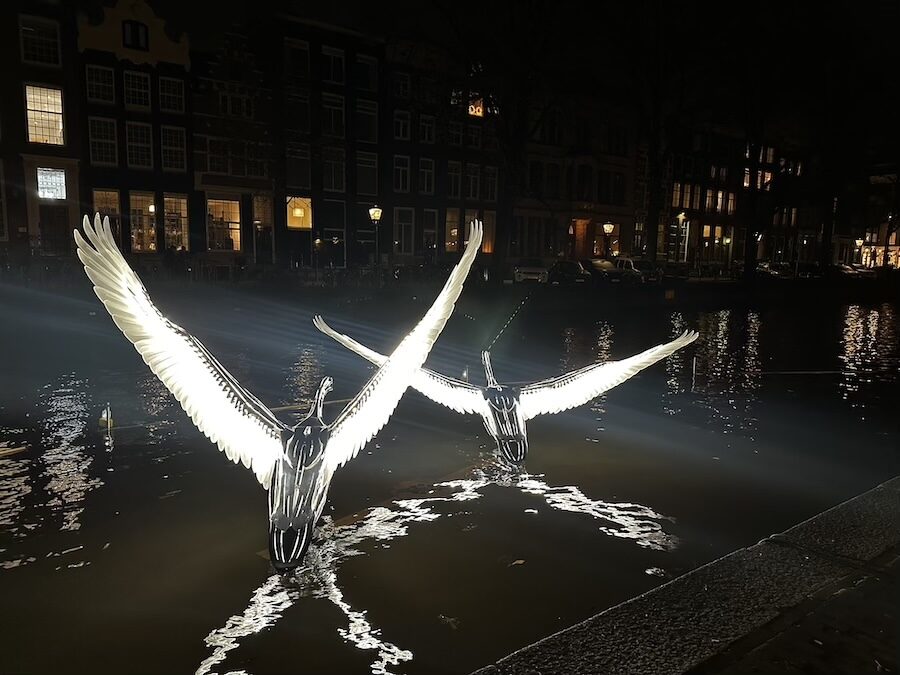
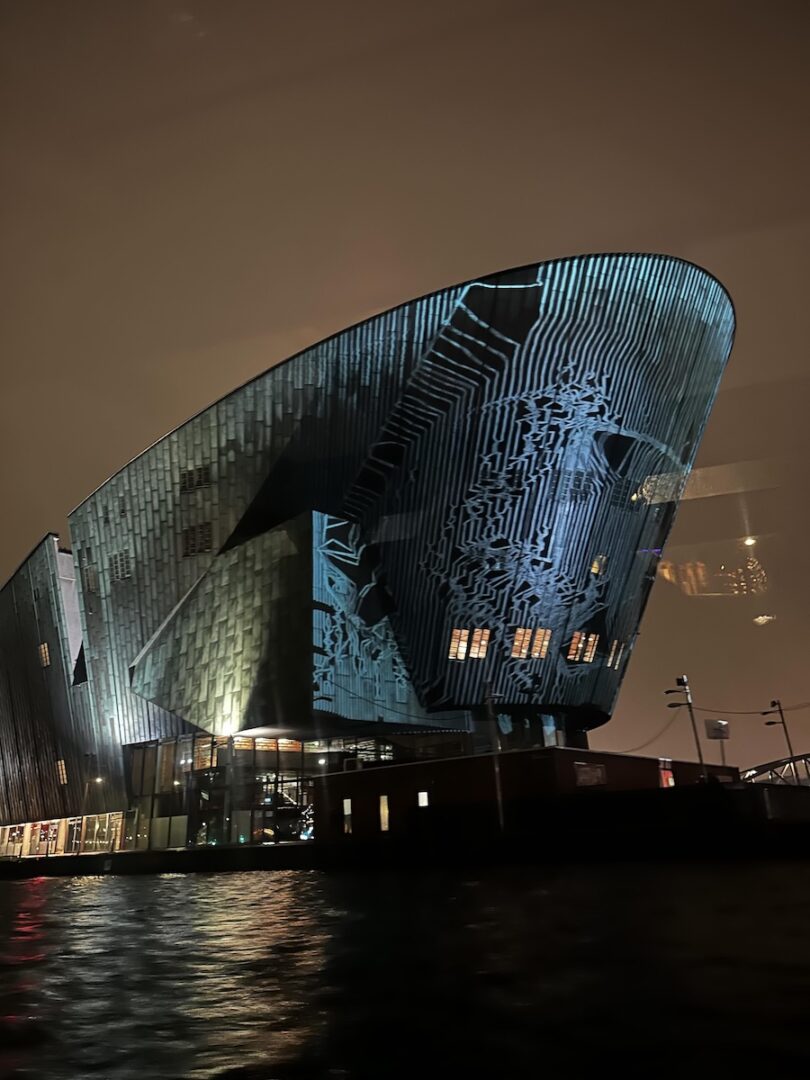
Reflected in the water, the installations were beautiful, each entirely different from the other. I was struck by two snow geese, seemingly taking flight off the water, and Filip Roca’s piece, “Fracture Point,” a massive light projection covering the Nemo Science Museum. Grids of light assembled and disassembled over the building, “the critical moment when outdated structures begin to crack and something new emerges,” Roca writes about his piece. “The fracture where belief splits from truth.”
Another favorite: Norwegian artist Thomas Bendiksen’s “Keep Me Warm.” Placed atop a boat, the light sculpture is shaped like a glowing hot radiator. He created the piece as a reflection on how light and warmth are shared between people. I loved the piece for its simplicity and evocative look; everyone on the canal tour boat felt the same.
In dark days of winter, the Netherlands leans heavily on light shows. Another light exhibit, the Zandvoort Light Walk, will be held on January 31 in the coastal town just west of Amsterdam.
A New Museum Dedicated to Suriname’s History
The next day, I explored a museum that had opened a few days before, intrigued that it was the only Netherlands museum dedicated to Surinamese-Dutch culture and history. The visit to the Suriname Museum was refreshing, given that the Dutch, through the institution, are facing their colonialist past and role in the slavery trade.
The museum focuses on voices from the community, beginning with the arrival of the Dutch in Suriname in the early 1600s. Suriname’s story is presented chronologically in numerous rooms, each dedicated to a period or group of people.
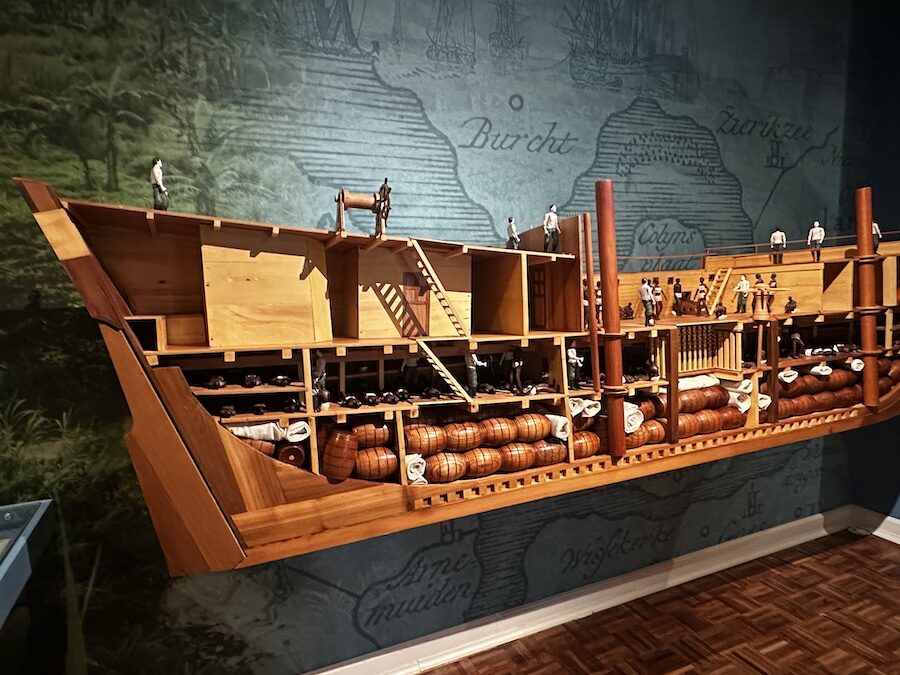
In a dark basement alcove, there’s a replica of a slave ship. It’s paired with a film that recreates scenes inside the ship—men crammed together, barely surviving. It’s a chilling scene, among the museum’s most visceral, as it places the viewer nearly inside the inhumane confinement that Africans faced as they were captured and sent to Suriname.
More than 350 years of Surinamese-Dutch history is on display via documents, clothing, letters, artworks, videos, and other media. Upon entering, lush plants and vivid sounds surround you—representing the period before the arrival of Europeans in the Americas.
The Story of Anton de Kom, an Intrepid Activist
I especially enjoyed learning about Anton de Kom (1898-1945), a firebrand Surinamese anti-colonial activist, author, and resistance fighter whose influence is still strongly felt in the Netherlands.
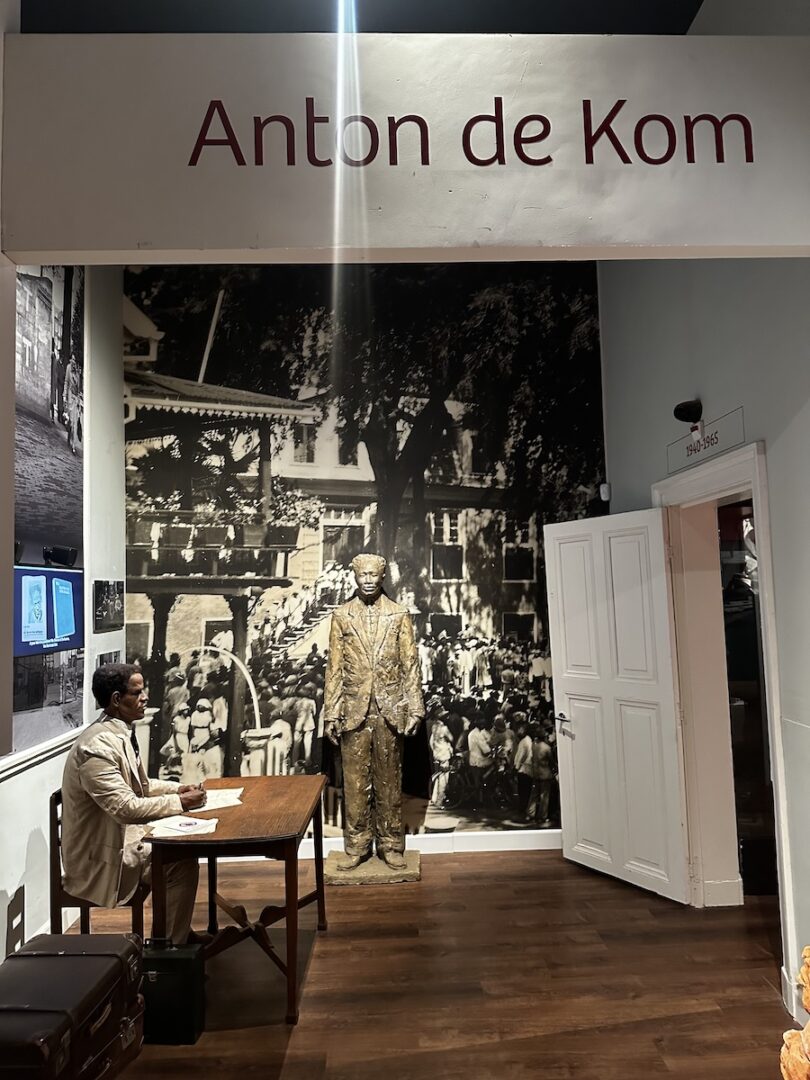
Born in Paramaribo, Suriname, de Kom advocated for better working conditions as a young adult. He came to the Netherlands in 1921, working for a Hague coffee and tea merchant. His anti-colonial lectures became popular; authorities viewed him as a threat. He returned to Suriname in 1931 and was arrested the following year, sparking major protests.
De Kom’s enduring work is Wij slaven van Suriname (We Slaves of Suriname), published in 1934. It’s the first encompassing history of Suriname written from a native perspective. The book documents the horrors of slavery and the ongoing exploitation of natives after slavery was abolished in 1863. The Dutch government heavily censored the first edition, and the original book was not widely available until the 1970s.
I took heart that a new generation of Black Dutch activists has popularized Wij slaven van Suriname in recent years, making it a bestseller.
A Museum that Celebrates Death and Beauty
I visited another off-the-radar museum on the weekend: the Art Zoo. I was delighted to rediscover its Dutch proprietors, Jaap Sinke and Ferry van Tongeren. I wrote about their first book (titled Our First Book) for the Los Angeles Times in 2018.

The pair met in 1994 when they were advertising creatives. Van Tongeren left the business to pursue his childhood fascination, taxidermy, and Sinke joined him in stylizing creations. The men have since elevated the art form to unseen heights, resurrecting the spirit of 17th-century Dutch painters.
Sinke and van Tongeren’s animals strike exaggerated and often impossible poses: parrots fly from cages, snakes curl, and a hanging crocodile greets visitors in the lobby. Every animal they work with has died of natural causes. Their artistic collaboration goes under the name Darwin, Sinke & van Tongeren, a nod to the naturalist Charles Darwin.
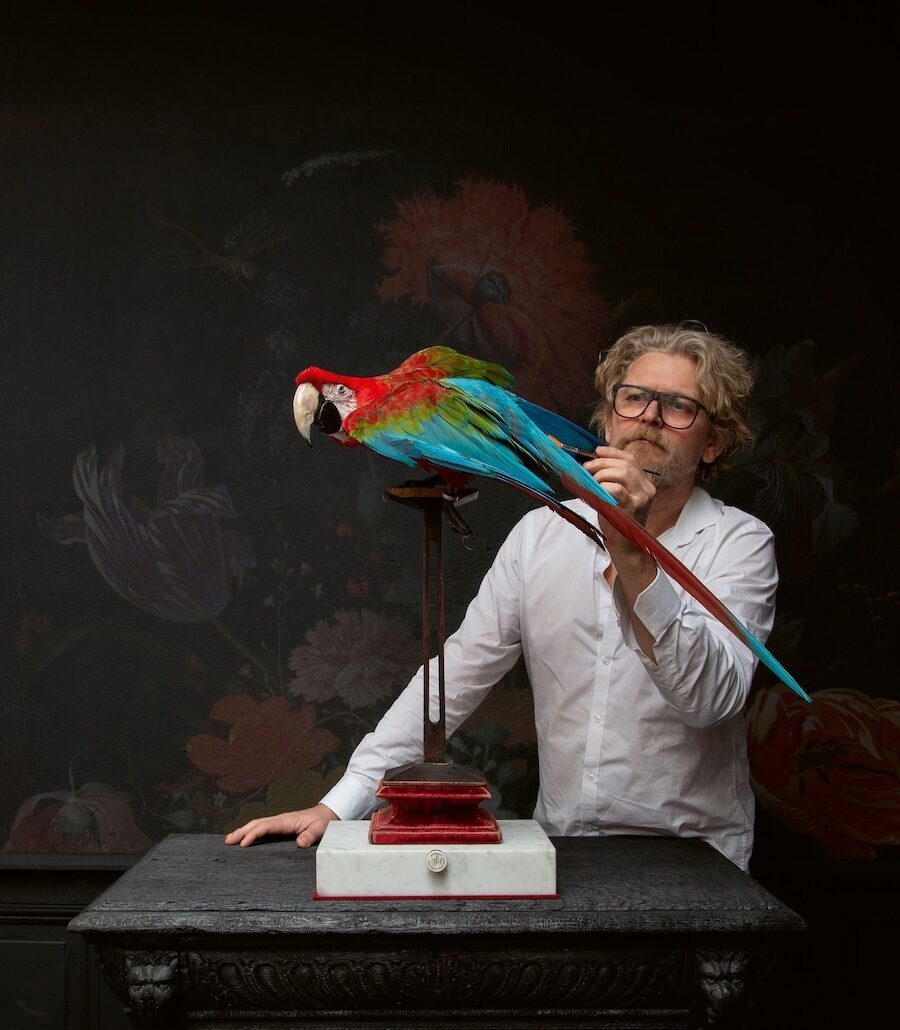
In some cases, the artists reproduce, and not merely mimic, the work of Dutch painters. Painter Asselijn’s “The Threatened Swan” (1650) is skillfully reproduced as the “Mute Swan.” They’ve also cloned Weenix’s 1716 “Dead Swan,”—as I write in my Los Angeles Times piece—“with its strung-up leg, a wing placed faintly upon the breast and the other far extended, its final feather artfully arched. Swans make for a killer operatic display.”
The Art Zoo opened in June 2025 at Cromhout House at Herengracht 368—designed by architect Philips Vingboons in the 1660s. It’s one of Amsterdam’s stunning 17th-century canal houses. The museum, a collaboration between the artist and the Vrije Academie (Free Academy of Arts & Culture), features seven spaces where visitors become the caged—literally. The main space is actually a large cage, with the creatures hovering, flying, and crouching just beyond the bars, peering at the curious humans.
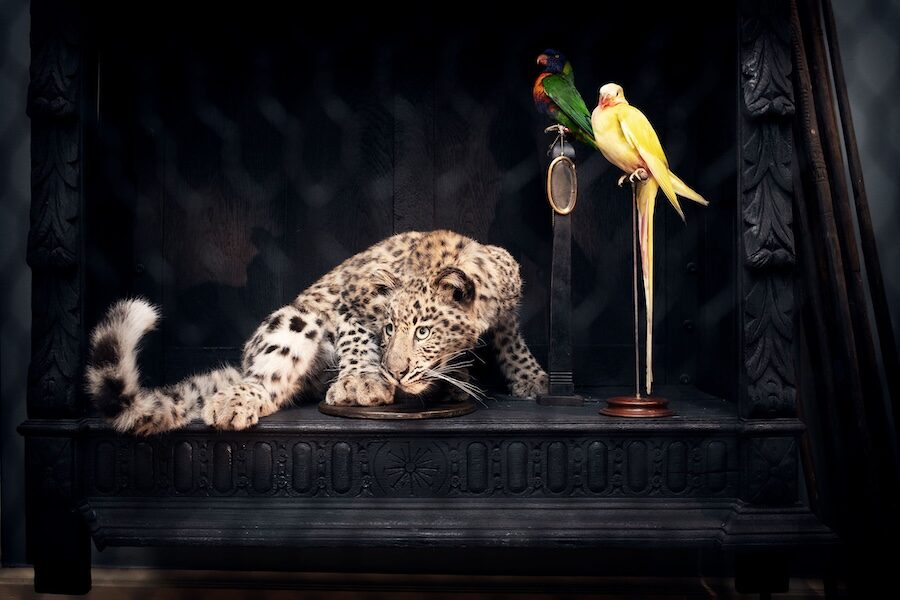
British artist Damien Hirst bought the duo’s entire collection in 2015. They’ve since been busy assembling more tableaus; the new museum is a natural outgrowth of their work.
A Convenient Way to Tour the City
The Art Zoo is located in central Amsterdam, and in truth, all of the city is easily accessible by tram, metro, and bus–also train, with one running from Schiphol Airport to Central Station (€5.20 for the 15-20 minute ride). And of course, biking is the optimal way to see the city—about half the population uses bicycles to get around.
I opted for the “I amsterdam” City Card (the name of the city is purposefully branded in lowercase). The pass affords access to 100-plus museums and attractions, along with free city-wide public transport by metro, tram, bus, and ferry. Also included: a one-day bicycle rental and a canal cruise. Card durations range from one to five days and are priced from €65 to €121.
I recommend uploading the card to the I amsterdam City Card app. There, I could save favorite locations and create an itinerary.
If you’re taking the train from Schiphol airport to Central Station, stop in at the I amsterdam store located in Central Station. You can get a good overview of current happenings, and snap up some Amsterdam-branded merch for friends back home.
Backstage at the Internationaal Theater Amsterdam
I wanted to see some theater while in Amsterdam, and worked to get tickets to Prophet Song at the Internationaal Theater Amsterdam (ITA). But the show was on tour. I loved the show’s topical description:
“When a repressive, democratically elected regime rises to power, the rule of law begins to erode, and democracy slowly unravels. In the grip of a tightening reality, a mother fights desperately to protect her four children. As her freedoms are steadily stripped away by an unyielding government and a society that is rapidly losing its humanity, she struggles to hold on to her identity.”
If you’re in Amsterdam in January, Prophet Song will be playing from January 8 through January 25. ITA’s top ensemble actors are in the show; they rotate performances in repertoire. The troupe also acts on 100 stages worldwide.
ITA stages 600 theater and dance performances each year. I wasn’t able to get a ticket, but I got the next best thing: a backstage tour.
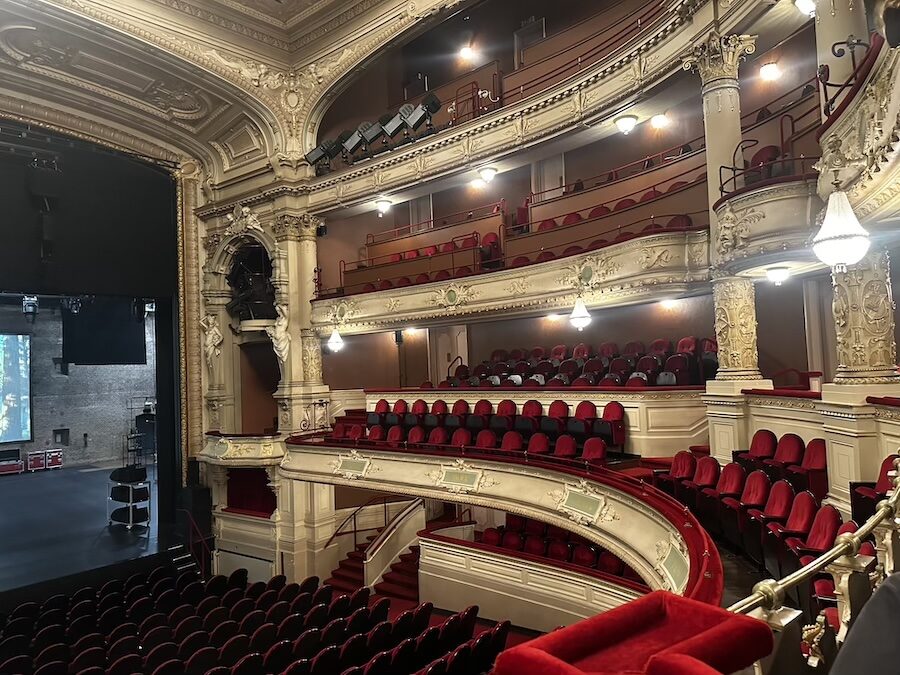
The main theater, Stadsschouwburg, dates from 1894, but the origins go back to 1638 when the original structure burned to the ground. Done in Baroque style and ornamented with sculptures and large chandeliers, the horseshoe-shaped theater has 900 seats, with 750 in use.
Although fully renovated, the theater with its royal box is now augmented by the Rabozaal, commonly called Rabo Hall, a state-of-the-art performance space with more than 500 seats. I was struck that the structure seemingly floats over the Lijnbaansgracht canal, and during the back stage tour, I was impressed by a massive glass wall behind the stage. It allows natural light into the auditorium and can be sealed off for performances.
A visit to a 1675 Fair and Market
Wrapping up my visit, I decided to visit Amsterdam’s distant past, and not through a history book. I checked out the city’s new VR experience, ENTR, founded by Vincent Slangen. Set to open in 2026, Slangen is now showcasing a preview: “Botermarkt 1675,” a 15-minute stroll—dressed as an Amsterdammer—through a 17th-century market and fair.
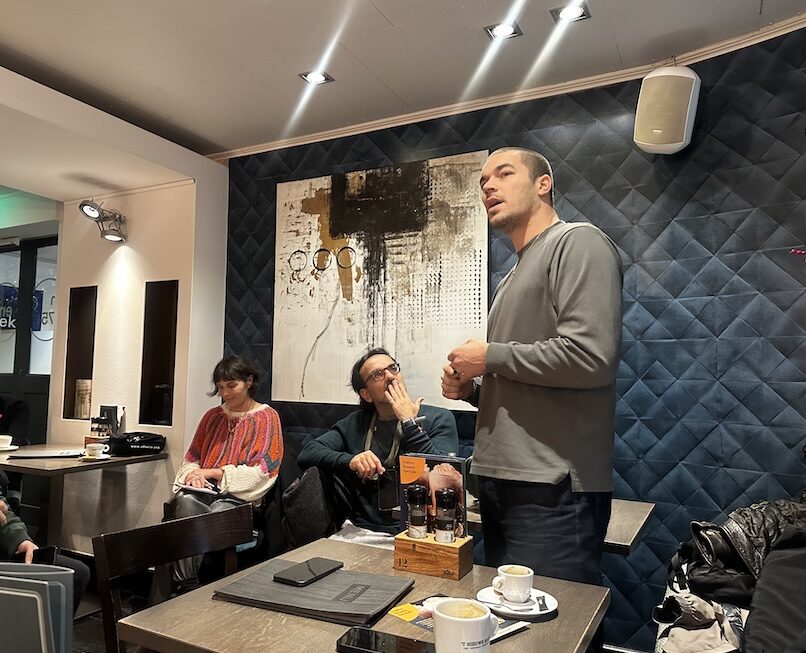
I joined three friends in a small room as we strapped on VR goggles. We stepped through a curtained opening to find ourselves in a blank grid-lined room. Our guide was a ball of light that floated just to the right of our vision.
We were instructed to choose an outfit. Several hats floated in front of me. I chose a wide-brimmed one made of felt, and in seconds, I was clothed in a linen shirt, silk doublet, breeches, high yellow stockings, and a cloak. Suddenly, a rift in the wall grid opened. I was ushered into a bustling market.
Before me were various stalls, including someone selling vegetables and another, baubles. I looked to my friends whose virtual outfits were as period-exact as mine. We had been instructed to enter spaces marked by lighted oval outlines on the ground if we wanted to hear stories of the merchants, some calling me over as they hawked their wares.
I chatted up all of them (well, they didn’t reply to my questions, actually). But I learned of the challenges and the joys of 17th-century Dutch life as they told me their personal tales. All the accounts were actual, pulled from the historical record, which was a nice touch. It elevated the experience, turning it from a mere amusement to something with gravitas.
After the market, we entered a small tent piled with wares, lorded over by an old woman. She directed us through another opening where a late 1600s fair was taking place, replete with a stage and actors. There were more personal stories, some touching, others witty. I made sure to look around and was impressed at the breadth of the illusion—both the market and fair seemed to stretch out for a good half mile, populated by tents, roads, transport, and people. The actual room we were in was probably no bigger than my living room. The illusion was well done.
If you’re in Amsterdam, ENTR currently runs until January 14, 2026, with a price of €8. The current preview is held at De Nieuwe Kerk (the New Church) near Dam Square. A more permanent space will open soon near Central Station.
A Hotel Bordering Oosterpark
During my stay, I lodged at Hotel Arena, an extensive property that borders Oosterpark. The property originated as the Sint Elisabeth Gesticht, built in 1888 as a Catholic nursing home. After it changed hands in the early 1980s, the property catered to young world travelers as a “sleep-in.” You could rent a mattress and sleep on the grounds or in communal rooms. The property has since grown into a four-star boutique hotel.
A two-year renovation that launched in 2015 greatly expanded the property, but it wisely adhered to architect Andrianus Bleijs’ original design. Bleijs favored eclectic looks with Neo-Baroque and Neo-Renaissance styles. The property is a popular event and wedding space, and also includes the Park Cafe and Restaurant. I found the location to be ideal, a bit over a mile from Dam Square and the crushing crowds. If you rent a bike, everything is nearby. The rooms were large, and it was lovely to step out into Oosterpark, literally at the hotel’s front step.
Restaurants to Check Out in Amsterdam
Located in the Plantage neighborhood, Mama Makan Indonesian Kitchen is a cozy spot I’d recommend for an intimate dinner. I was impressed by the local suppliers: cheese from Fromagerie Abraham Kef, meat from Brandt & Levi, and craft beer from Amsterdam Brew Boys. I had the beef tartare (excellent), and the Spatchcocked baby chicken done in lemongrass, kaffir lime, and served with garlic string beans. As a side, you can’t go wrong with the Cassava fries dunked in Dambai mayonnaise with a squeeze of kaffir lime.
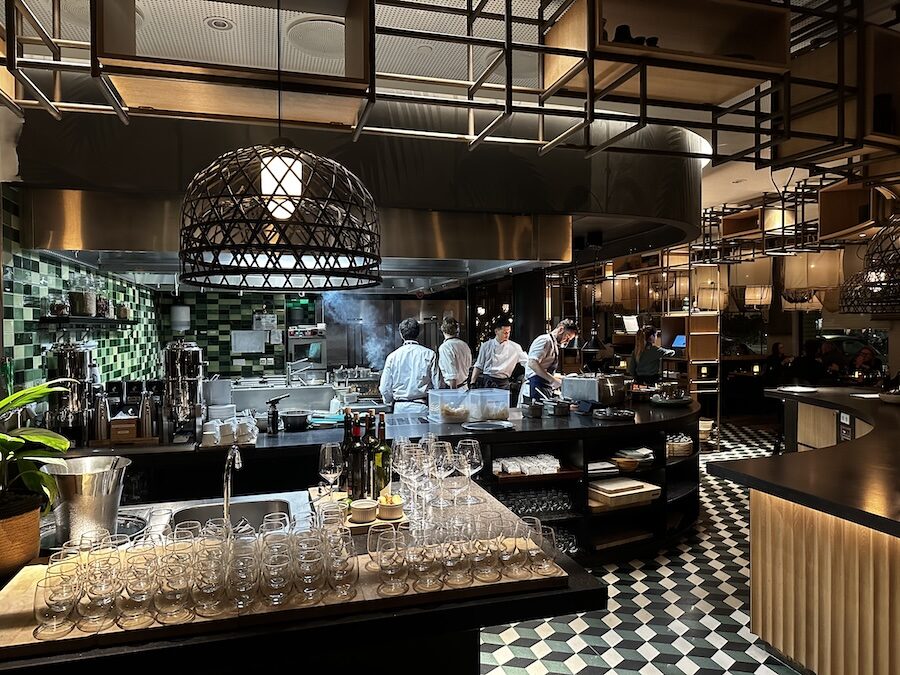
A great night spot: The Living Kitchen on the Zoku Amsterdam rooftop. Banked by views of the city, the spot serves Mediterranean cuisine, much of it sourced from the location’s garden. A five-minute walk from the Weesperplein Metro stop, the eatery has distinct Middle Eastern flavors: spicy feta dip, salt-roasted bimi with tahini cream, and Lebanese Aubergine jam, to start the list.
Located at Oosterdokskade 227, A Beautiful Mess Restaurant has a passionate mission: to increase equality in the Dutch labor market by offering jobs to newcomers from other countries. Its goal is to “live in an inclusive society where everyone matters equally and is of value.”
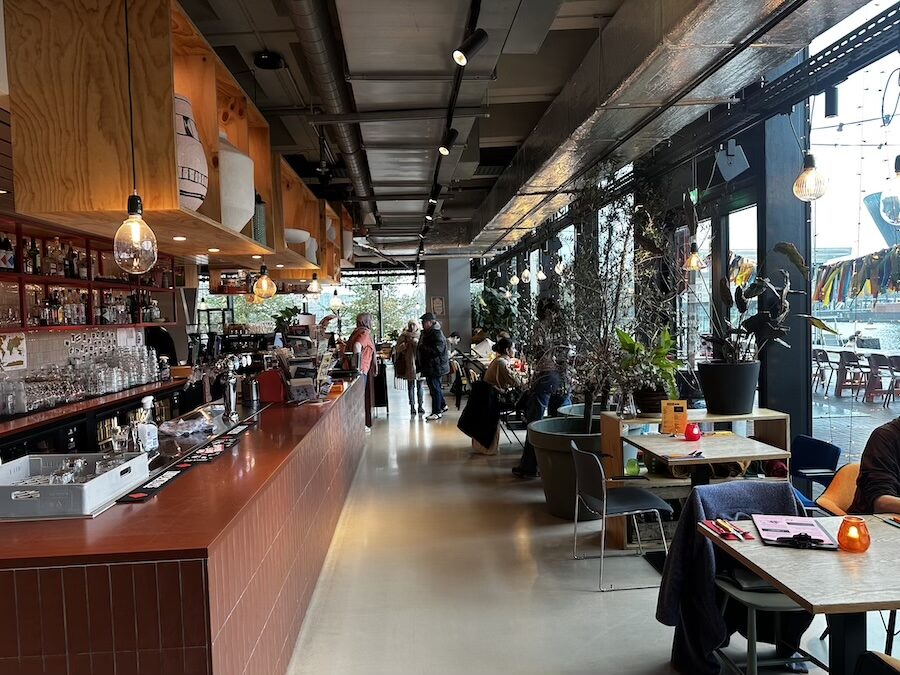
Expect a casual atmosphere with authentic food from the chefs’ home countries—among them: Syria, Iraq, and Eritrea. All the food is halal, and there are plenty of vegetarian and vegan options. A Beautiful Mess also has locations in Utrecht and Arnhem.
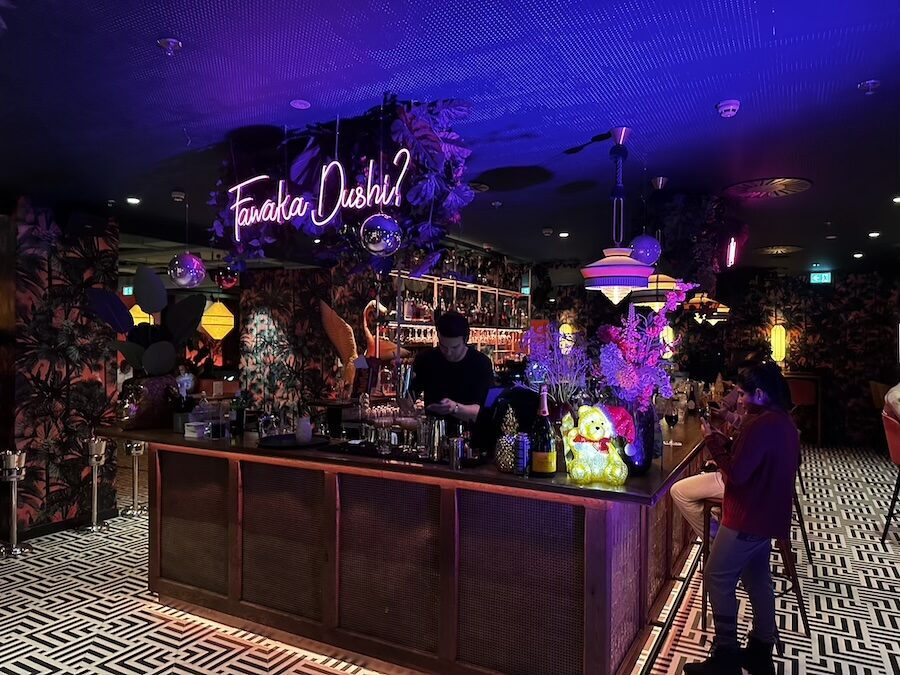
If you’re in a party mood and willing to make a trek outside the city center, the Caribbean-themed Mondi Amsterdam is a kick. There’s a DJ and live entertainment—and more than one cocktail made with dry ice. Special nights include Caribbean Night, held every two months with dancers and surprise acts.
What’s Upcoming in Amsterdam
A great overview of upcoming city events can be found on the I amsterdam website’s “What’s On” page.
Here’s the short list: