


Jordan Schnitzer stands in his 50,000-square-foot Portland warehouse, 22,000 artworks on shelves backing him. It’s the largest collection of prints and multiples in the U.S. Schnitzer, a real estate mogul, art patron, and philanthropist, wants you to experience it.
Moreover, Portland-born Schnitzer wants young people to view, contemplate, and absorb art. In an exhibit space that fronts his warehouse, about a dozen teenagers do just that on an early February morning. Schnitzer has bused them in from a high school in Aurora, set in a rural area, 25 miles south of Portland.
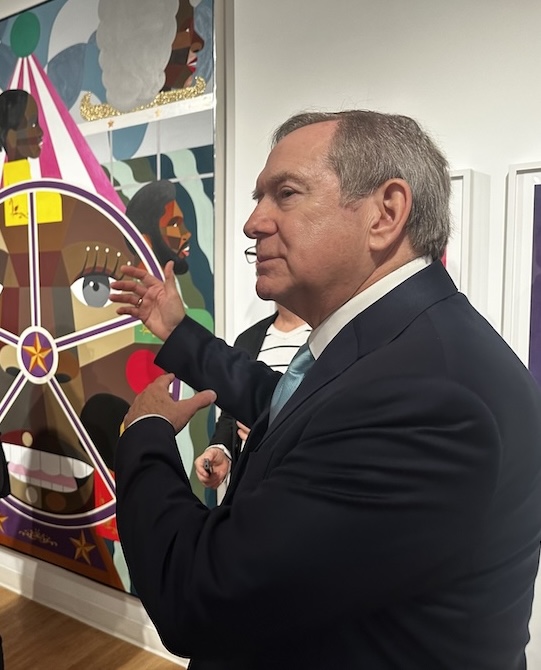
A Mission for Inclusivity
A teacher tells Schnitzer that her school’s funding has been cut; there are no more art classes. All the more reason to “bring the school to us,” Schnitzer tells the instructor and teenagers.
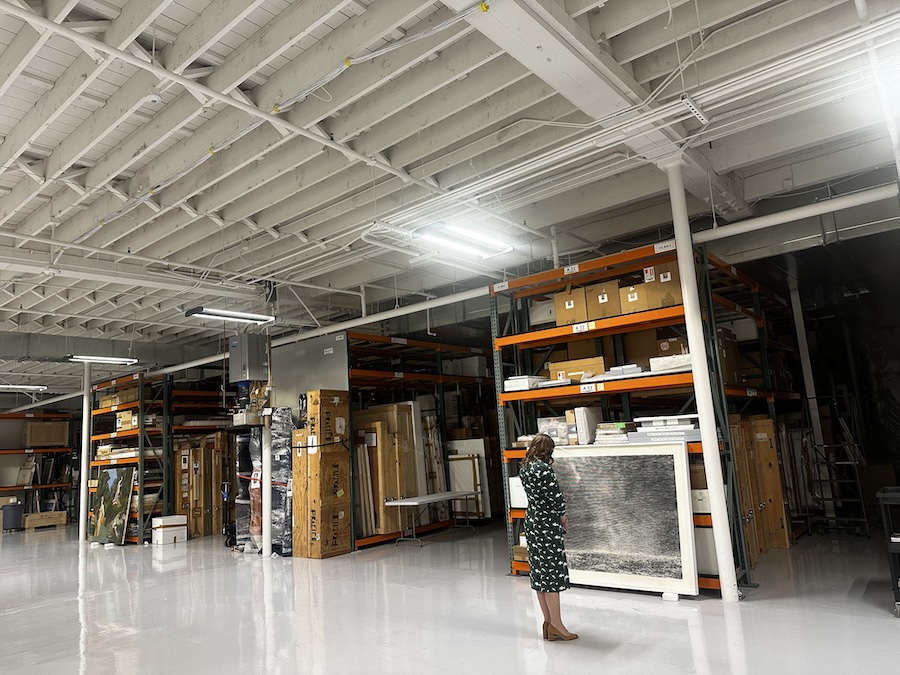
With students encircling him, Schnitzer says, “For too many decades, women, people of color were not represented on the walls of major museums.” His collection includes works by Kara Walker, Marie Watt, and Hank Willis Thomas. Schnitzer adds that his collection is now geared toward expanding holdings of younger artists, especially indigenous, women, and those of color. Still, he admits, works by Ellsworth Kelly, Frank Stella, and Robert Rauschenberg—all represented in his collection—might now languish in archives as they make room for new and underrepresented artists. Still, he views this shift as a necessary evolution.
All told, Schnitzer’s collection includes mixed media works, glass, paintings, and sculptures.
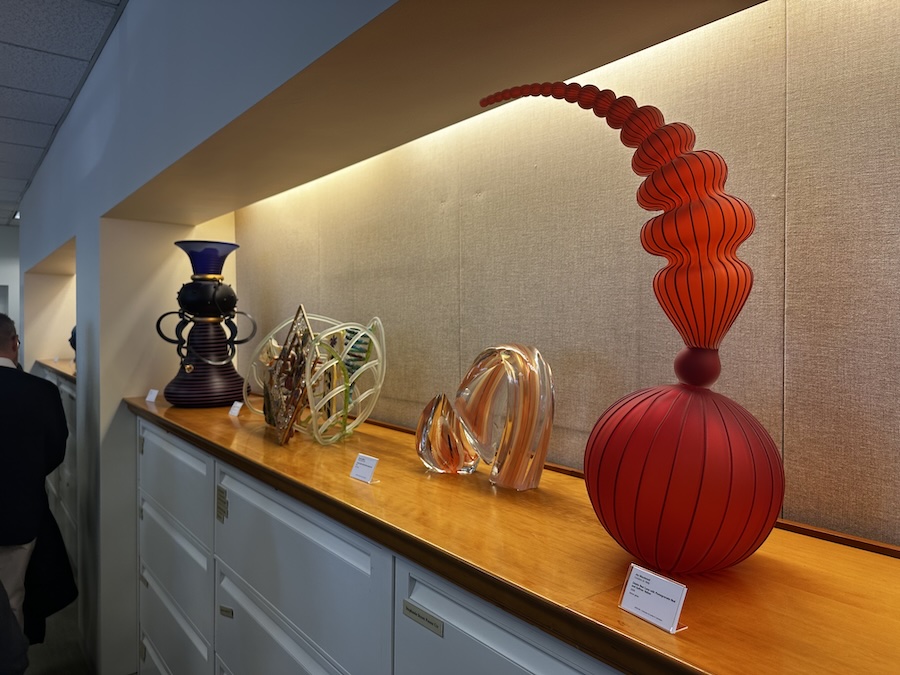
Before the warehouse tour, Schnitzer gave a walk around his real estate headquarters, Schnitzer Properties on Salmon Street. Original modern art covered every wall, with sculptural pieces lining shelves in meeting rooms and along hallways. Even the copy room was adorned with artwork. We passed delicate glass works by Dutch artist Frank van den Ham, who has been fascinated with Africa and the Far East throughout his career. Also, Jay Macdonnell’s towering whimsical 2006 piece (it resembles a strung-out jellyfish): “Diablo Red Cane with Pomegranate Red and Saffron Yellow.”
Nearby, a Judy Chicago cast glass sculpture stood out: “Grand Flaming Fist,” part of a later series in Chicago’s 60-year career.
The Evolution of a Private Collection
Schnitzer acquired Chicago’s print archives in 2021, which, upon expansion, is now the largest collection of Chicago’s work in all media. In 2023, the Jordan Schnitzer Family Foundation published Judy Chicago: The Inside Story, described in the book as “a crucial collection of prints and multiples from the doyenne of feminist art.” (The foundation also has a publishing arm that creates exhibition catalogs and artist monographs.)
Schnitzer aims to expose the masses to art–whether in his real estate offices, by busing in teenagers, or by lending his art to more obscure museums where the populace would be unlikely to see it if not for his efforts. He calls it “art as a public good.” He’s shared his private collection, which he calls his “lending library,” with millions via loans through his non-profit foundation, which has organized more than 180 exhibitions appearing in over 130 museums.
Schnitzer’s mother, Arlene Schnitzer (1929–2020) founded the Fountain Gallery in 1961, credited as Portland’s first professional commercial art gallery. She was intent on providing a venue for local artists to sell and exhibit their work, and helped launch the careers of Hilda Morris, Louis Bunce, Mel Katz, and Robert Colescott. Alongside her husband, Harold, the couple became known as Portland’s “First Family of the Arts.”
The couple’s only child, Jordan, caught the art bug, collecting prints and multiples in earnest starting in the late 1980s. At age 14, he bought his first piece, a small study named “Sanctuary,” by Portland artist Louis Bunce. With a family discount, he paid $60 for the work, with its vivid shapes in blue, green, orange, and red.

Schnitzer has since established three academic art museums in the Pacific Northwest, one at Washington State University, another at the University of Oregon, and a third at Portland State University. Continuing the legacy of his parents, the Harold & Arlene Schnitzer CARE Foundation has given over $300 million to fund nonprofits, including those geared to arts and culture, youth, educational programs, and medical and social services.
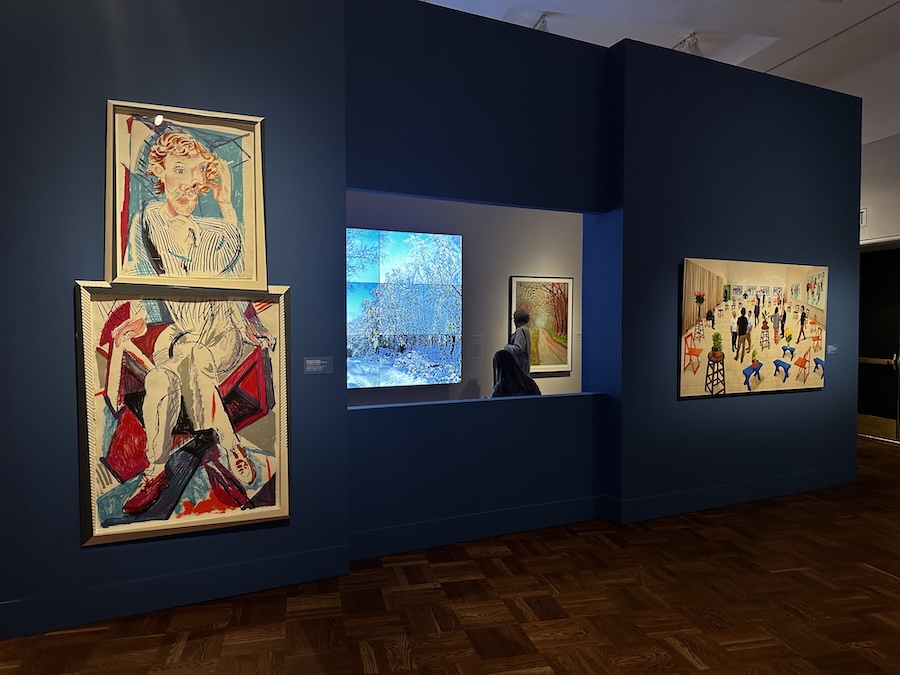
Schnitzer’s newest exhibit is located a few blocks from his real estate headquarters—at the Portland Art Museum. “David Hockney: Works from the Collections of Jordan D. Schnitzer and His Family Foundation” opened February 14 and runs until July 26. It’s the largest North American survey exhibition of Hockney’s work.
Hockney: Merging Art and Technology
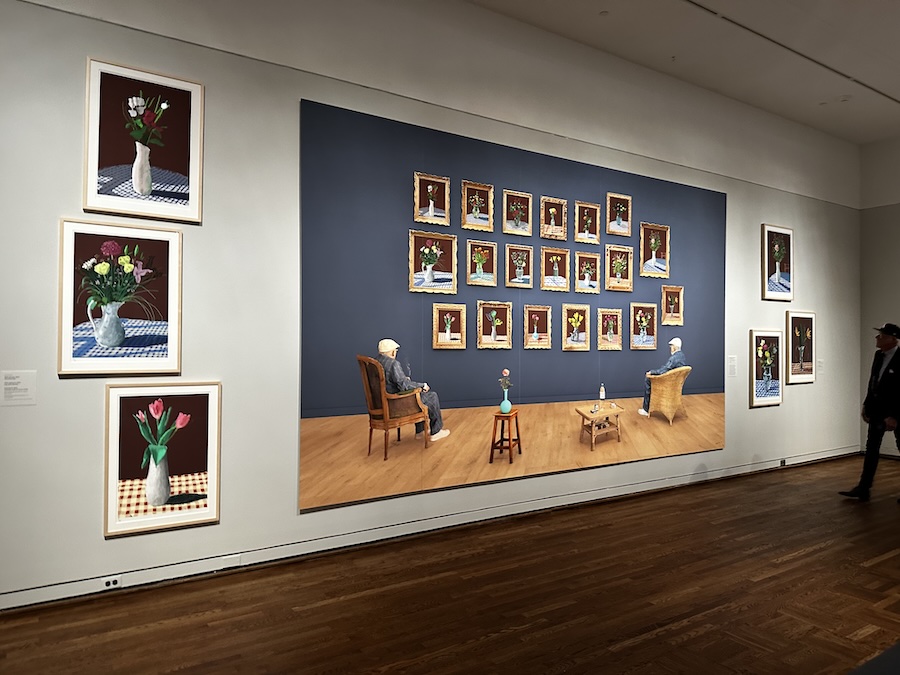
On opening night, 200-plus prints, video, collages, photographic, and iPad drawings were on display—a six-decade survey of Hockney’s work. Always an early adopter of technology, Hockney has forever experimented; the show is a singular overview of his work presented in varied forms. Seen as a whole, viewers can perceive exactly how Hockney’s ingenious mind works.
Far from using technology as a gimmick, Hockney employed it as a way to convey fresh perspectives, including how to depict a 3D world onto a 2D surface. He first used Polaroid photographs to create collages of dozens of photos, mimicking how the human eye surveys a room. In the late 1980s, Hockney used office copies as a kind of printing press, layering colors and textures by running sheets through a machine multiple times. Later, he began faxing his art to galleries and friends, favoring the technology’s low-resolution lines.
From there, the artist used early versions of Photoshop, and in 2008, began drawing on his iPhone and later, an iPad.
Perspective and the Human Eye
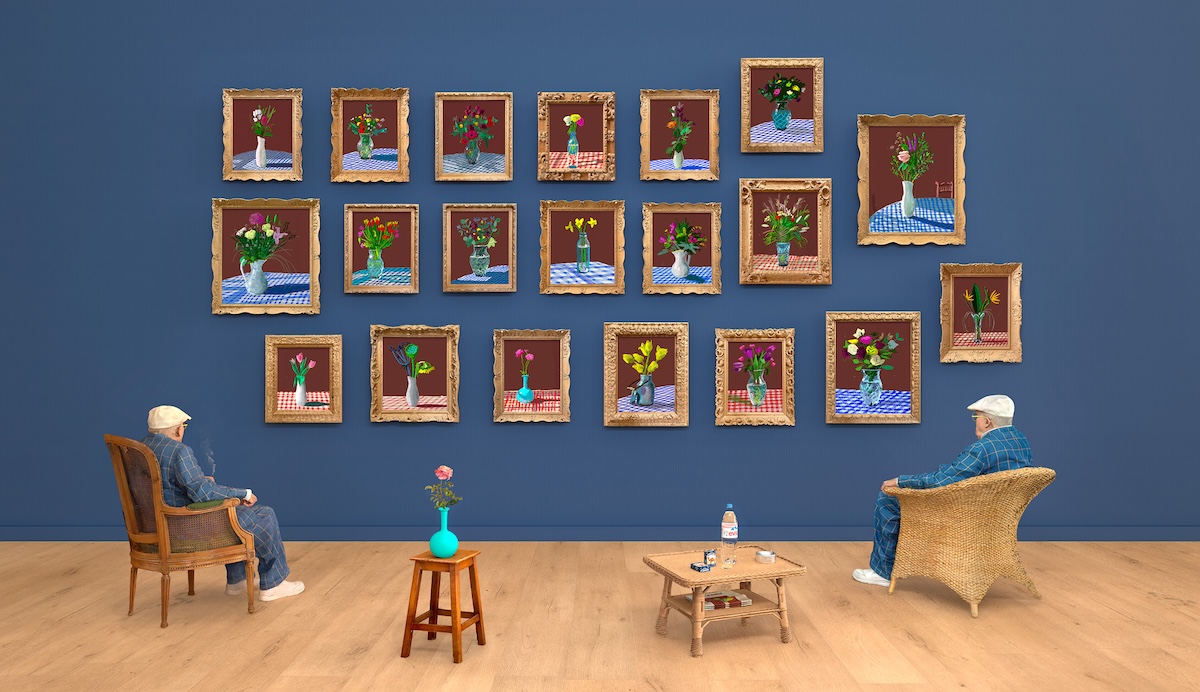
One large artwork covered a back wall at the Portland exhibit: “25th June 2022, Looking at the Flowers.” The large photographic drawing is a self-referential panorama in which the artist is cloned on either side of the painting. He’s seen from behind, wearing a blue plaid suit and a white cap, sitting in an armchair while looking at a wall of his iPad paintings of flowers.
The work was created from hundreds of individual photographs, digitally joined to create a unified scene, enabling multiple perspectives. Hockney says this point of view more closely resembles how the human eye sees as it moves through time and space. The more than 20 flower paintings shown within the work (some shown separately in the Portland show) are from a series Hockney began in early 2021.
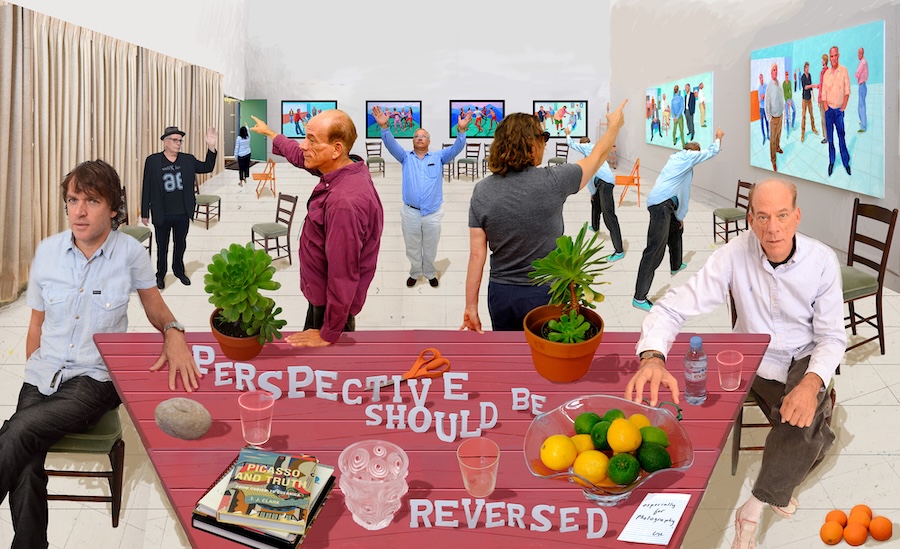
The two Hockney figures in the painting reflect two different moments in time that exist simultaneously within the artwork. Seated with his back(s) to the viewer, Hockney invites the viewer to look over his shoulder, joining him in the act of contemplation. In short, it’s a meta commentary on Hockney as an artist in his ninth decade.
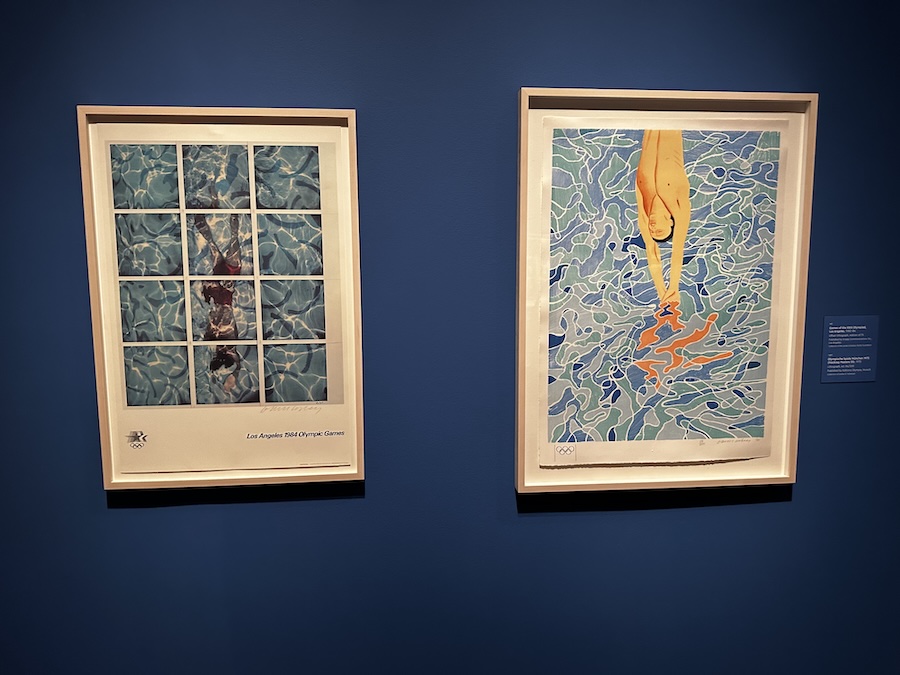
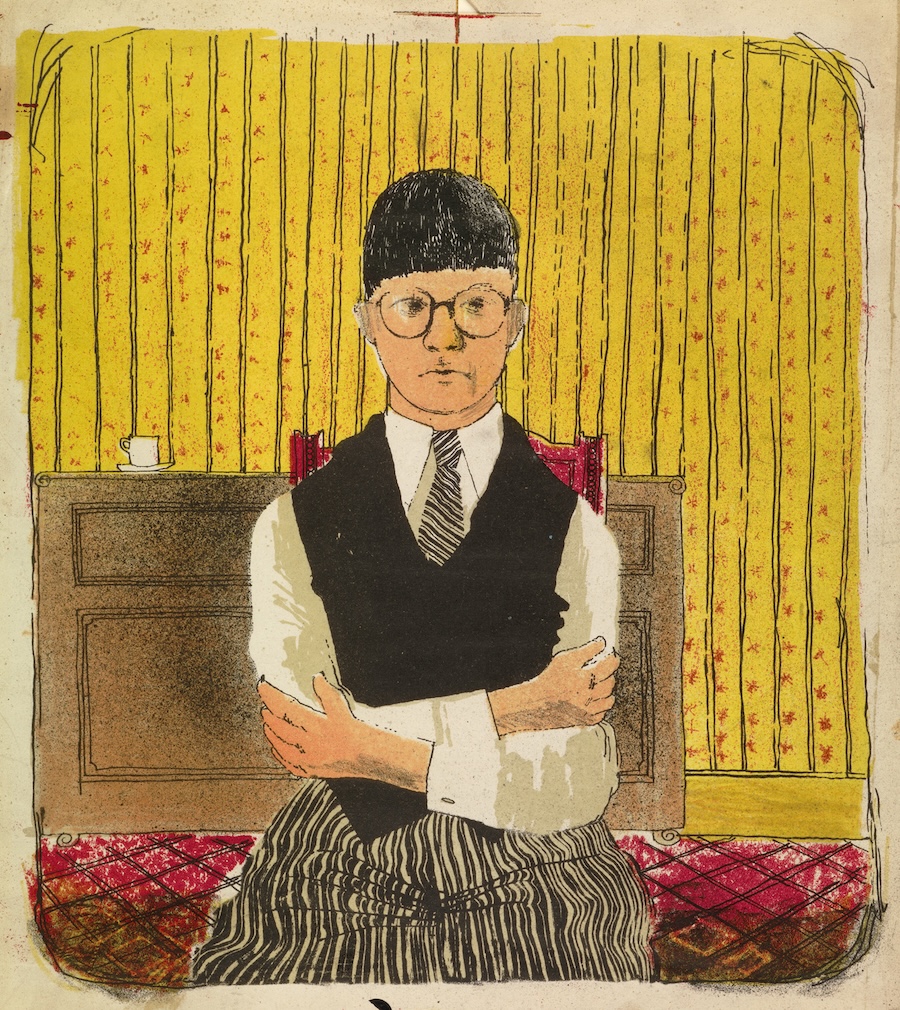
Other works in the exhibition—California swimming pools, self-portraits, Yosemite, and flowering British landscapes—offer similar novel perspectives. These are the “whimsical new ways” one can reconsider ordinary objects, said Catherine Whitney, Honolulu Museum of Art Director of Curatorial Affairs and exhibition consulting curator.
Schnitzer’s efforts—the warehouse visits, his collection as a “lending library,” and his overarching philanthropy–rest on a single conviction: that art belongs to everyone.