


Billed as a “new play with mixed reality,” Simon Stephens’ An Ark begs the questions “Is it theater?” and “Does the technology make up for a lack of conflict, character or clear purpose?” Audience members remove their shoes (although the reason for this is never explained) and enter an open space at The Shed. Folding chairs surround a large, illuminated globe suspended above the center of the room. You are shown to a seat and instructed by the friendly staff to put on a headset with goggles. The headset allows you to see virtual versions of four empty chairs. When the “play” begins, four actors or rather their video images, enter, sit down and advise you not to panic. They then deliver a series of verbal sensory images and fragments of memories in the second person, repeatedly asking us to savor what it’s like to be alive. At one point, we can hear raindrops. Perhaps that’s why it’s called An Ark? After about three-quarters of an hour, we have been taken through a lifetime’s worth of touching and sensing. The headsets come off, we reclaim our shoes and return home.
Credit: Rachel-Louise Brown
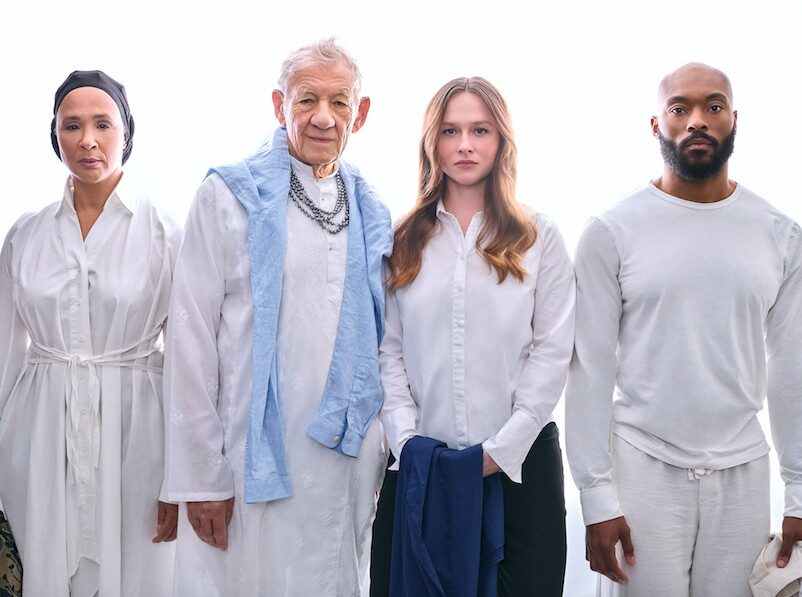
The quartet of virtual performers have soothing voices and speak their lines like tender lullabies. Ian McKellen, Golda Rosheuvel (Queen Charlotte from Bridgerton), Arinzé Kene, and Rosie Sheehy are all expert at keeping us calm and relaxed. It’s a thrill to see Sir Ian (or his avatar) who could make reciting the telephone book compelling and the other actors are proficient at conveying snippets of experience and feelings.
But what’s the point here? There is very little drama or conflict. The one moment of potential confrontation arrives when one of the characters (Kene) confesses he was at the wheel during an automobile accident resulting in the death of his passenger. Sheehy objects to his being present and he walks out of the frame in shame. He returns a few minutes later but with no change to his demeanor or evidence that the confession has changed him. This is the only hint at character development. Sarah Frankcom is listed as director, but her contribution is difficult to judge with so little action.
The piece’s raison d’être seems to be that with the goggles, the characters appear to be talking directly and intimately to each individual audience member. The same experience could have been achieved in a movie theater or in one’s own home through streaming on your TV. So what makes this strange event theater with no live actors? Viola’s Room, a similar experiment with no people in the cast told its tale through sets, lighting and sound at The Shed a few months ago, and was more engrossing. Unlike An Ark, it had a story to tell.
Technology in service of riveting material can enhance the theatrical experience. But An Ark feels like an example of tech for its own sake.
Credit: T. Charles Erickson
Matthew Libby’s Data also addresses issues of technology but from a more realistic, less abstract angle. The play could have easily become like one of those made-for-streaming spy thrillers in which attractive young techies steal vital software and wind up running through the streets of LA or London after bedding each other. But what the playwright delivers is a thoughtful, complex work exploring scary issues of government overreach and technological eradication of human rights. With the inflammatory national debate over immigration raging on our streets, Data is an important and gripping indictment of the Trump administration’s authoritarian policies and the digital industry’s complicity.
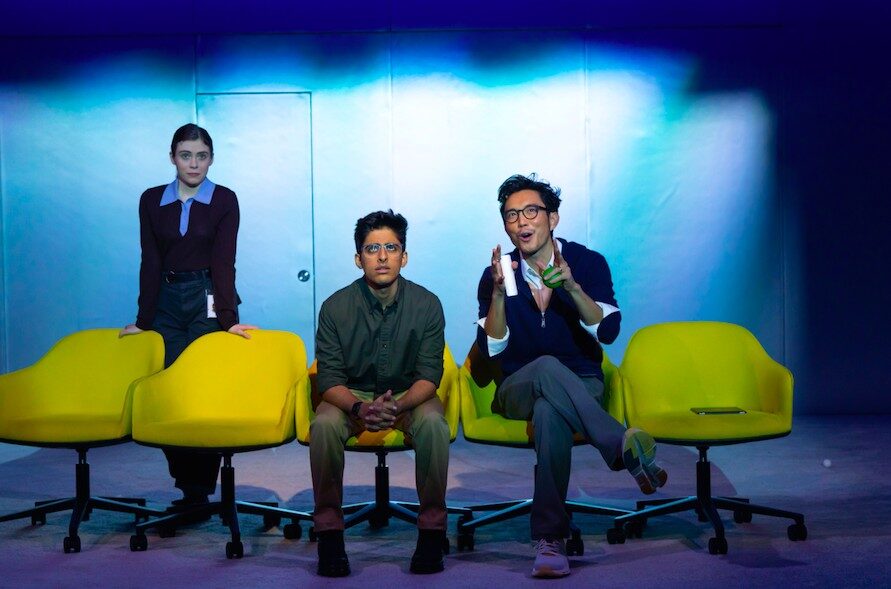
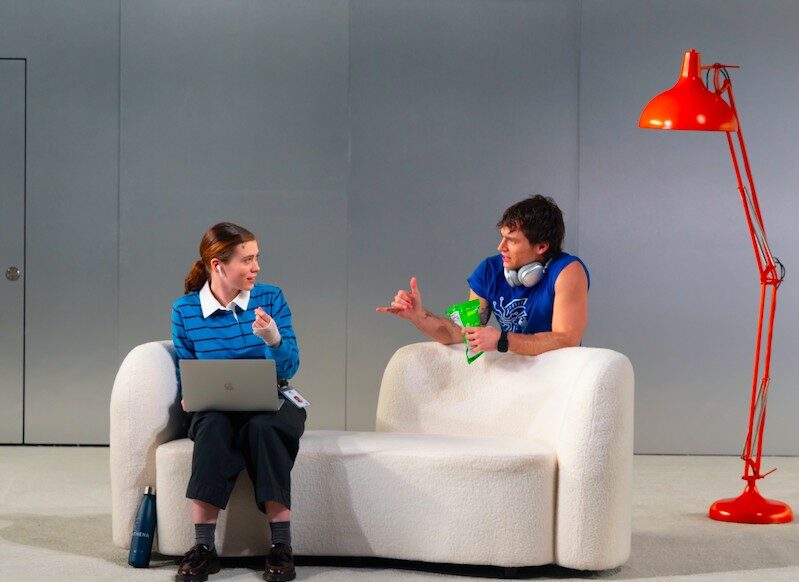
We begin innocently and almost comically with low-level programmers Maneesh and Jonah playing ping pong in the break room of the giant programming corporation Athena. They are interrupted by Riley who works on the higher-up Data Analytics team. At first Libby seems to be steering us into rom-com territory with the alpha-dog Jonah moving in on the aloof Riley—who isn’t interested—and Maneesh attempting to minimize his college relationship with her. (Libby confounds our expectations with dexterity, casually revealing Maneesh is gay and treating this information as a detail and not a vital plot development.) But as we learn more about the secret project Riley is working on and for which she wants to recruit Maneesh, the play takes on dark and dangerous dimensions.
Both Libby and director Tyne Rafaeli ratchet up the tension as Maneesh is drawn into a web of moral ambiguity, made to seem attractive and reasonable by Athena executive and hot shot Alex. Libby adds shades of complexity, rendering the conflicts in shades of gray rather than black and white. Maneesh has developed an algorithm to predict unforeseen events in baseball. Athena, Alex and the government want to use his work in potentially discriminatory ways with regard to immigration. The fact that Alex is himself an immigrant from Singapore who has had difficult dealings with the US authorities and Maneesh’s status as the son of Indian immigrants adds to Libby’s layers. Without revealing any spoilers, each of the four characters has a stake in the outcome of Maneesh’s actions and Libby delineates all of them with depth and suspense.
Credit: T. Charles Erickson
The cast captures the conflicted motives of their characters. Karan Brar infuses Maneesh with an innocent drive to do the right thing and charts the painful struggle to find the right way to do it. Sophia Lillis delivers a dynamic portrayal of Riley’s frayed edges and jittery energy as she navigates the treacherous waters of self-preservation and moral ambiguity. Brandon Flynn expertly transforms Jonah from a swaggering tech bro to a sniveling toady when it suits his purposes. Justin H. Min gives Alex charisma and intelligence as well as a wily sense of justifying his questionable ethics. No one is a hero or villain here.
Rafaeli balances tension with humor, employing Marsha Ginsberg’s metal box of a set and Amith Chandrashaker’s noir-ish lighting to maximum effect. Characters skulk in corners and linger at the edges, scurrying to negotiate their way through Libby’s seemingly inescapable labyrinth of government and technological walls. Data is an exciting, frightening look at our increasingly tech-controlled world.
An Ark: Jan. 21—March 1. The Shed and Tin Drum at The Shed, 545 W. 30th St., NYC. Running time: 47 mins. with no intermission. theshed.org.
Data: Jan. 25—Feb. 21. Lucille Lortel Theatre, 121 Christopher St., NYC. Running time: one hour and 45 mins. with no intermission. datatheplay.com.