


Over the next three weeks, Orange County-based Backhausdance returns to the Knoebel Theater in Long Beach (Sat., March 28) and then brings its distinctive brand of contemporary dance to LA Dance Project in LA’s Downtown Arts District (Sat., April 18).
As a dancer and emerging choreographer in 2003, Jennifer Backhaus saw contemporary dance companies in San Diego and Los Angeles County, but not in her home base in Orange County. Ballet, yes, but not modern or contemporary companies. So she started her own. During the two decades since, Backhausdance built a performance company plus a second educational and community involvement component. Starting with cities in Orange County then extending beyond to Temecula and Palm Desert in Riverside and also into LA County, Backhaus has crafted city and theater partnerships that combine performance and ancillary involvement that now provides year round employment to dancers and staff.
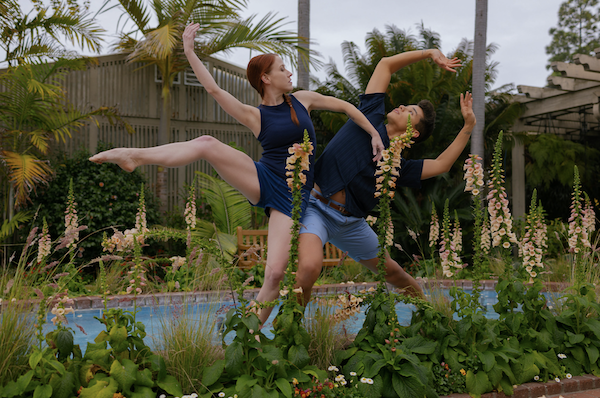
Dance writer Ann Haskins recently talked with founder/artistic director Jennifer Backhaus about Backhausdance, the SoCal connections of the choreographers in the upcoming program, and sustaining a company in the current arts environment that has seen two long-time contemporary companies close. (The conversation as been edited for clarity and space).
Haskins: Backhausdance is often identified as an Orange County-based contemporary company. From that Orange County base, you have built an extended presence throughout Southern California. Are there different considerations or issues you think about when in different areas?
Backhaus: I don’t think that there’s any different Orange County or LA or Southern California sensibility. I think they’re very similar outside of the fact that every company has its own identity, but that rarely is location based; certainly it isn’t for us. The idea over the past few years has been to reach out into more areas in Los Angeles to broaden our audience space and to be more part of the dance community in LA. Because we are a little removed, I think people sometimes forget that we’re over here.
Today, we think of ourselves as more a Southern California company than we are Orange County. The concerts at Long Beach’s Knoebel Theater and downtown LA at LA Dance Project reflect that. About half our dancers live in LA County, and a lot of them live in Long Beach. Also, most of the choreography we are bringing this year has a focus on voices that have ties to LA.
Haskins: I’m curious if you think that starting in Orange County allowed your company to be nurtured in a way that LA-based companies often are not?
Backhaus: I think I would say two things. One is we really started with our strong relationship in Orange with Chapman University, where I was on faculty for a long time. While we never had any financial support from them, we paid for rehearsal space and such, just being able to cultivate dancers has enabled us to grow in some ways, because we are able to work on dancer training. We host the Summer Intensive in Orange, so we have capacity to find people and give them opportunities. Being connected in university systems, that’s been helpful. It’s hard to be on your own, just out there flying solo. Having this type of collegial support is very helpful.
The other thing is when we started there were not a lot of modern or contemporary companies in Orange County. There are now, but we are one of the longest running, and we have built a lot of relationships. Over time, we reached out and built relationships with Orange County cities and with other cultural organizations that have been beneficial to our growth. For example, we do a lot of work with the cities of Costa Mesa, Newport Beach, and Santa Ana, and their arts commissions. As a result, we have grants working with students in their school systems. I will say it was because we put ourselves forward. No one reached out and said ‘let me give you all these great opportunities.’ We had to get in there, show our work, and get people to trust us. So there has been cultivation. Also, I think we tend to be a bit lucky, because there’s not really another beast that kind of does what we do. Orange County has fewer contemporary dance companies running full time, with full annual year contracts and pretty stable scheduling without long gaps in between. We’re able to offer dancers longer contracts and keep developing those relationships.
Haskins: When Backhausdance started in 2003, ballet had a number of professional and training companies in Orange County, but my recollection is there was not a lot of contemporary dance. And there were limited venues. UC Irvine’s Irvine Barclay Theatre offered a mix of local and touring dance, while Costa Mesa’s Segerstrom had mostly large, touring dance companies. That would have been a pretty sparse landscape to start a dance company.
Backhaus: Yes, you’re absolutely right on all of that. In 2003, I was working in small contemporary dance companies up in LA and I saw there were things going on in San Diego, like the Malashock Company, but really nothing in between. That was one of the reasons why I did it. Part was my own artistic development, wanting to grow as a choreographer. The other thing was I knew dancers coming out of Chapman College who really wanted to stay and dance in the area and not have to move to LA or San Diego, but there wasn’t anything for them. So I saw the need in Orange County and tried to build something. Also, I had support from my colleagues at Chapman College where I was working.
Haskins: Did you start out with the intent to be a repertory company or primarily to present your choreography, and then it evolved to the mix you have now?
Backhaus: I did start it as a single choreographer company. And I’ll say that in two ways, although I’ll contradict myself a little bit. I really wanted to work on my own artistic voice in choreography with a group of dancers over time. I knew that I wanted a deep, process driven experience, instead of just a quick, “pop in, pop out” situation. And to be quite honest, I didn’t have any money to start as a repertory company. So it was “well, you get me, because I’m free.” The second year of the company, Nancy Dixon-Lewis made a work for us, and in roughly our seventh year, Jodie Gates made a work for us. But that definitely was not the norm until about 2010 or 2011 when we switched to a repertory model to diversify the voices.
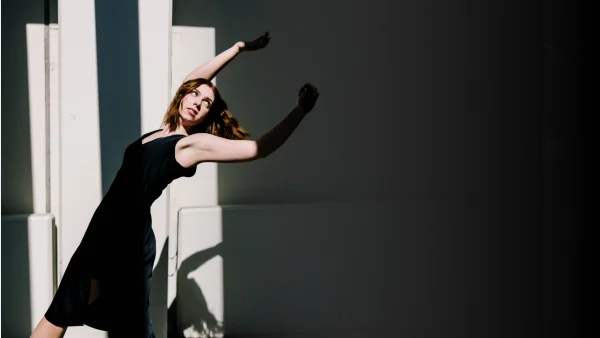
Haskins: What are the four works you are bringing to the upcoming shows.
Backhaus: This year and last year, we were really looking at dancemakers who had connections with Los Angeles and with Orange County. We asked how we could bring forth voices that are interesting and incredibly accomplished in other parts of the world, but have this connection to what we do and to our location in Southern California.
The first piece is a world premiere, The Four Winds. The choreographer is Zachary Ryan Schlegel. He danced with the company on and off for about seven years. He produces the Congress performance series in Los Angeles and is rehearsal director for Shen Wei Dance Company based in New York, so he’s traveling all over the world. His work is really informed by his last ten years dancing with Shen Wei. It’s this meticulous, quiet intensity in the work that has always been in Zach. We kept a really great relationship as his career developed and watched how his worlds have kind of meshed together to give him an interesting movement palette, a rich world that’s layered and very nuanced.
For the second work we’re bringing back the 2022 work, Everywhere, But Here, by Tommie-Waheed Evans. He started out his career in Los Angeles, danced with a number of companies, choreographed maybe 50 works, and is now co-artistic director at Philadanco! His language is so interesting and we brought back the work because it fits so well. It is an ensemble piece, big and technical with a very emotional, yet abstract storyline.
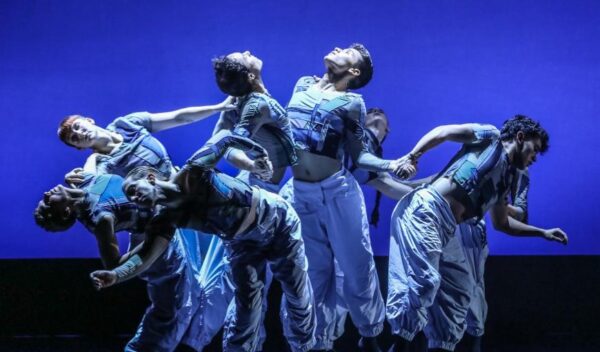
After intermission, the third piece on the program is for six dancers, another world premiere, Never Enders, by Megan Doheny and Ilya Nikurovoh. They choreograph as Out Run the Bear. Megan is an Orange County gal and they met in Israel’s Kibbutz Dance Company, so their vocabulary is influenced by Israeli dance and the things they were doing in Kibbutz. They make a lot of work on themselves as a duet, but they’re also increasingly setting on other companies. This one is nostalgic, like a family who gets together, but only every few years with a sense of comfort, all of the wonderful things are there, then also deeper, more difficult things.
The last piece on the program is Multitudes that Amanda Kay White and I are working on. It’s an abstract conversation between us about the nature of the movement language we’ve created over the past 23 years that we’ve been working together, how ideas have layered on over time, what is essential to the way we move together, and how the dancers have changed. I don’t expect most of the audience will get all of these aspects. And, quite frankly, it’s not important that they do, because for us, the important part is we made it to this amazing piece of music Partita for Eight Voices, by Caroline Shaw. The whole suite has four sections, but this year, we’re only premiering three of them. Next year we’ll add the fourth.

Haskins: Earlier, you referred to the distinctions that exist among the current population of dance companies in Orange County and LA. In that context, what is distinctive about Backhausdance?
Backhaus: If I’m just talking about the work, I would say we have a very clear movement approach that has developed over time, a shared language that includes a lot of different modern dance techniques, a language that has become unique to us. There’s a sense of flow, a sense of weight, a sense of rhythm, but also a sense that we follow rules and break rules all the time. I would say across the board, a lot of rule following and rule breaking. I would say too, that we are a collaborative company. Even when we bring in choreographers from the outside, we are about the interplay between multiple voices, a give and take. It’s not a full democracy, but it really honors all the voices in the room.

Haskins: What are your plans for Backhausdance, say over the next five years.
Backhaus: Interesting that you’ve mentioned it, because we are undergoing a four year strategic plan. On the side of artistic growth, we’re looking for more performance opportunities. We did the trying to tour thing, and we were modestly successful doing that pre-Covid. After Covid, I decided I wanted to make more of an impact in our own backyard. We established our relationship with Temecula combining performance, education and community involvement. We’re building relationships with other regional theaters. We’re going to be at the Irvine Barclay every year for four years, starting next season, which is great. Our relationship with the Knoebel Theater continues and reaches into the Long Beach market and now we will be up in Los Angeles at La Dance Project. I would love to find another LA theater that would be a good fit for us. As we’re growing, I would like to get one or two more partner theaters up a little north as far as Santa Barbara and south as far as San Diego, and be able to offer a performance season with more opportunities to perform the same program up and down Southern California.
Also, we also have a lot of growth possibilities in our education work, and we’re doing health and wellness classes. We’re doing a dance for joy, wellness, and well being class for seniors, and we’re expanding our school programming, new assemblies and after school programs. We’re looking at all those opportunities and trying to decide where to put our efforts.
Backhausdance at Martha B. Knoebel Dance Theater, Cal State University Long Beach, 6200 E. Atherton St., Long Beach; Sat., March 28, 2 & 7 pm, $48.75-$69.75, $27.75 student. Backhausdance.
Backhausdance at LA Dance Project, 2245 E. Washington Blvd., Downtown Arts District; Sat., April 18, 8 pm, Backhausdance.