


The J. Paul Getty Museum in Los Angeles has just opened a major exhibition, Photography and the Black Arts Movement, that depicts the African-American community with a particular focus on the protests and social change of the 1960s and 1970s.
There are straightforward black-and-white images that document the civil rights movement and its leadership. There are also works ranging from quiet portraits of private life to colorfully arty combinations of photography integrated into paintings and sculptures. The photographers and artists represented in the show include famous names such as Gordon Parks, Carrie Mae Weems, and Betye Saar, though most are relatively unknown.
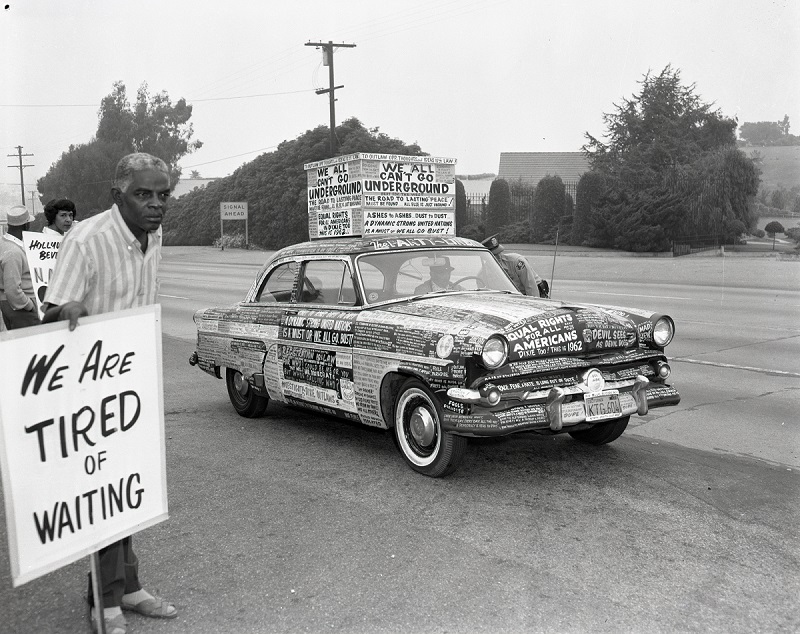
Protest Car of 1962 by Harry Adams, who worked for the Los Angeles Sentinel and other publications, is a good example of the show’s “straight” photography. In the center of the shot is a two-door sedan completely covered with painted slogans, such as “EQUAL RIGHTS FOR ALL AMERICANS”; on the left side of the road is a man carrying a large sign saying “We Are TIRED of WAITING” at the front of a line of protesters. The image is strong and completely self-explanatory.
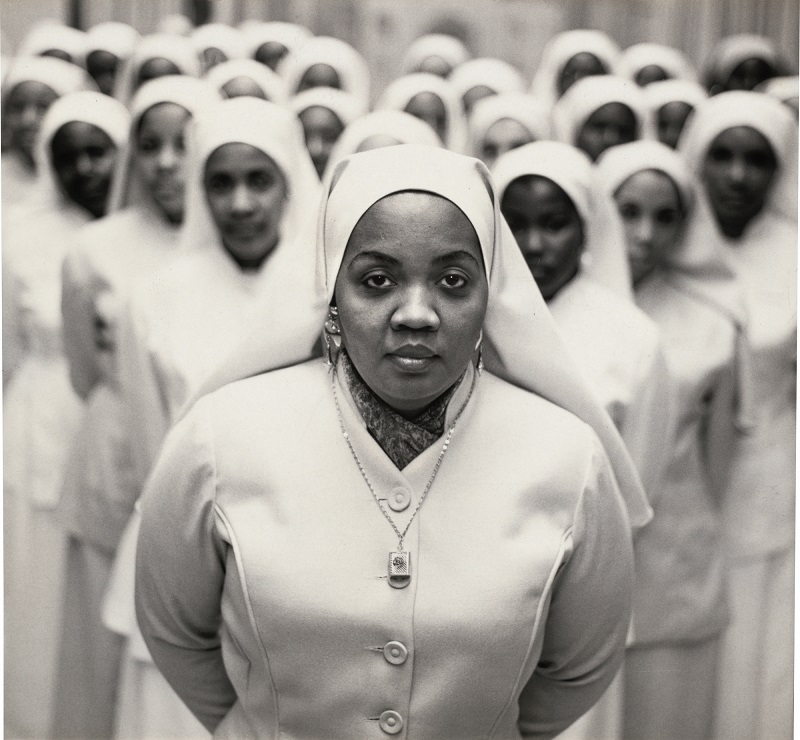
Gordon Parks’ Ethel Sharrieff in Chicago, 1963, is a clearly posed portrait of the daughter of Elijah Muhammad, the leader of the Nation of Islam. Dressed entirely in white, she stands unsmiling before dozens of other identically dressed Black Muslim women. They look like soldiers standing at attention, arranged in a triangular pattern that seems to recede forever. It’s a memorable image that also comes close to an advertisement.
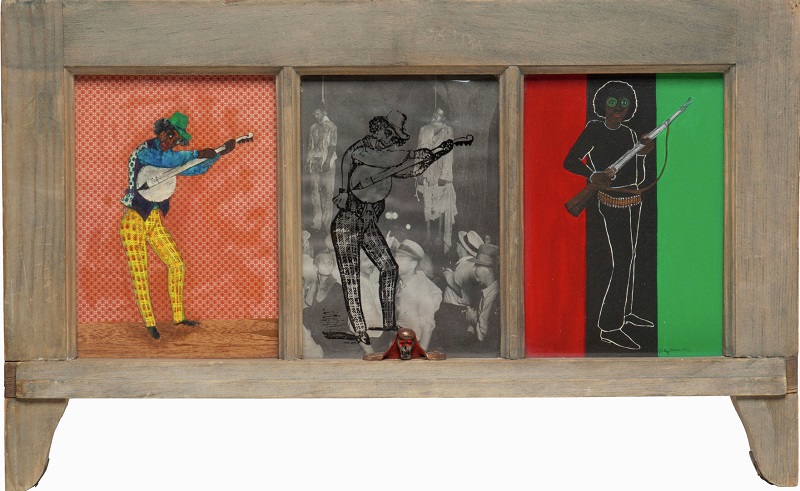
Betye Saar’s assemblage/sculpture of 1972, Let Me Entertain You, combines three images within an old wooden window frame. On the left a colorfully dressed, banjo-playing minstrel poses against an orange-colored background. In the center, the same image is repeated in black and white, overlaid against a gruesome historical photograph of a lynching. Several white men (and a woman) mill around the site, smiling, smoking cigars, pointing to the two victims still hanging from a tree. At the bottom of the center window frame, a tiny skull has been inserted into the brass lock fixture, grinning out at the viewer.
On the right side of the window frame is an image of a young Black man, sporting black clothes and an Afro haircut, holding a rifle in the same stance as the banjo players. In the background is the red, black, and green Black Liberation flag designed by Marcus Garvey more than a century ago. The cumulative effect of the three panels is, to say the least, powerful and thought-provoking.
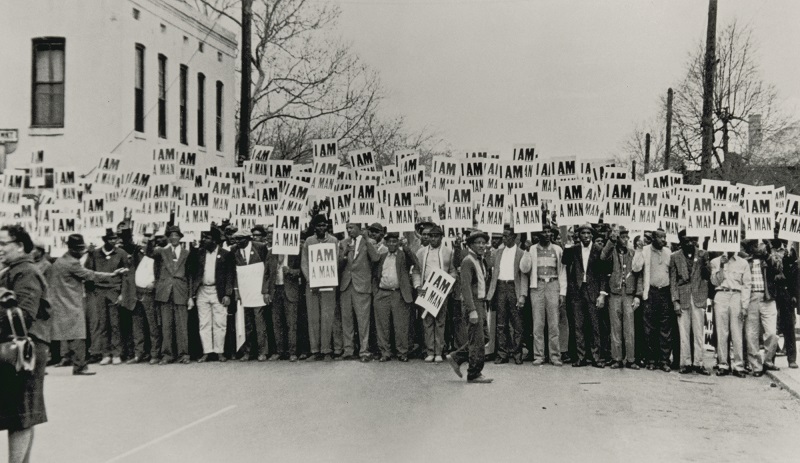
Another graphically strong image of protest, with an historically important back story, is I Am a Man, Sanitation Workers Strike, Memphis, Tennessee, photographed on March 28, 1968, by Ernest C. Withers. After two sanitation workers were killed on the job by a malfunctioning garbage truck on February 1, 1968, about 1,300 workers went out on strike 11 days later.
Tensions mounted after Mayor Henry Loeb rebuffed the union’s demands for wage increases and better working conditions. Martin Luther King Jr. briefly visited Memphis on March 18, delivering a major speech to a crowd of 25,000.
Ten days later, the hundreds of workers depicted in Withers’ photograph marched again, carrying signs proclaiming I AM A MAN and repeating their demands. King returned to Memphis on March 28 and again on April 4, when he delivered his famous “I’ve seen the promised land” speech. On the following day he was assassinated on the balcony of his Memphis motel.
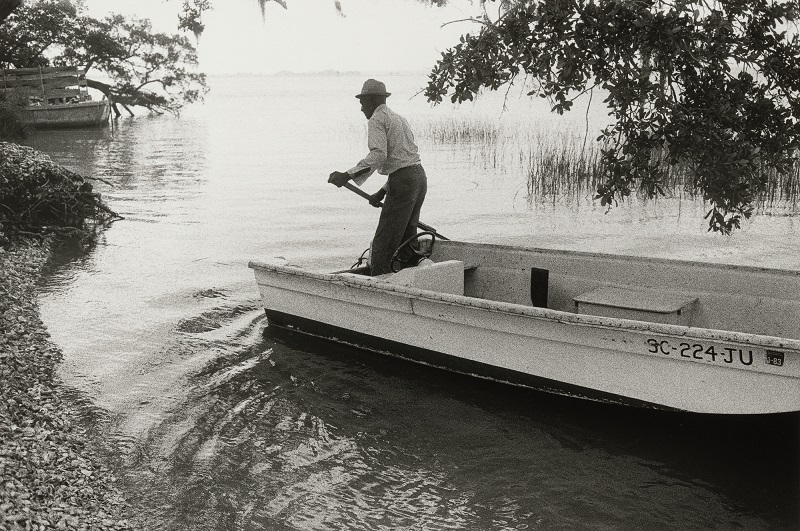
Many but not all of the photographs in the Getty exhibition focus on the turmoil of the time. There also are quiet portraits and landscapes, and one of the most touching is Jake With His Boat Arriving on Daufuskie’s Shore, Daufuskie Island, South Carolina, photographed in 1978 by Jeanne Moutoussamy-Ashe (the wife of tennis star Arthur Ashe).
Fedora-wearing Jake, a member of the isolated island’s Gullah population, stands in the stern of his rowboat and maneuvers toward the shore with one oar. He’s surrounded by an overhanging tree limb on the right and more vegetation on the left. The image is both simple and elegant, a reminder of a now-lost world.
Photography and the Black Arts Movement runs through June 14 at the J. Paul Getty Museum in Los Angeles. The exhibition was organized by the National Gallery of Art in Washington, where it was on view from September 21, 2025, to January 11, 2026. The show travels to the Mississippi Museum of Art in Jackson, Mississippi, from July 25 to November 8. A 288-page catalog is published by Yale University Press.