


Armed with insouciant physical comedy recalling Carol Burnett, sibling interactions reminiscent of the Marx Brothers, and just a dab of puppetry suggesting Mummenschanz, The Seaweed Sisters bring WEED OH NO! to the LA Theater Center June 5 to 14. Known for their engaging humor and sly physical slapstick, The Seaweed Sisters, aka Jillian Myers, Megan Lawson, and Dana Wilson, create magical worlds rooted in fun, fantasy, and deep dance backgrounds. In their other lives, each of the three has impressive credentials in the commercial dance world–the film LaLa Land where Jillian also was assistant choreographer to Mandy Moore, touring with Justin Timberlake, Janet Jackson, Michelle Dorrance, and working with Adele,. Ariana Grande, the Backstreet Boys, Chappell Roan, Ed Sheeran, Hozier, Justin Timberlake, Kesha, Madonna, Miley Cyrus, Olivia Rodrigo, and Paula Abdul, among others.
Proving the wisdom of doing favors for your friends, a request to perform at a benefit show in 2009 struck a funny bone, led to a YouTube video sensation, and opened a strikingly different parallel universe to their successful commercial dance careers. Juggling their individual professional film, touring, teaching, and choreographing commitments, the trio collaborated as The Seaweed Sisters where each has become known by their color designation–Dana Wilson is blue, Megan Lawson is pink, and Jillian Meyers is green. The Seaweed Sisters’ adventures in various fun and fantastical worlds have been chronicled over 12 years in videos and brief performances, and now in a 70-minute live performance.
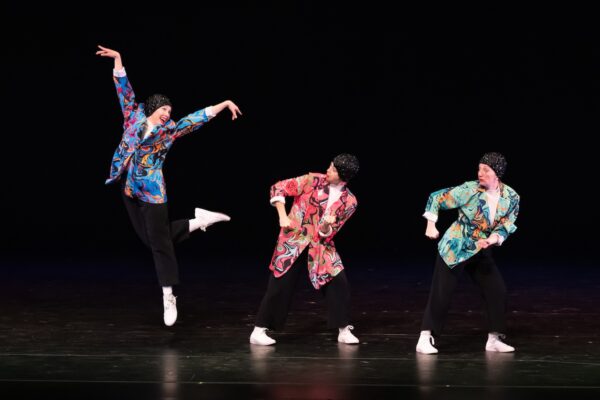
The three ‘sisters’ spoke in a zoom call with dance writer Ann Haskins about the upcoming show, the evolution of their Seaweed personas, and how their commercial dance backgrounds brought them together and underlies The Seaweed Sisters comedic explorations. The interview has been edited and condensed for length and clarity.
Ann: I’d like to know a little bit about your backgrounds and what led you three to coalesce as The Seaweed Sisters.
Dana: All three of us grew up in competitive dance spaces, training in all styles, and moved to Los Angeles to pursue our dreams of working in the entertainment industry. We moved here around the same time in 2005 and did not meet each other for at least a year.
I didn’t book any work as a dancer for my first calendar year living in Los Angeles, then my first professional job was working for Justin Timberlake. I’ve done three world tours for him since, as well as countless music videos and live performances, TV shows, films, and things like that. We worked at very high levels on various types of projects within the entertainment industry. Gradually, we connected and became friends, but we very rarely work together. Most of the projects that we work on might have space for one oddball in the cast…but rarely three. I think the only time we’ve all worked on the same project is La La Land. Still, our realization of kinship as people, happened simultaneously with our individual careers growing.
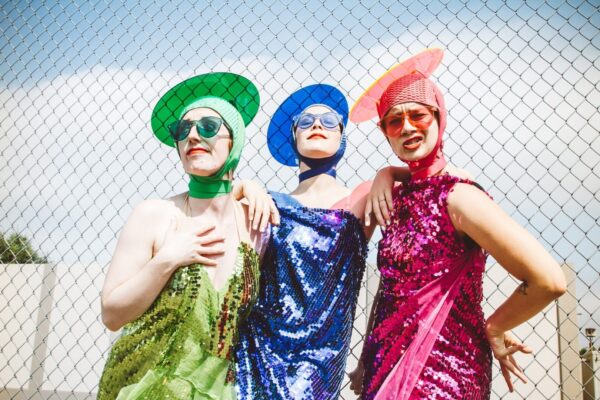
Jillian: Adding to what Dana shared — not having had the opportunity to work together commercially is part of what brought us together. That and the work happening in those spaces didn’t satisfy all of our creative interests. As you know — commercial work generally has a certain container.
I danced for Janet Jackson on and off for five, six years. It was a long time. And then alongside that, and I think this is true for all of us, we were always teaching, making choreography. All of us are very dedicated teachers. Even that first meeting when Dana proposed we perform together was at a class Megan and I were teaching together. The classroom was another really fruitful place for us to find our voices as choreographers, share, and find friendship. Mandy Moore is my mentor. I have assisted and worked with her for half of my life. That is another place that I’ve gotten to experience a variety of working situations. All of it living more commercially in the sense of film, television and music artist work. Alongside that, I’ve always had a deep passion for other types of projects existing in the theater space. Recently, I have been performing Time Spell, a piece I co-choregraphed with Michelle Dorrance as part of Turn It Out with Tiler Peck & Friends. I’ve tried to keep engaging in this part of the dance world, because variety is really what satisfies me. Live performance is a deep passion, and such a different experience than work that is filmed.
Dana: Dancing for pop stars and selling Amazon Prime left me wanting more. It did not scratch my itch of this thing that I love to do, this dance thing that I’ve loved since I was three, when my mom put me in dance classes. A huge piece of me was not satisfied and a huge piece of myself as a woman was confused. Is it my job to be sexy all the time? I was not satisfied with that answer. And I think The Seaweed Sisters, in many ways, is a rebuttal to what the entertainment industry presents as being a woman, as being fun, as being funny, as being a dancer. I think The Seaweed Sisters is our answer, a rebuttal to what we think the entertainment industry got wrong about a lot of those things.
Ann: So is that “rebuttal” with the emphasis on the “butt?”
Dana: That’s it in a nutshell.
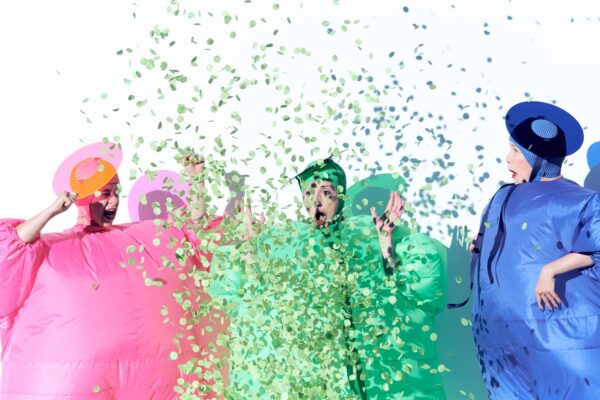
Ann: How did The Seaweed Sisters begin?
Megan: Dana had been invited to choreograph a work for a Dancescape LA benefit show, and asked if we wanted to join her for a trio collaboration. I think it was 2009. The video of the performance is still on YouTube. The video is a wide frame, no edits, a little blurry and so cool to hear the audience react to our first time taking the stage together.
Ann: So, you did this benefit and debuted as The Seaweed Sisters. What happened next?
Dana: After that benefit show, a dear friend said “You guys NEED to film that, that needs to be captured, shared, and committed to eternity in the format of digital media, forever. And I’ll help.” We looked for a location, settled on the pool at Megan’s apartment, and that piece of choreography created for the stage easily and quickly transformed for the camera. It became our first short film “Get Sea.”
We committed loosely that once a year, we would prioritize “us,” and in a tight, short amount of time, make a short film as The Seaweed Sisters. We’re all fans of the thrill of live performance, but also really enjoy that we can work on a short film, intensely for two days, and then it can be out there reaching people while we are sleeping. With the assistance of other friends and collaborators, and with the exception of Covid, we have really stuck to that once-a-year model for the past 12 years. We’ve been very lucky to have brilliant collaborators in our mix, in our immediate network, who also prioritize making work that satisfies and prioritizes joy and discovery over sales or over anything else.
Ann: You now have roughly a dozen short film works that were either live and then filmed or done for film. What prompted this full-length live show?
Megan: As we started releasing films, we were also invited to perform more frequently starting with the band Lucius that was started by Jess Wolfe and Holly Laessig. They invited us to be their opener on New Year’s Eve in San Francisco. This was a very cool entry point to a new audience, and in time, to larger scale events like the Newport Folk Festival. Lucius already had a built-in fan base, who initially weren’t clear on who the three of us were, but over our 15 minute set, we could see those folks’ faces go from a question to pure delight.
These moments of live performance magic kept reinforcing the feeling that we were onto something worth expanding. Hence the scale, time, size, and budget of this live show has felt like a dream for a long time, with lots of questions including: When can we do it? Because we have to sacrifice other work that we do as individuals, which is ongoing. Finally, we just pulled the trigger thanks to Emily Wanserski who asked when were we going to do it, if not now? That lit the fire, and she helped us carve out this time and space to make this happen.
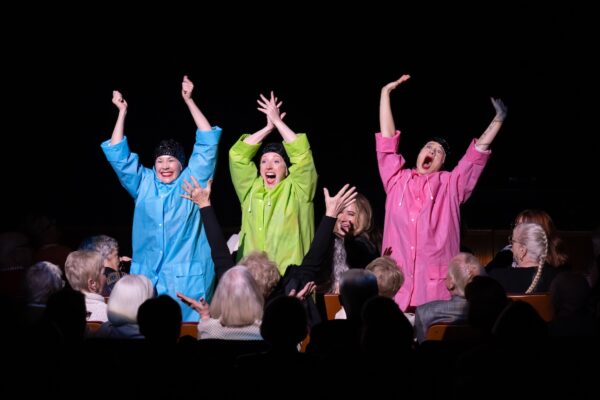
Jillian: In the beginning, the challenge was carving out time for The Seaweed Sisters with each of us also pursuing individual careers as choreographers. Over the years, the bigger challenge became how to align the growth of our individual careers with the growth of The Seaweed Sisters. And to your original question about doing a full show, we love new and variety, and it is time to try something that we haven’t done yet.
Ann: Tell me about the show, WEED OH NO!
Dana: A very blanket, 30,000-foot view is that with our short film works and with our other live works, you see us in environments out in the world: in the bottom of a pool, in the desert, in the redwoods, at Tongva Park in Santa Monica, at the beginning of Dance Camera West. There’s an agility to showing up in real time.
WEED OH NO! is us inviting you into our bubble, into our space, and showing you all the many things and talents that we have and keep or use or misuse in that space. It is basically the equivalent of going to the home of a dear friend who has small children and entertaining those children when they say to you, “Hey, do you want to see my room? Do you want to see my bed? Do you want to see me jump on my bed? Do you want to see the dance I made up? Do you want to see my belly button?”
Megan: It really is that for 70 minutes, because we really connect with that playful energy. We all have young people in our lives who inspire us. They remind us of ourselves, because at large, we have all been those tiny people. Sometimes that gets lost in our adult lives. This is for our younger selves, for our peers, and people of any age to be reminded that everything can be magic, and that our imagination still exists if we can tap into it.
Jillian: We consciously take our silliness very seriously. There is a craft to it. The fact that not everyone registers that immediately is a plus. Because if you don’t feel that very conscious curation and are just experiencing the silliness and joy then I think we’ve done our job well. Of course, so much care goes into it. We have many serious conversations about how we hope the work will land for people and more importantly how they might feel when they watch it. Yet we also leave just enough room for absolute play for the three of us, so that there can be spontaneity in the moment. Working that dynamic in can be a fun challenge. Like in comedy, we are considering timing and reaction while leaving room for the unexpected. It’s a combination of planning and spontaneity that we’re conscious about finding the balance of in an artful way.
If we had to categorize what we’re up to — we definitely lean more into dance theater that has physical comedy attributes. We are very inspired by clowning and there is a mime element to The Seaweed Sisters’ movement. That said – dance is at the heart of our trio. Our dance training is the undercurrent to showing our prowess. Just as you may wonder if these ladies are going to goof around the entire time, we’ll execute tight and intricate choreography in counterpoint to the very loose play. That is a dynamic we’re always trying to shape and form, so that when the play kind of goes off the rails we can satisfyingly sweep it back up with choreography that is definitive and consciously made.
One other thought to add that fuels inspiration is that I am a huge fan of Megan and Dana as dancers. When we’re playing as we create I love watching them. If something comes out during those moments that really makes us laugh it usually is an idea that we keep. Especially ideas that somehow defy, maybe our younger studio dance selves, that were focused on what you should do or shouldn’t do. For example, we know how to point our foot like a cashew and have a strong flex or a demi point or a forced arch, but what we choose and love most is a floppy foot.
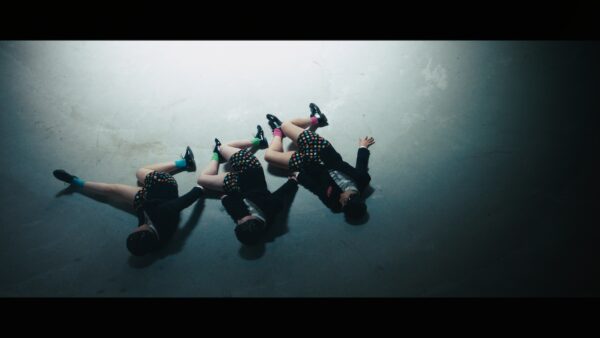
Megan: Of course, there’s a lot of giggling and we have a blast, but the work is sneakily advanced. We’ve refined our Seaweed style and language to be both challenging and full of heart.
Dana: Beautifully said, Sisters. The only thing that I would add to the “seriousness” of this humor in dance is not easy. We’ve practiced for 12 years finding the humor, utilizing laughter as feedback in our process and shaping “products” accordingly. We definitely borrow from improv comedy’s golden rule of “saying yes and,” and we have really led with ‘yes’ working with each other. Our process is hugely collaborative and based on the ‘game of yes,’ which can take an idea and really blow the lid off in a pretty short amount of time.
We don’t often have a lot of time to create together. But because of our working relationship, we get in the room and it’s instantly exponential play happening in a short period of time. When we disagree, we have three people: two out of three, a very democratic process.
The way that you find the funny or the way that you find the best result is the same way you “find your leg” if you’re trying to balance: you try; you take a look at it; you make a correction; usually over-correct the other direction, and then you try again. And we’ve been trying and trying again for 12 years. We’re fine. We’ve, I think, “found our leg!”
There are several challenges in making your own work. Raising enough money to make it in alignment with your vision is one of them. Being inside of it and trying to have an outside eye is another interesting challenge that we will always face, because we will always be dancing our own work and have been for 12 years.
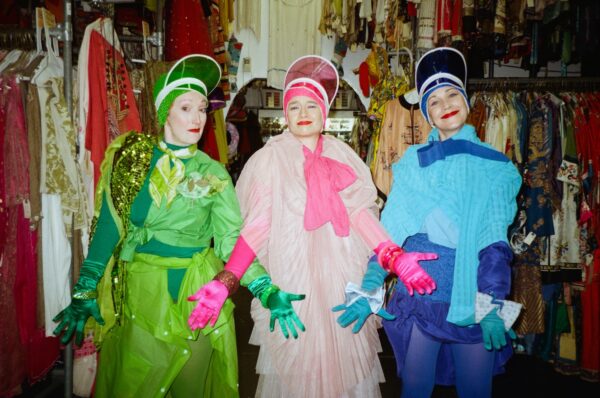
Megan: That’s right. This is a highly developed trio. This didn’t happen by accident, and it’s not a flash in the pan. We have been researching each other and the movement of our individual characters as Pink, Green, and Blue, and our array of feelings. This show is the biggest stretch on the feelings front. And spoiler alert, we’re doing solos for the first time to explore our individual identities as sisters. Even though we feel very connected and aligned on most fronts, we are very different, like real siblings.
Ann: Do the Sisters have a name beyond their color?
Megan: I think in the show, we do refer to each other as Pink, Blue, and Green. But in our lives we have found that a Seaweed name cannot be chosen, it must be given, often by a young person. Blue was named Zaggy by Pink’s niece early on. We — Green and Pink — are still awaiting our kindred names, and we’ll see where that comes from.
Ann: If it doesn’t divulge, something that you might want to save to reveal in the show, can you tell me about The Seaweed Sisters’ personas?
Megan: As Megan, I am the youngest and only girl with three older brothers, and that gave me a strong personality with leadership qualities. As Pink, I am often just pretending to know where we’re going or what to do, totally uninformed. Deep down, I am insecure but I put on a strong front. I’m also a bit sassy, same as Megan.
Ann: What’s Green’s profile?
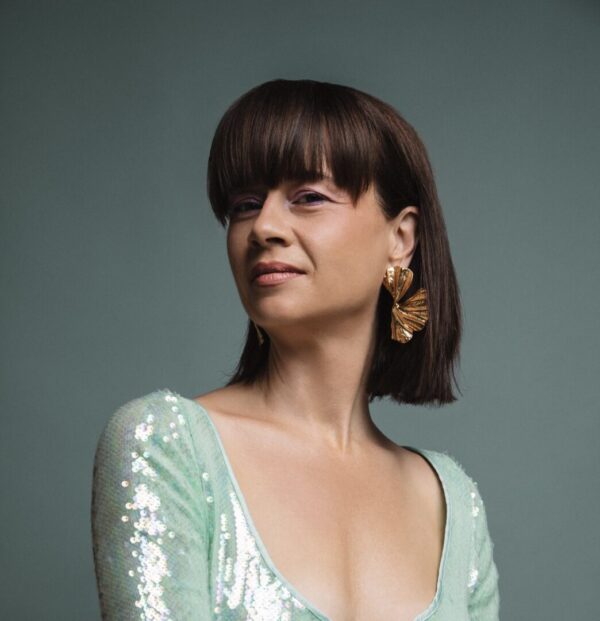
Jillian: This is a fun fact. We each have multiple siblings. In real life, I am the oldest of three. Megan is the youngest, and Dana is a middle child. Our birth order shows up kind of inversely to Megan. In my family, I am the oldest. I have two younger siblings, and very, very bossy in real life, or was as a kid. Conversely as Green, I’m a little bit more hesitant, a little nervous, but I really want to try. I really want to be friends, but I get a little shy about it, even though I think I know the answer.
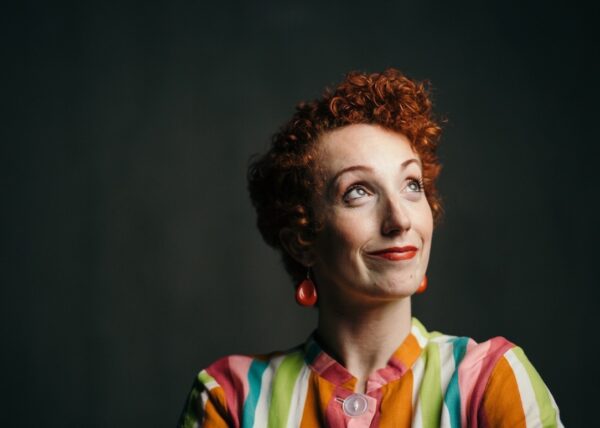
Dana: But then there are moments as Green, where there’s a little tiny burst of confidence, but I think she wants to follow, but also, there’s a real purity to Green. There’s real heart. And I actually think Green is the smart one.
Ann: …and Dana, you’re Blue.
Dana: I am the dumb one, who is happy to be here, no matter where we are. I don’t have a ton of ideas about what to do next, but whatever you say, sounds great. I’m a bit of a showgirl, definitely a diva. I like to flirt, I love to win, but I’m not very smart. Ironically, I think Pink pretends to know what to do, Green actually knows what to do, and Blue doesn’t mind or care, because it’s going to be a blast either way…as long as I win. As a middle child, I will bridge the gap between my older and younger siblings, and I think something that Blue does a lot too. There’s a part of Blue always saying: “Look at me! Look at me. I’m right here, remember?” WEED OH NO! is an excursion, a field trip, a playdate with the three of us. The camaraderie between us mirrors something familiar that audiences can step into.
Ann: Is there anything you would like to talk about that I haven’t asked?
Dana: We are a living, breathing example of how funny and fruitful it can be to make work with your friends. I think it is contagious. When at our best, our energy is contagious, and we spark the spirit of play that satisfies parents and children, non-parents and non-children alike. Our work speaks to all ages, even though it was not initially designed to be that way. That outcome was accidental and hugely satisfying, and we’ve achieved it by satisfying our own whimsies.
Megan: I don’t think any of us would have imagined, at this point in our career, continuing to feel such personal satisfaction from this project. There is unwavering joy and synchronicity that we continue to discover as friends, creators, and artists. And as a trio, we get to decide what the work is without outside constraints. We have always made what we want to see more of and fortunately, more and more others do too.
Seaweed Sisters — WEED OH NO! at the Los Angeles Theater Center, 514 S. Spring St., Downtown LA; Fri., June 5, 8 pm, Sat., June 6 & 13, 2 & 8 pm, Sun., June 7 & 14, noon & 5 pm, $38.50-$60.50, $38.50-$110 Fri., June 5. Seaweed Sisters — WEED OH NO!