


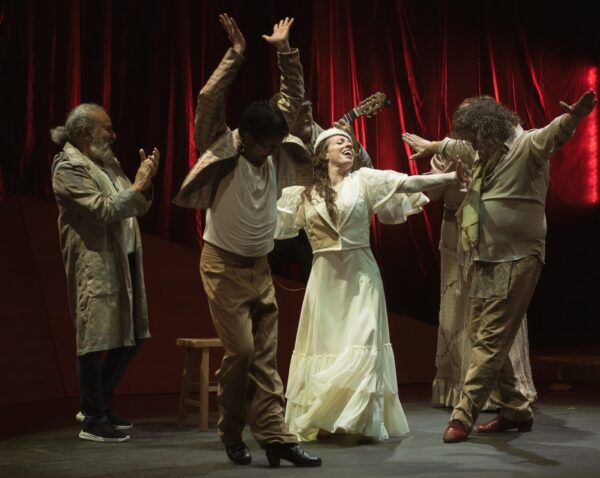
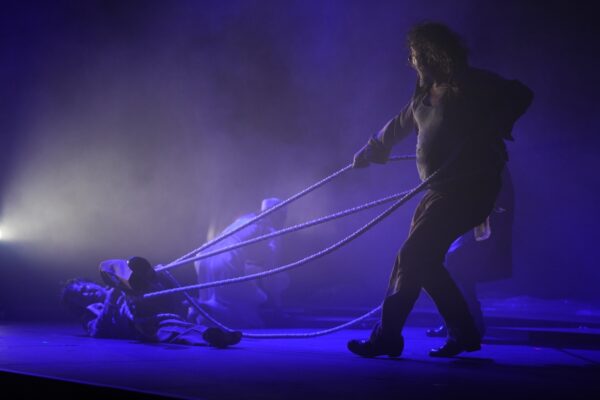
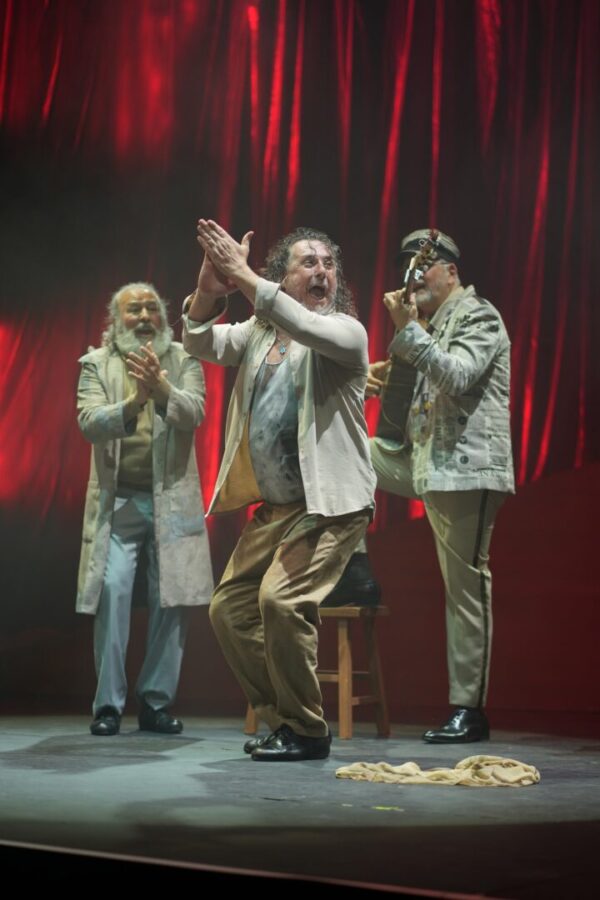
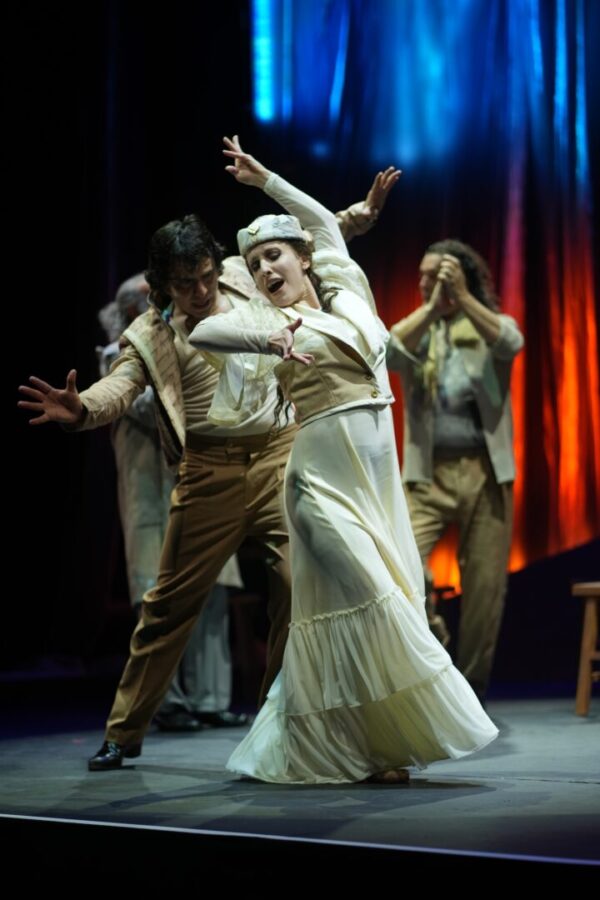
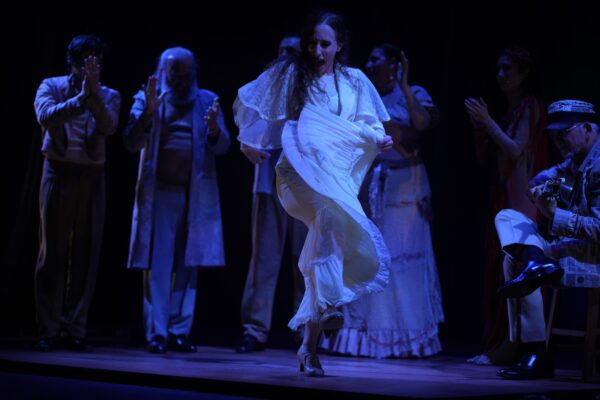
Voyages gone wrong have been story touch points from the novel Robinson Crusoe to the tv sitcom Gillgan’s Island to to the blockbuster film Titani. It now fuels dance in Songs from a Sinking Ship at the Irvine Barclay Theatre for one performance on March 13. The San Francisco-based Flamenco Arts International (FAI) casts flamenco dancers, singers, and musicians as the crew and passengers grappling with the existential realities aboard a doomed ship. FAI’s introduction of a storyline and theatrical elements of projections, video, and lighting effects into the highly improvisational art of flamenco is adventurous and already getting positive attention. A workshop production of Songs From a Sinking Ship garnered two Isadora Duncan award nominations, San Francisco’s equivalent of New York’s Bessie awards.
FAI’s founders, Marina Elana and Isabel del Día, bring two decades of flamenco experience to the table. They met performing with Soledad Barrio and Noche Flamenca. Marina also toured with Alfonso Losa and Pastora Galván while Isabel also danced with Alejandro Granados and Carmen Ledesma. With that deep background and the connections they formed, they recruited the legendary El Torombo from Spain and Carlos Menchaca to dance in Songs and share choreography credit with Elana.
Recently the two founders spoke by phone with dance writer Ann Haskins about the upcoming production and their efforts to bolster flamenco’s presence and legacy. The interview has been edited for clarity and length.
Ann: Where did the idea for Songs From a Sinking Ship come from?
Marina: I worked on a dance film and became connected to this brilliant young filmmaker, Yvonne Zang. That led to conversations about working on a dance film and we started brainstorming concepts. One time, we had been talking about the sea, and she came back to us with this idea called Songs From a Sinking Ship where the crew members of the ship were flamenco artists. It started as simply as that. At first, the idea sounded way out there but after a couple of weeks it grew on me, and then the next time we talked, Yvonne was the one who said she saw it as a live production, not a film. At first, I thought that would never work, but I dreamt on it, and realized it was brilliant. I could see the flamenco artists could be the crew members of the ship, that the audience members walking into the theater could become the passengers, and that the artists who are crew members could treat them as such. We fell in love with the idea. As we thought about it, we talked a lot about how we felt the world is going today. We don’t shy away from whatever analogy you want from the title Songs From a Sinking Ship, but for us, it felt timely and it also felt very flamenco. Yvonne was in the first conversations, and then we brought on an amazing flamenco director named José Maldonado, who then helped us take it from the concept to a live performance.
Ann: There are credits for three choreographers, Carlos Menchaca, El Torombo, and you, Marina. How did that work?
Marina: We are the three professional dancers, yet everyone, the singers and the musicians, also dance. There is choreography, and also within the structure and through line of the story, there is also a lot of improvisation. There are certain things, like the duet, that are more choreographed or more structured, but there’s a lot of open space for the individuals and the groups to improvise. There’s a duet in the show that was choreographed by Carlos Menchaca and a point where the three professional dancers work together that was choreographed by El Torombo. The choreographed elements shift. In my moment, I choreographed the material. For Carlos Menchaca, he does the same.
Isabel: The whole process has been really collaborative. We were brainstorming with Jose Maldonado and also with our musical director, Eugenio Iglesias, who helped us conceptualize the structure from a musical perspective. He composed all original music and worked with the musicians to create the right dynamics for every moment of the show. I feel like every single person not only brought their own artistry to their character, they contributed ideas that became a part of the show. So it really is a collaboration of all the artists on stage as well.
Ann: You mentioned that some may read politics into the show. Flamenco’s history seems ever entwined with politics.
Isabel: I think all art is political, even if it tries not to be. Art is really a reflection of us as people, and our lives are impacted by politics, whether we’re opening our eyes to that or not. Flamenco is an art form that was born from marginalized communities, and there are a lot of different cultural influences. The Roma, who faced a lot of discrimination in Spain throughout history, have been a driving force in the creation and the preservation of flamenco. I think both of us also really wanted something that could have different ways for it to resonate, through the music, the dance, the visual, or the story arc. All of these elements can hook you into this voyage that we take and this idea that we’re all in this boat that’s sinking, and what are we going to do? How are we going to address this kind of existential crisis? And I think that can be interpreted in so many different ways. It can be interpreted in a political way. It can be interpreted on a personal level. It’s just really interesting to think about what happens when things are going awry. How do people respond to that? What are the feelings that we feel? Do we work together? There’s a lot of really interesting questions that come up with that kind of premise. So yes, it is political, and it’s also anything you want it to be, once you enter that story.
Ann: The program lists characters for each of the eight cast members. There is a mechanic, a pilot, a siren, a pirate, which suggest a plot, or some sort of a storyline.
Isabel: There is a story arc. We don’t want to give away any spoilers, but there is a journey that we go on. We know that the ship is going to sink, and we watch how the different crew members react to what’s happening.
What makes this unique and where we’re seeing the company’s artistic vision come to life, is this idea of taking very traditional flamenco, very traditional flamenco artists who are celebrated in the flamenco world, and at the same time, presenting immersive theater elements you don’t usually see, characters in a narrative or story arc, a theatrical set, and video projections. This kind of immersive theater that we’re incorporating into flamenco, is something unexpected and out of the ordinary. Another element is the audience who are not just audience members, they are passengers on the ship with us. Flamenco audiences are used to being a part of the kind of energy that comes together during a performance. People will yell ‘ole!’ and those things, but here there’s a bit more of a dialogue and interaction between the artists on stage and the passengers in the ship with us.
Ann: How did each of you get into flamenco? Of all the dance forms in the world, what drew you into flamenco?
Marina: I started in ballet at three years old, my parents took me and I loved dance from the very beginning. When I was around, I want to say around 12, my parents took me to see a flamenco performance here in San Francisco. I fell in love from the first moment I saw it. At the time, San Francisco had a thriving flamenco scene. My first teacher, Adela Clara, had founded Theater Flamenco in San Francisco in 1966. When I went to Stanford University, I could study abroad. I went to Seville and focused on taking as many dance classes as I could. I also studied abroad in Madrid. I am still very much in love with it, obsessed with it.
Ann: Is there a California style of flamenco or any particular element that when you went to Spain, they said, ‘You’re not from Spain.’
Marina: Well, I don’t know about a California style, but I have flaming red hair that I’ve refused to dye, ever. It was pretty noticeable when I went to Seville, which is like a small town, and there was this little redhead girl in all the flamenco classes. So, people could tell I was not from Seville.
Isabel: Now there are blonde Spaniards, Spaniards with a mix of different hair colors, but I remember there was a period of time where if you didn’t have brown or black hair, you really stood out.
Ann: What about you Isabel?
Isabelle: I had seen flamenco as a kid, but in college I took an elective and, same thing, I just fell in love. It was such an expressive art form, and an art form where I felt people were really encouraged to be themselves and to express a full range of who they are. I had studied ballet and other dance forms when I was younger. There was an ideal, a kind of perfection that ballet dancers were aiming towards, and with flamenco, it just felt different. It was okay to be messy. It was okay to be angry. It was empowering, really empowering, to be able to be yourself, however you are feeling that day, and to have that come out in a really honest way in your dancing. So I think that’s what drew me in.
Ann: What led you to establish Flamenco Arts International in San Francisco.
Isabel: Marina and I met as young dancers touring with Soledad Barrio and Noche Flamenca. Those years were an incredible learning experience, and a bonding experience too, because we were on tour together and traveling. We became really, really close friends who always dreamed of doing something of our own. And one day, I just called Marina up, and said “what are we waiting for?” We had to just kind of dive in the pool, and we did?
Ann: I read that one motivation was concern for the lack of support for flamenco dance.
Isabelle: So we really wanted to do something in San Francisco. Marina was born and raised there. She really wanted to start to put some roots back into her hometown. There are really incredible artists in San Francisco and the Bay Area. There used to be a lot more flamenco artists, dancers, and musicians in the Bay Area. Because it became so difficult to afford to live there, a lot of those artists have had to leave, and opportunities started dwindling. It was really important to help rekindle that flame and to create more opportunities for the flamenco community in the Bay Area, despite the financial pressures. It is a scary time for the arts in the U.S. with how funding has been cut, but we feel the arts are really important. Now is the time to try to do what we can to fight for the arts, and for this specific art form, flamenco, that we both love so much and we believe in so much. So it seems like a dangerous time, but also a really important time to start something now.
Ann: I understand that after the Barclay performance, the show next is at the Presidio Theater in San Francisco.
Marina: The Presidio Theater took a chance on us, believed in us. We had a relationship with the theater previously, and approached them with the idea and wanting to premiere it at their theater. We were working toward that Presidio premiere in May when the opportunity to do this performance at the Barclay came up. I performed at the Barclay a couple of times before with another dance company. I knew what an incredible theater it is and what an opportunity. The Barclay has the full production, but for these reasons, the official world premiere is still at the Presidio in May.
Flamenco Arts International — Songs from a Sinking Ship at the Irvine Barclay Theatre, UC Irvine, 4242 Campus Dr., Irvine; Fri., March 13, 8 pm, $34-$140. Flamenco Arts International.