


Huguette Caland, whose artworks across several media range from cartoonish to sexy to serious, and Mavis Pusey, whose abstract paintings and prints often evoked city living, are the subjects of two major exhibitions at the Hammer Museum in Los Angeles.
Both artists were strong women who didn’t receive the recognition they deserved during their lifetimes, Hammer Museum Director Zoe Ryan said at a press preview of the shows.
Caland was born in 1931 to a wealthy family in Lebanon, where her father served as president from 1943 to 1952. She studied art at American University in Beirut, married and had three children, and then embarked on a career as an artist. She moved to Paris in 1970 and later to Los Angeles in 1987, and spent her final years back in Lebanon. Her work spanned several areas, including painting, printmaking, and fashion design.
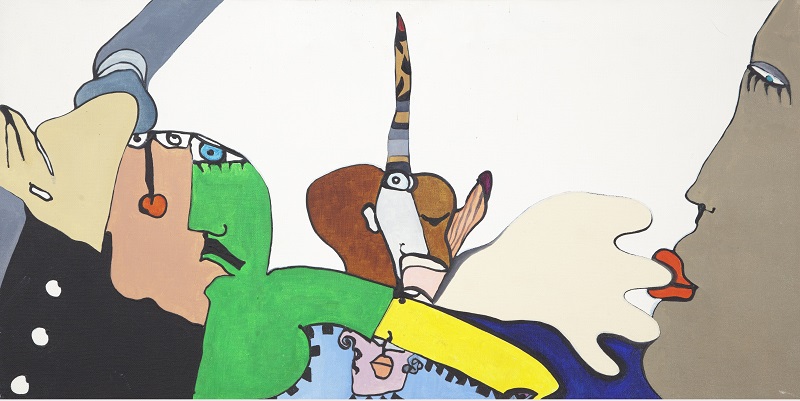
The playful and weird side of Caland’s work is apparent in Enleve ton doigt of 1971 (top image and above). An amused creature with a pointy head sits in the center, surrounded by several other heads, tan and green to the left, brown to the right. The brown head sucks on one finger of a large, four-fingered white hand. What it all means is anyone’s guess, though the English translation of the title is roughly “remove your finger.”
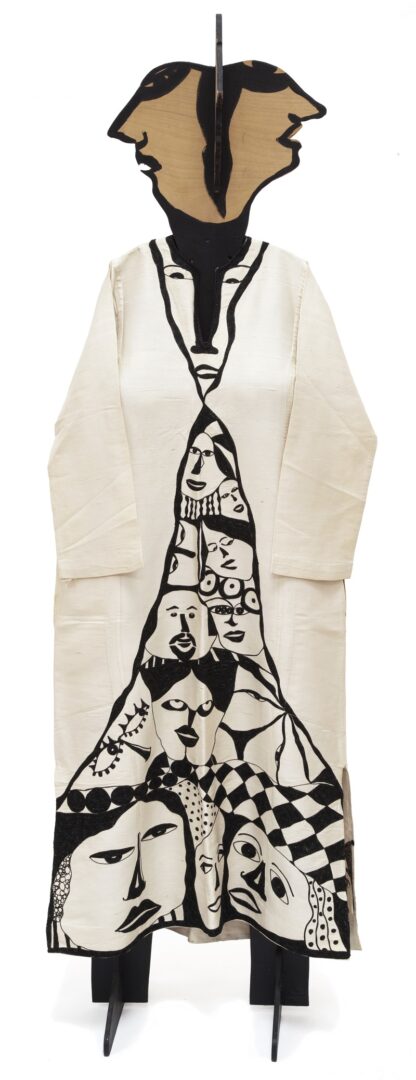
Caland’s fashion experience in Paris, which included working with Pierre Cardin, is represented by a group of caftans that the artist designed and decorated. One example, Foule (Dress #2) of 1970, features paintings of mostly women’s heads crowded one on top of another. Another caftan displays a painting of a naked woman with cartoonish breasts and pubic hair.
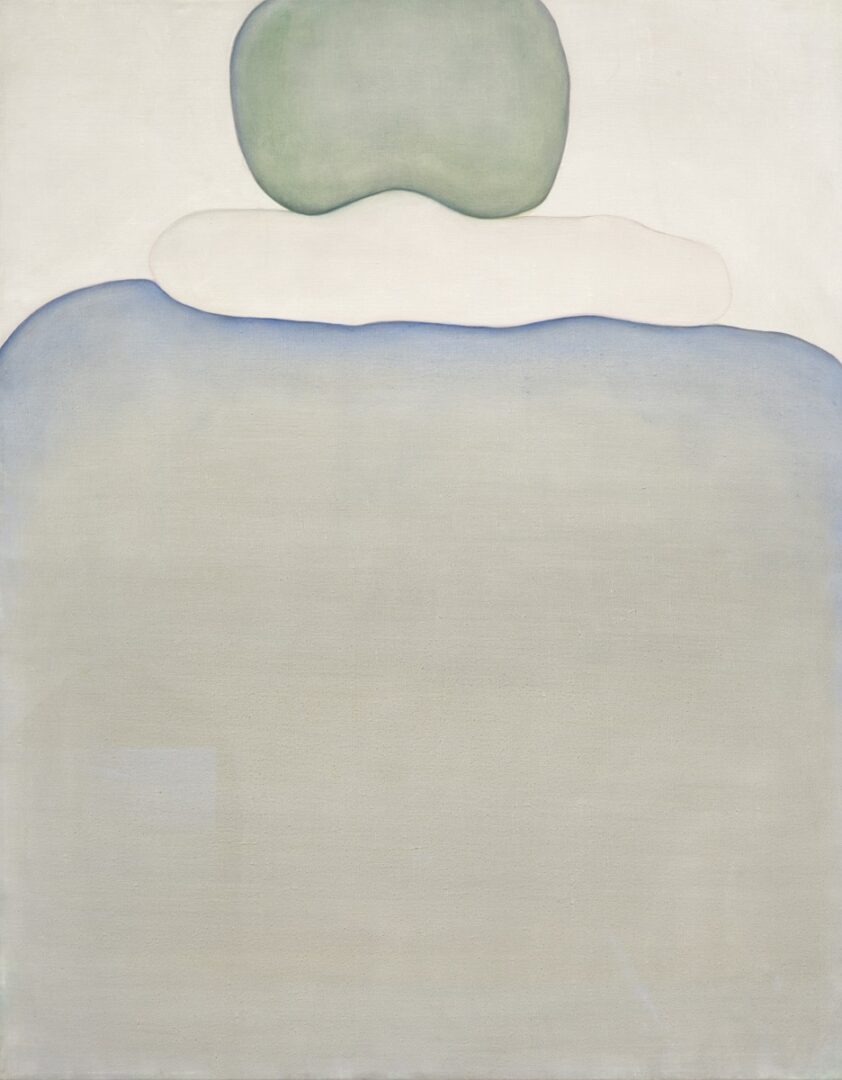
Many of Caland’s most powerful works are abstract or near-abstract, such as Self-Portrait (Bribes de corps) of 1973. In this work the bottom two-thirds of the canvas is filled with a bluish blob defined by a squiggly dark blue line at the top. Sitting above the blue section is an almost invisible off-white section shaped like a curvy hot dog. And on top of that is a greenish blob that seems to hover over the rest of the image. To call this a self-portrait is a stretch, or a joke, but there’s no doubt that it carries a strong visual power.
Caland pursues this strategy in many of her works in the 1970s. Sometimes two blobs fill the canvas, one on top of another or side by side, snuggling with each other. In other paintings they evoke body parts (a pair of lips, a woman’s bottom). The paintings are carefully crafted, with colors that smoothly transition from dark to light or from one tint to another. For me, these are Caland’s most powerful works.
Mavis Pusey was born in Jamaica in 1928 and moved at age 18 to New York, where she worked in the garment industry. She began to study at the Art Students League and took up painting, adopting an abstract style. After four years, when her visa expired, she moved to London and continued to paint.
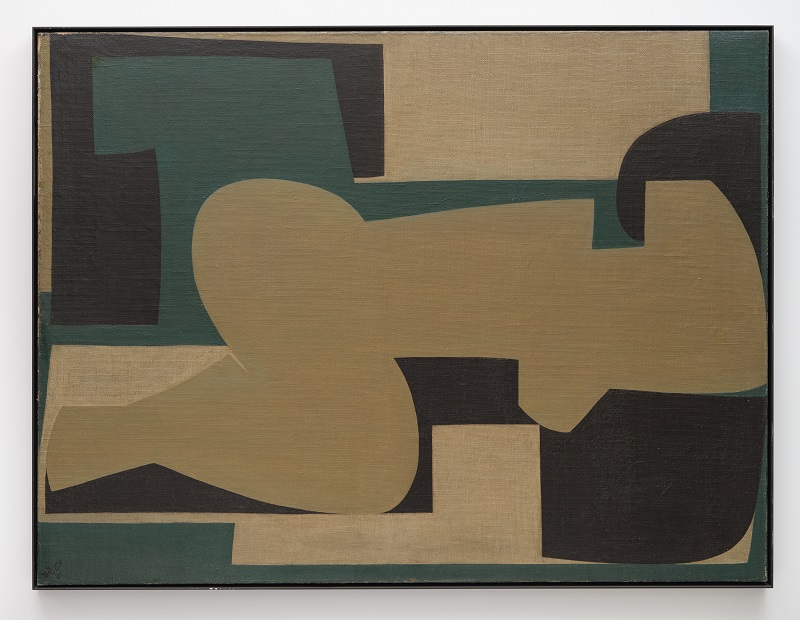
Following a year in Paris in 1968, she returned to New York for almost two decades. She then moved to Virginia, where she taught at a private school, and died in 2019.One of Pusey’s earlier works, Recumbancy of 1963, presents her abstract style while still suggesting the idea of a person lying down. The colors are limited to tans, browns, blacks, and a muted blue, all in simple geometric shapes. It’s a modest work but clearly suggests where her future artworks would go.
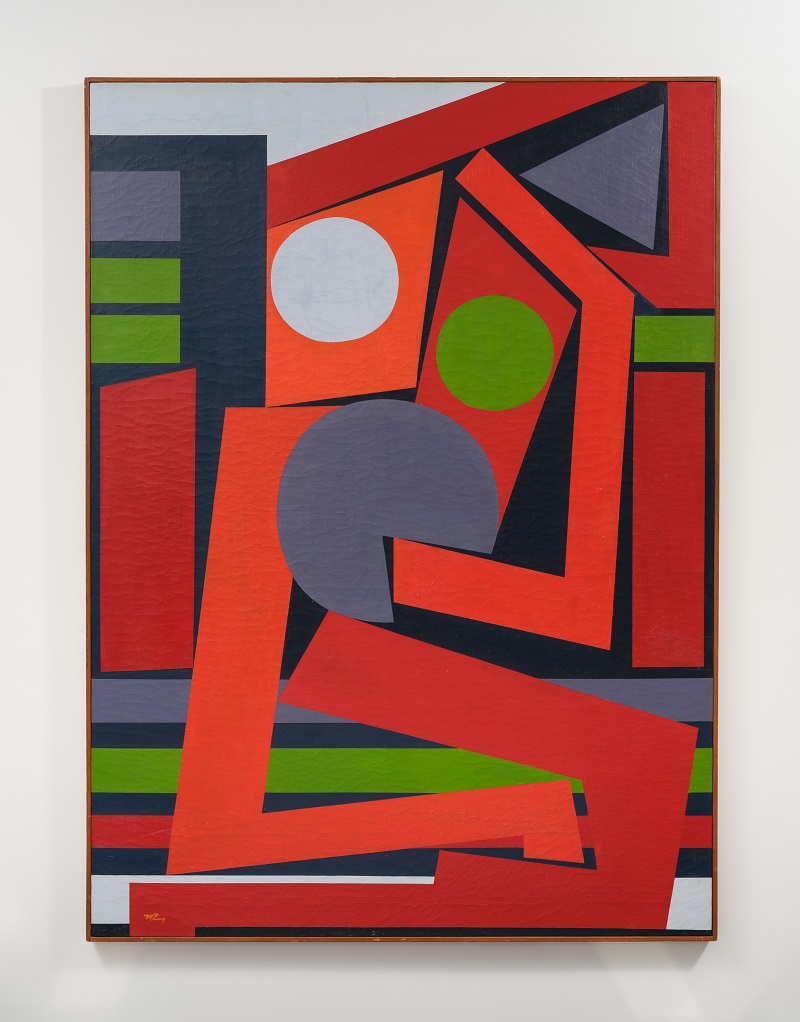
A somewhat later painting, the undated Personante, uses brighter colors on a larger canvas (more than 6 by 4 feet). It’s also completely abstract, though perhaps it suggests a face (two large round eyes and an even larger round mouth) above orange arms bent at the elbow. In any case, it shows how Pusey was developing a more energetic style.
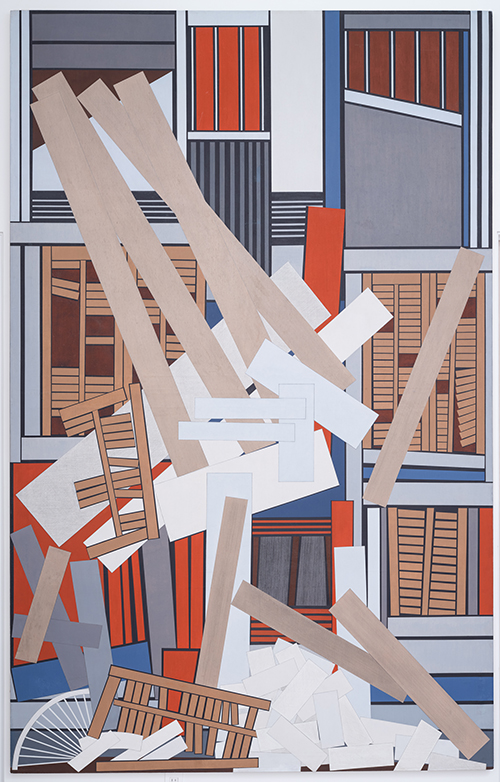
One of the largest of Pusey’s paintings in the show, the 6-by-9-foot Within Manhattan of 1977, is also the most representational. In the background is a dilapidated wall of windows, several with broken shutters. Overlaid on them is a pile of lumber and, in the lower left corner, part of a spoked bicycle wheel. The chaotic scene clearly suggests the decline of Manhattan neighborhoods in the economically challenged 1970s.
Huguette Caland: A Life in a Few Lines and Mavis Pusey: Mobile Images run through February 28, 2027, at the Hammer Museum, 10899 Wilshire Boulevard, Los Angeles. The museum is closed Mondays. Major catalogs are available for both exhibitions. Huguette Caland: A Life in a Few Lines is published by the Hammer Museum and DelMonico Books. Mavis Pusey: Mobile Images is published by the Studio Museum in Harlem and the Institute of Contemporary Art at the University of Pennsylvania.