


Two sprawling exhibitions featuring the work of Mexican and Mexican American photographers have just opened at the J. Paul Getty Museum in Los Angeles. Together they present a broad sampling of styles and subjects across much of the past century.
The first show, titled Instante/revelación: Moments in Mexican Photography, includes some prominent names, such as Manuel Avarez Bravo and his wife, Lola Alvarez Bravo, whose work is often more arty and abstract than straight documentary photography. The second exhibition, Every Minute Is History: Five Views of Los Angeles, ranges from scenes of political protests to highly personal portraits, often nudes.
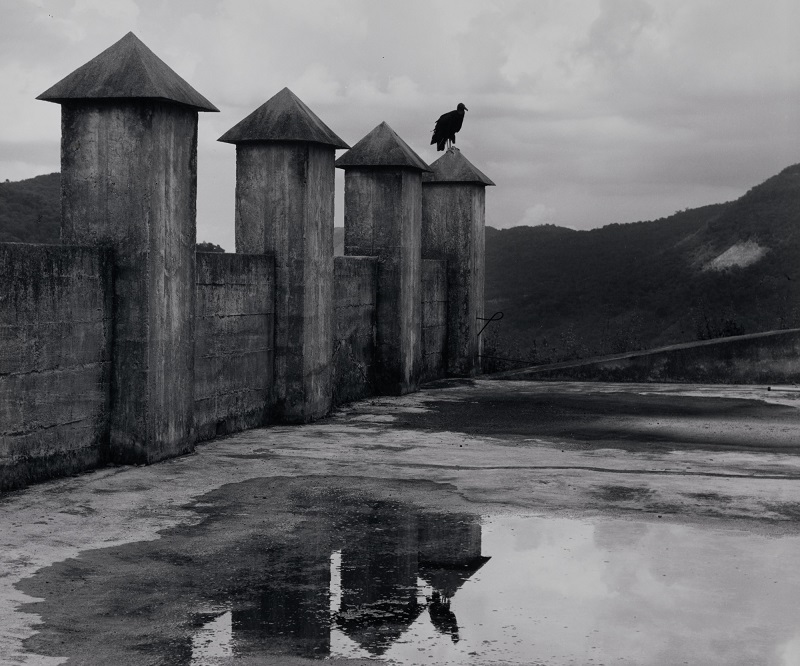
In the Moments show, Flor Garduno’s eerie landscape La espera/The Waiting Time of 1980 (top image and above) depicts an almost medieval-looking wall punctuated by a series of short towers, much of it reflected by water on the ground. On the farthest tower sits a large black bird surveying the scene and perhaps looking for dinner. Below a cloudy sky and mountainous landscape, it’s a mysterious and powerful image.
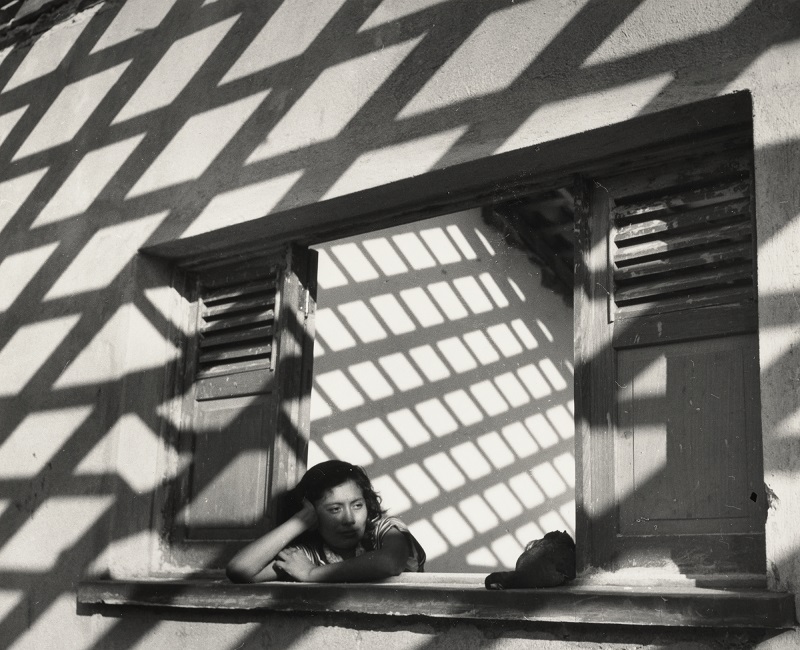
Lola Alvarez Bravo’s 1950 En su propia carcel/In Her Own Prison sets a small portrait of a young woman inside a complicated diagonal grid of light and shadows, with a second, contrasting grid behind her. While she appears to be resting her arms on the window ledge of her apartment, she also seems to be trapped in a giant cage. Why doesn’t she go outside and take a walk? Who is she waiting for?
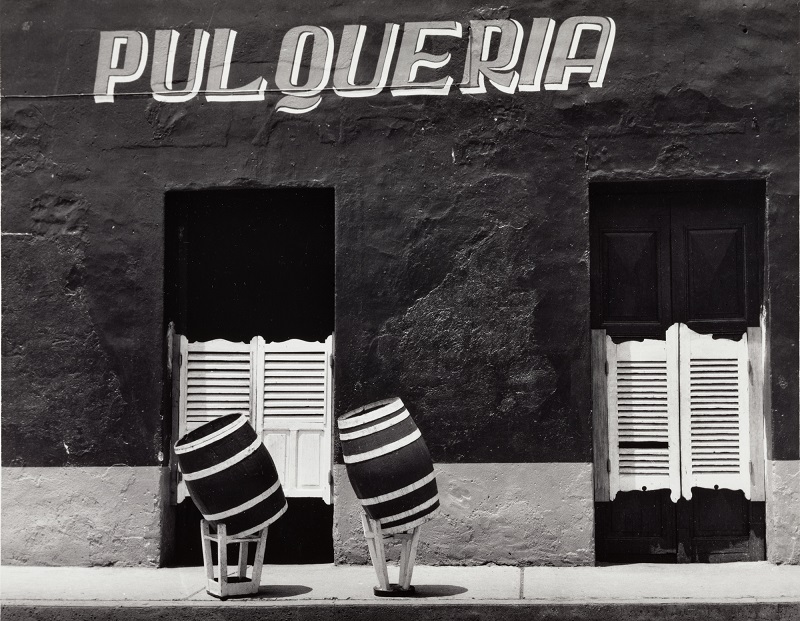
Manuel Carrillo’s nicely balanced 1970 study of the front entrance to a pulque bar in Toluca, near Mexico City, shares a certain ambiguous tone with many other photographs in the show. Shot head-on, Pulqueria, Toluca/Pulque Bar, Toluca balances two swinging barroom doors, the large Pulqueria sign above, and two wooden barrels sitting precariously on two small stools out front. Once again, there are no humans in the picture, just a suggestion that they may be somewhere nearby, probably inside drinking their pulque.
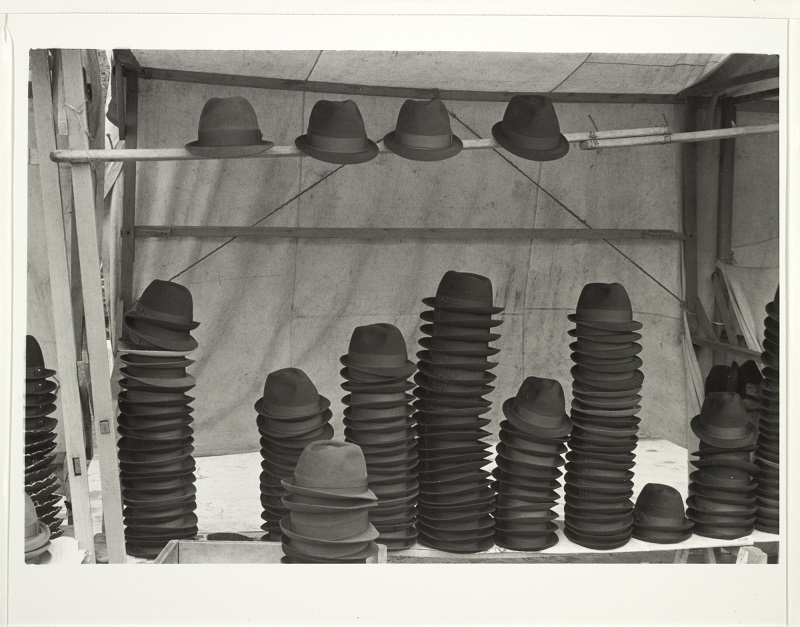
Like other images in this exhibition, Manuel Alvarez Bravo’s Sombreros/Hats of 1984 finds visual order amid the chaos of city life. In this case, he focuses on a horizontal store window containing vertical stacks of almost identical black fedoras with narrow brims. There’s a bit of humor in the slightly uneven stacks, some tilting to the left, others to the right, as if they’re in a conversation with each other.
The second exhibition, Every Minute Is History, is more of a mixed bag, with images ranging from striking farm workers to obese nudes to masked partygoers celebrating the Day of the Dead.
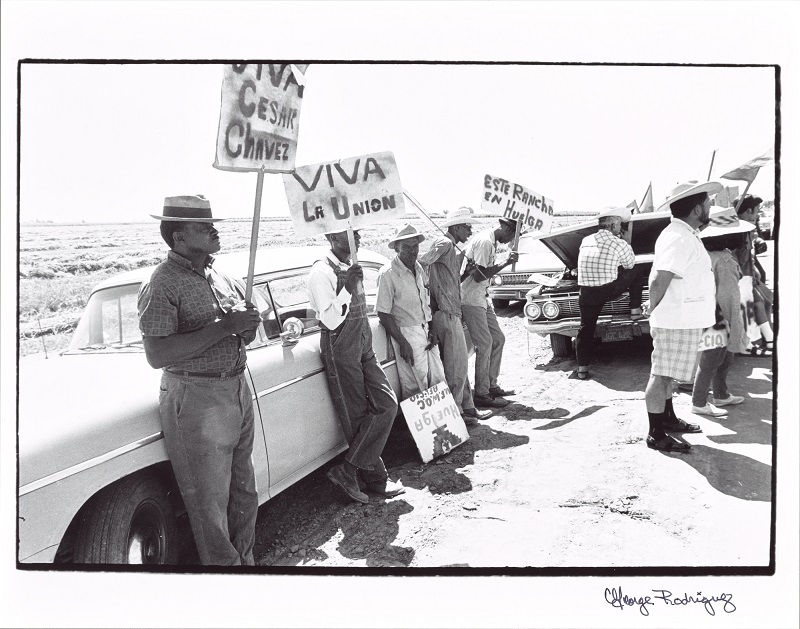
George Rodriguez’s Delano of 1969, for example, is classic “straight” photography. Members of the United Farm Workers hold signs (“Viva La Union,” one says) as they lean against a car and look tired or bored. It’s an excellent image for a newspaper article but not necessarily a work of fine art.
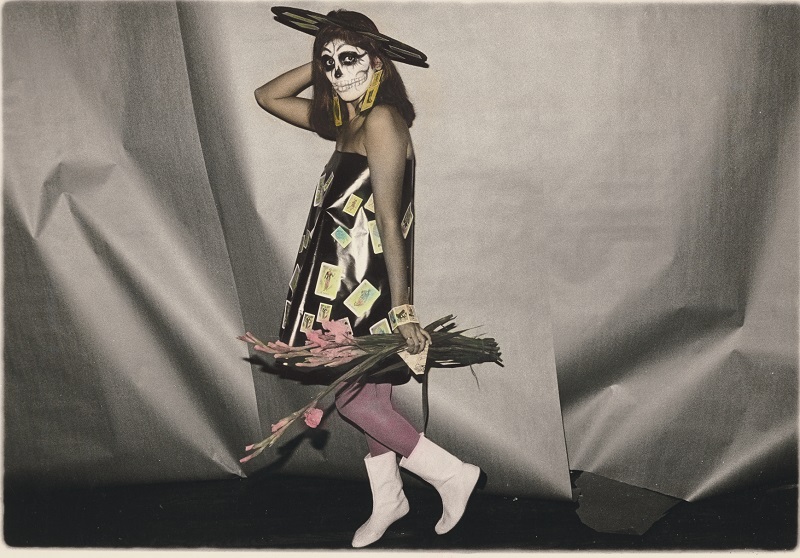
On the other hand, Ricardo Valverde’s 1983 Loteria de Muertos is a knockout. A young woman wearing a party dress, wide-brimmed hat, and white boots — along with a very creepy Day of the Dead mask — poses in front of a photographer’s paper backdrop. She gestures like a fashion model, adding to the mix of humor and weirdness.
The two exhibitions run through January 3, 2027, at the J. Paul Getty Museum, 1200 Getty Center Drive, Los Angeles. All of the works in Moments in Mexican Photography were donated to the Getty by longtime collectors Daniel Greenberg and Susan Steinhauser.