


I used to tell myself that I was the scariest thing in the street at night. To inspire ease and confidence as I navigated the grit of the city. But in Echo Park there was always humbling evidence of the potential chaos that danced from block to block. The startling blast of glass smashed against something too near, the constant echo of large dogs leaning into their rope leashes with thunderous shotgun barks that split the nerves, the howl of a pack of feral coyotes parading the blvd for prey. If you kept your eyes and ears wide…and homie…you should do that…. you might survive the East Side tonight. Because you never know what kind of heart you’re going to meet. But for 2 dharma bums in their mid-20’s Weed and youth was our watchtower.
In the early 2000s there was a quiet but grimy sophisticated buzz of Creativity, community and closeted hipster tinged rumbling blooming in small pockets on the East Side of Hollywood. Not quite Hollywood, Not quite East LA. This particular strip of Echo Park Ave, where the barrio slide up into the affluent hills around Elysian Park there lived a circus of artists, models, DJs, designers, misfits and me. A young ghetto philosopher stained with a vision. Just trying to keep my cardigan clean while I danced.
Justin McNulty, aka Kutmah, often stayed with Kimmy, a talented artist who had many of her designs stolen by Urban Outfitters (tomatoes, tomatoes. I heard that was something the kids say these days to throw shade), community icon and friend of his whose apartment hummed directly above Hancholo‘s jewelry shop. Poised on a quaint strip of bodega breathed mum and pop shops, thrift shops and cafés at a junction where Echo Park Ave split to create Morton Ave veering right. Where an old Norman Rockwell worthy gas station sat in the split as a notable monument. A marker to let your homie know that if they passed the gas station they went too far.
We would hang out in her apartment when she was away doing artsy stuff, and we often would run out of rolling papers while playing Halo and listening to records. If you can stomach the thought. These were necessary for our own spiritual evolution! To keep the nonstop stream of epiphany flowing as we listened to music and chatted about art and women. Often with the same sentiment but different adverbs.
Kutmah and I used to walk to the liquor store near Echo Park Ave and Sunset Blvd. To a special space across from what was once a Pioneer Chicken and what is now a Lassens’s grocery store. Wedged between the Echo barber shop and the current Halloway gastropub, there was a magical portal of funk and festivities. A monument to the old neighborhood when a fool was a foo! You know what I mean? Apparently, it’s since been swallowed whole by the hipster hypocrisy that has yet to reach the barbershop 50ft away. Stand strong, foo!
The walk to the liquor store was about 10 minutes but seemed to take 30 most nights because of all of the characters we would run into on the way. Everybody we knew lived there, or rather, we knew everyone who lived there. Catching up with Tokes who lived across the street. Running into Chris Haycock well before he started to do over with Jaime Strong. We might run into Mear one who lived in the area preparing for a night of wheat pasting. This night, we made it to the liquor store in record time; it was about 9:30 p.m. on a Friday, and our THC levels were dangerously low. But it’s possible we were the only ones who couldn’t afford some dope-ass concert happening at The Echo venue on Sunset, so the streets were fairly empty. We strolled up to the liquor store like locals. Because we were locals.
Liquor stores like this they don’t make anymore. The store sat at the feet of a small dark patch of parking lot which felt like it was once a front yard of dead grass, shredded tires and rusty workout equipment turned into someone’s hood dream.
Pulling the handle of the single glass door, you were greeted with the light tinging of a tiny bell and a sharp “what’s up, fo’!” from the cashier, which may seem confusing, but that’s not a question you answer with words when vibes will do. I don’t remember his name, but he was always cool.
The subtle seductive scent of the Fabuloso hissed from the floor. While tones of vomit kissed urine, seasoned spit, and sugar peppered the tacky black and whitish floor. All excellence churning the wild air married with the sweet choke of dying churros rotating in the machine near the register. The rhythmic sound of the machine squealing poetically as it slowly paraded its product always reminded me of a mental patient dancing in circles. Oblivious, disturbing, but sweet. Aisles upon aisles of tiny overpriced bags of powdered laundry detergent, expired Capri Suns, canned tuna, plastic toys turned yellow by time, and tiny fingers picking them up and putting them down thousands of times throughout the years. Dusty posters of breasty Latin women in tight-cut-off jean shorts, wearing tighter Chivas soccer jerseys, holding a bottle of Chivas Regal, leaning on a lowrider. The checkered floor worn by the frequent steps of this nation of a neighborhood. Dragging a groove in the floor. Falling directly toward their refrigerator of choice. These sensations and smells made the Musk of Echo Park and this spot a neighborhood jewel.
The cooler display glass was always clean, even though it was often cracked. Through it, you could see an array of malt liquors and full-on etcetera. Saint Ides, Mickey‘s, Old English, Steel Reserve, Wild Irish Rose, MD20/20. All marched up to the front like a police lineup. With solemn, low brows unbothered by the idea of more jail time. The kind of libations that soothe a working man’s soul. Rocking him away from the traumatic day deep into the impoverished nights like a sleepy baby in a cold sweat.
On this night, Kutmah and I weren’t looking for beer. I was never a drinker. Neither was he. All we needed was one packet of rolling papers, bleach white, the one without the wire. I don’t know who thought that was a good idea. We knew they were up front behind the counter, but we couldn’t resist exploring the aisle for inspiration amongst the discarded lotto tickets. Inspiration mostly in the form of exotic Mexican candies and trinkets. Well, exotic to me.
Before we left, I made sure to grab us two tall cans of Arizona mango “juice drink”. We both enjoyed the nauseatingly sweet kiss of corn syrup after smoking a weak joint. This was 2004. There were no dispensaries we knew of, and the weed was 10% THC at most.
We made our purchases and walked out the front door. As I searched my plastic bag for the papers to separate them from the cans of mango delight dripping with condensation in order to avoid ruining the rolling papers, I heard Kutmah yell out, “Otis!”
Yo, what’s up, Otis? He said in a playful and respectful tone.
I raised my head and adjusted my high and heavy eyes in the darkness to meet a humble figure leaning on a dark car dressed as if a pimp and a gemstone convention had a grown-ass man baby.
Eight of the fingers on his 2 hands were populated with various stones and crystals. Quartz, coppers, selenite, onyx, tourmaline, turquoise, moldivite (what can I say, I’m a Pisces, I know my crystals). The rings caught my attention first, and then the large rimmed sunglasses. Sunglasses he rocked fearlessly at 9:45pm sitting on top of an immaculate beard and haircut machine groomed with precision! Held together by a vintage floral print butterfly collar shirt and a dark vintage leather jacket. All crowned by a VERY large amber amulet that swayed around his neck the size of a toddler’s fist.
“Yo, what’s up?” Kutmah said.
“This is the Homie Marcus, aka, hiphop chocolates.”
Kutmah introduced me.
Otis took his fist out of his jacket pocket slowly, as if he was giving up on hiding something to give me a pound. He then nodded his head humbly while touching his heart in one gentle movement.
His vibe was immaculate, calm, immaculate calm! Confident and in no hurry to escape this moment, but pensive in a way I recognize in myself. A pensive that says I’m only here temporarily. But so are you, so feel me feeling you and then let’s get back to that lovely silence we all came from. In retrospect, he was definitely high.
“What’s up with you tonight?” Kutmah said?
“Oh, not much, just gonna go see about this dime up the street, roll up, listen to some records, vibe, you know…”
“We are on that same shit,” Kutmah said.
“Except for the dime piece.” I injected. Nobody laughed.
Except me.
“Have a good night, y’all,” he said.
“Pleasure to meet you,” I said.
And with that, we parted ways. Otis jumped into his car, which felt like a crushed black velvet spaceship back then compared to my sickly but feisty Ford Fiesta. We headed up the block with a pep in our step and zigzags in our hearts.
Halfway back, Kutmah turned to me and said, “You know Madlib’s music, right?”
I did indeed.
Wait…Mablib is Otis??
My head cracked a little.
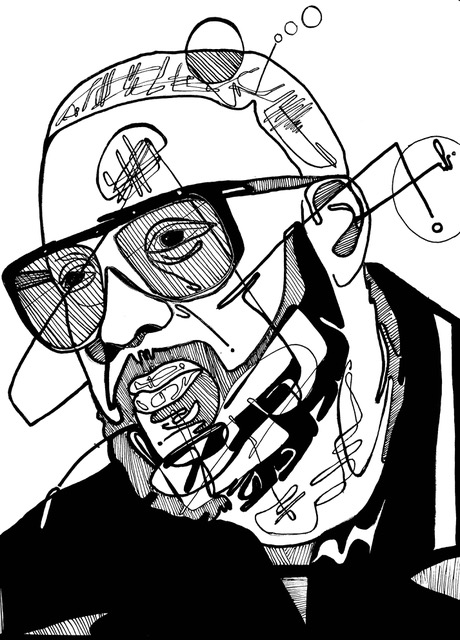
I had seen Otis many times at Kutmah’s sketchbook. A night of instrumental hip-hop that ran for years in Hollywood and later further east at the little temple (currently The Virgil) off Melrose and Virgil. It was a place where artists came from around the city to listen to instrumental beats mixed dam near every genre of music you can imagine and draw in the sketchbooks placed on the bar. It was where I was, you could say, a regular. Of all the places in Los Angeles where talent was incubating, Sketchbook was a unique space. Genius could be found holding up shadows in corner booths, rolling up dingy joints, and nodding their head hypnotically to the sacred sounds bouncing through the darkness.
Madlib was just one of the frequent flyers at Sketchbook. But he was one of the most accomplished, compelling, consistent, and respected in hip-hop culture and at the club. (Until Prince showed up randomly. But that’s another story.) Often times, there would be a group of artists and MCs outside behind the street-level billboard, crowded around Ras Gs boom box, smoking and playing various beat tapes from those producers that would frequent the little temple on Wednesday nights. It was church, a holy space, inside and out.
When I had met Otis that night, I didn’t know he was Madlib. But I had seen him before at sketchbook. Often times with said dime pieces in tow. After feeling into him during that interaction, his music made more sense.
Its quiet, solemn, almost shy, pressured demeanor telegraphed a sparkling symphonic clamoring that must populate his sonic imagination. Something you hear in his work. Something he seemed to keep sacred behind his amber amulet yet has shared with millions through his music. A heart of gold and grit is what you hear.
I had heard of this urban legend pacing rooms filled with stacks of vinyl in a smoke-zoned trance, searching for a release from the pensive language of his soul. Compelled and adept at chopping the appropriate sound into epiphany extracted from the past, manipulated and hammered into the present for ears to meet in the future. Pure alchemy. Birthed from bellows of smoke, the magic of these compositions became a brief sonic landscape pieced together by an intuition no one has ever given texture to before.
He’s a man who spent many decades in the lab learning himself and his sound. Only recently has he received a fraction of the accolades he truly deserves as one of hip-hop’s most prolific, innovative, and talented producers ever! I’ve met him many times since. Even gifted him one of my chocolate MPCs. I’m forever grateful for the evening I connected the man to the music. Madlib is truly one of hip-hop’s mystics.
Madlib: The Shaman of Sampling
In the realm of sample-based production, few artists demonstrate the principles of sonic servitor creation with the depth and intuitive mastery of Otis Jackson Jr., better known as Madlib. Operating at the intersection of scholarly musical knowledge and intuitive flow state creation, Madlib exemplifies what happens when sampling transcends technique to become a genuine magical practice—a method for manipulating reality through sound.
The Medicine Show Approach
Madlib’s Quasimoto project samples everything from 1950s jazz to 1970s educational records to contemporary conversations, creating what he calls “past-future music.” This approach mirrors magical practices that work with “time loops” and “temporal folding” to access possibilities outside linear time. Madlib’s approach to production differs fundamentally from more calculation-oriented producers. Rather than intellectualizing his process, he works from a place of intuitive connection to the material, allowing the samples to speak through him. As he explained in a 2014 interview with NPR: “I do it for myself, really. I don’t think about an audience or what people are going to think about it beforehand.”
This creator-focused approach parallels magical practices that prioritize the practitioner’s relationship with the material over expected outcomes—what chaos magicians call “results-free working.” By creating primarily to satisfy his own standards and relationship to the sounds, Madlib creates a purity of intent that ironically makes his work more universally affecting.
His prolific output—hundreds of releases under various aliases including Quasimoto, Yesterday’s New Quintet, and DJ Rels—isn’t driven by commercial ambition but by a compulsion to channel and transform the sounds that speak to him.
Where most producers might approach sampling methodically, Madlib describes a process closer to possession or channeling.
In his Red Bull Music Academy lecture, he explained: “I don’t have a process. I’ve never had a process. I just… I just do it. I don’t do, ‘Oh, I’m gonna make this kind of beat today.’”