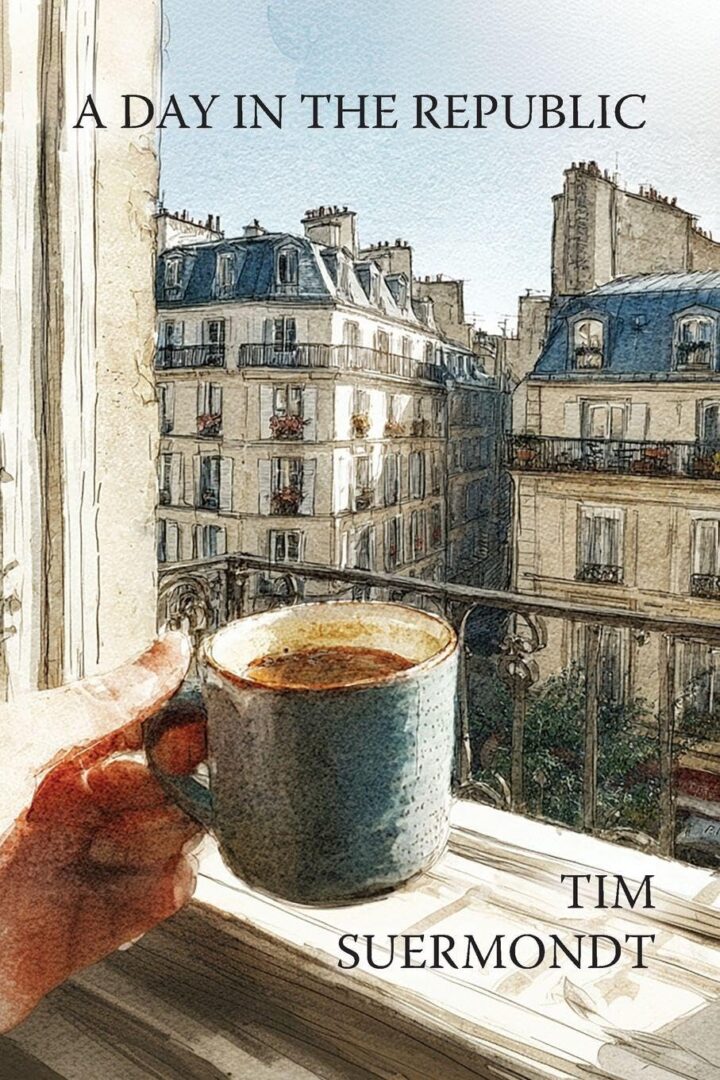
Tim Suermondt, in A Day in the Republic (Dos Madres Press), gives us a collection of short poems—none longer than a page—that create little worlds, little slices of the poet’s life in Boston. In four well-curated sections, Suermondt writes of the world around him in such specificity that the reader recognizes the poet’s world in the one we all inhabit. In the book’s first poem, “Who,” the poet begins:
I was convinced it was an omen,
seeing the owl on a plank
in the apartment complex—
wisdom, wisdom.
The owl becomes a herald not just in this poem, but of this collection, of our deep need, as a species, to make sense of this increasingly befuddling world. So, to keep the reader from spinning out on what wisdom our omen owl brings, Suermondt brings us back to this specific little world he built in the first stanza: an apartment building, in a city where a diner stands within walking distance:
Making my way to the diner
for an evening soup and sandwich
I thought of how this wisdom
might manifest itself—
could it possibly be strong enough
to save me, save the world?
That’s asking a lot from wisdom,
but I trusted my instincts,
now that I was on the verge
of a sharp increase in intellectual heft.
I said to the moon Be nice,
great things are coming—wisdom, wisdom.
The poet, taking the owl not as an omen but as a messenger, then entreats that other great archetype, the moon, giver of light in darkness, to take it easy on us mere mortals. After all, “great things are coming.”
The first section of this collection presents poems that illustrate moments in the poet’s life that cement us to place while showing the reader how an image, a sound, a smell or taste—no matter how seemingly insignificant—can trigger an opening of memory and thought. It is this collection of observations that begins to stitch together a wholeness that finds that with contemplation comes an awareness of wonder and such great joy.
In the poem, “We All Move On, Somehow,” a visit to the local hardware store results in knowledge that the owner, after 25 years, is closing. Just don’t have enough to go on, the owner states. As the poet buys two identical sets of wrenches, he exits the store thinking “I am set for life,/ ready to repair anything the world keeps breaking.” Suermondt lets the store’s owner say, “Just don’t have enough to go on,” which is everything the poem needs to say. A younger poet might wax rhapsodically on the injustices of scratching out a living in late-stage capitalism. Suermondt has no need. It’s all in there. And it’s all in one line. The poet, walking away, is just eager to fix broken things.
The final poem in this section, “The Agenda,” may well be one of the finest love poems I’ve read in a long time. I think it’s because it’s not a love poem in the strictest sense. It’s a poem that begins by talking about enjoying a hot dog on the walk home. But as he comes to the end of the snack, he states:
…My wife having arrived ahead of me
will be simmering a healthier fare.
I pick up my steps when I see myself
falling into her arms and the last
bite of the hot dog feels exquisite.
If I were any happier they’d have
to arrest me—they know where I live.
If the first section of the book is setting place and giving us a sense of who the poet is (in a section beginning with a poem entitled Who), the second section engages the external world. In the section’s first poem, “To My Buddhist Friends,” Suermondt explains:
I insist on having baggage
so I can’t be one of you,
and some things you’ve accepted
I won’t.
I admire quiet, but I don’t love it.
I need some bustle, the bustle of a city,
even if it’s
merely a pizzeria by a busy bus station.
But I know you haven’t given up on me
so let me be charitable
and wind down with a koan of my own:
Why is this
beautiful day not enough
while a tiny white spider crawls
the kitchen wall?
Okay, dear friends, it’s enough.
One might suggest that Suermondt, with his answering koan, may well be much farther along the path of enlightenment than he lets on. After all, delighting in being present in the day is enough. At least it should be enough. We should all let it be enough.
This section also engages with memory; remembering the last book of a cherished author who recently passed, remembering fishing with his father in one poem, caring for the same father at the end of his life in another, sharing a broken umbrella in a downpour with an unhoused man. These singular memories, when woven together as Suermondt does in this book, illuminate the beauty of the complete human experience.
The third section shows the world to the reader through more of a philosophical lens, allowing Suermondt to stretch his legs a bit as a poet of the mind. The fourth and final section engages the world directly, responding more to contemporary events than in the previous sections, but, again, in such a way that is thoughtful, not performative. Suermondt does not shy away from dark subjects, but he still manages, amazingly, to pull out some light to leave with us. Even in this collection’s final poem, “The World Will Surely End,” despite the title, there is a sense of adventure and excitement, a sense that there can be joy in seeing what is next.
What is striking in this collection is the precision of Suermondt’s language that, while his lexicon is not overly complex, achieves an almost zen simplicity. There is no wasted effort in these poems; no decorative language, minimal use of descriptors, precise articles added only when necessary. This collection is a master class in Browning’s “less is more” aesthetic. But despite Suermondt’s engineered simplicity, these poems still dance and bounce and sing. And while this is not what anyone would mistake for light reading, it is not difficult, either. Each poem brings the reader to the next, building, bit by bit, the poet’s world for us to slip into, to delight in, and one in which we, the readers, still find the things that keep us in the world: beauty, wonder, and joy.