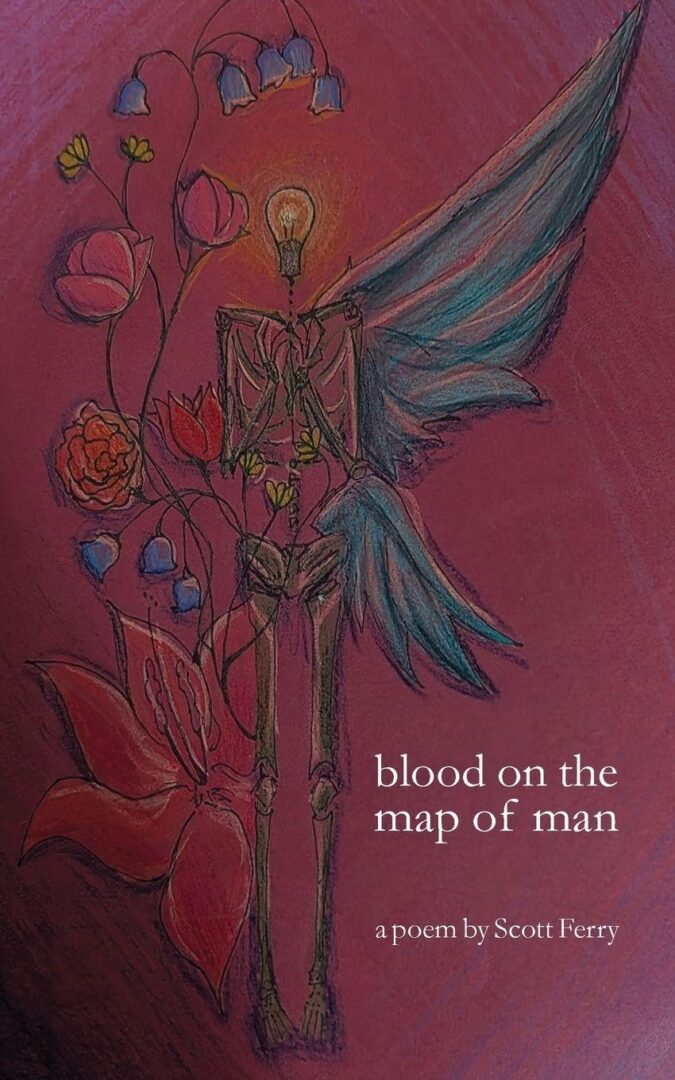
blood on the map of man, the latest collection from Scott Ferry, is meticulously paced (and sequenced). Additionally, Ferry possesses an engaging voice and a knack for constructing and/or documenting cogent imagery. The resulting poems are both contained and Dionysian, brimming with palpable tensions that would make the Greek playwrights smile in their graves.
“sometimes the kitchen cleans itself,” Ferry writes in his opening piece, adding, “even god’s nametag is crisp.” Here is a contemporary revisioning of Eden – no longer an idealized locale, but an emo-cognitive state a la Milton, but moreover, a suburban state a la the existentialists. Paradise, if it exists, occurs within the quotidian rituals, routines, and mindsets that make up our day, rather than as a deliverance from them. Ferry concludes, however: “i don’t trust the sky to / hold.” The future’s uncertain, as The Doors famously proclaimed. That truncation following the word “to”, the word “hold” sitting by itself as the closing line, is strikingly effective.
Ferry continues to eloquently explore angst and its (temporary) abeyance. In “14,” he writes, “i have always been seeking something i have lost / a place of light without pain.” Suffering happens, as The Budda underscored with his First Noble Truth. And, more crucially, we want release from it. Hence, craving and aversion. Ferry completes his lush quatrain: “if I take apart each of my molecules / it is there—the burn and hum of god’s wet fabric.” Forget quarks and leptons, the irreducible fundament of the human makeup is divinity.
The poem continues with Ferry acknowledging the need for worldly involvement (and yet, his ambivalence regarding it): “i still have this mask and script.” But he also wants to “heal what can be healed” and “share it with [his] wife [his] children.” We each hope (consciously or unconsciously) to transcend the sense of self or identity that binds us, our egoic demands, our frequent blindness to the grace in our lives. What better gift to give the next generation than to remind them that contentment is not synonymous with complacency, gratitude is not a rut.
In the collection’s closing piece, “30,” Ferry crafts a portrait of his daughter, who “tries to inhale deeply and … coughs,” suffering with asthma and influenza. He then describes how his daughter “writes poems [that are] more like prayers / about the thoughts which strangle her.” He goes on to blend narrative and rich imagery, noting: “she is proud of her poems / her way of taking that which chokes her / and stretching the red bronchitis / into strips of song.” It’s fascinating (and encouraging) that Ferry conveys his Ars Poetica via his daughter: this is what poetry (and more broadly, art in general) largely strives for, the reconfiguration of discontent, the transformation of that which “chokes” into that which frees, “each line a way to dissolve / the cage.” Indeed, Ferry impressively accomplishes his own feats of aesthetic alchemy, though he generously makes his daughter the hero of the sequence.
Ferry knows that human existence is, in part, Sisyphean; he also knows that freedom and creativity transform our toils into epics, our preoccupations into koans. He builds his poems from tangible “roots,” “field trips,” and “whales dolphins parrots crows,” but also sings of the broader universe – those “elastic opening[s]” we might not see but that are all around and within us. He shares his pressing anxieties, his radiant hopes. They resemble our own.