


“Dada is a state of mind” (Tristan Tzara)
*
John Yamrus’s new memoirette, Captain Beefheart Never Licked My Decals Off, Baby, is a slim volume you can read in one or two sittings. The memoir sections circle around Yamrus’s discovery of Captain Beefheart’s music back in the days when Yamrus was a struggling poet dating his future wife, Kathy. These narrative threads give the book shape, while Yamrus’s digressions—on modern art, artists, creativity, the blues—and his late-night musings that came to him while lying awake—open it up into something larger.

While reading Yamrus’s book, I even played one of Captain Beefheart’s albums in the background—Trout Mask Replica—something I highly recommend, besides buying the book. To my ears, multi-instrumentalist and composer Captain Beefheart’s music recalls Frank Zappa’s vibe. I never listened to musician Captain Beefheart before picking up Yamrus’s book, but I was introduced to Zappa’s music years ago. My college boyfriend used to blast Zappa’s Weasels Rip My Flesh in the dorm. Over time, I became a huge fan of Frank Zappa. Similarly, Captain Beefheart’s music won me over, despite its essential weirdness—or maybe because of it.
John Yamrus is drawn to Captain Beefheart because he recognizes a kindred spirit—a fellow innovator. Ezra Pound once said there are two types of creative geniuses: the innovators, who overturn tradition and make something radically new, and the masters, who refine and perfect what already exists. Both are vital, but innovators are rare. Pioneers like the Captain—Creators with a capital C—are clearly of another breed. In John Yamrus’s opinion, we can learn a lot about creating art by studying Captain Beefheart’s example.
Captain Beefheart (born Don Van Vliet) is a painter turned musician who led the Magic Band through a string of albums in the late sixties and seventies. His most famous record, the controversial 1969 Trout Mask Replica (produced by his friend Frank Zappa), is one of the strangest, most influential rock albums ever made. Its twenty-eight tracks push the boundaries of what we include in the term music.
This is how Yamrus describes Beefheart’s Magic Band: “If there are intelligences in space…these guys have to have come down from another planet.” He compares the album Trout Mask Replica to a “great black hole” that “chews things up and spits them out again, with them now looking, feeling and acting totally different.”
Captain Beefheart’s music baffled critics and alienated record executives. The Captain never sacrificed his vision attempting to appeal to the masses. This refusal to compromise is exactly what Yamrus admires—and what makes the Captain a patron saint for artists who refuse to sell out.
John Yamrus himself seems to belong in that innovator camp. He’s the author of one of my favorite poems, “endure.” The title is the whole poem:
endure
endure
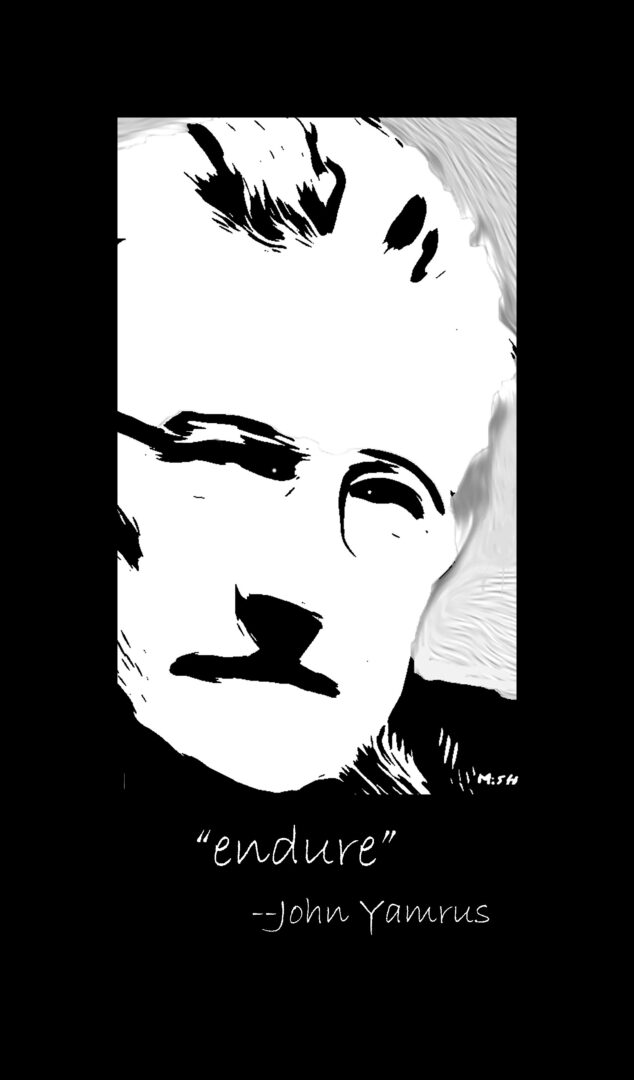
Of course, not every editor was impressed, as Yamrus explains in another poem:
when
i
sent the magazine
a
poem
that was one word long
he said what the hell is this?
i
said
art.
In over five decades, John Yamrus has published thousands of poems and 44 books—29 of which are works of poetry. His work is acclaimed by literary critics, taught in college classes, internationally renowned, and frequently printed in translation.
His style is quirky, but highly relatable because it disdains pretentiousness and often revolves around everyday situations; for example, this John Yamrus poem comes to mind:
“stop opening things with your teeth,”
she
said.
“number one,
you’ll break a tooth.
number two,
well,
it’s just a
nasty, ugly habit.
and I don’t
like it,
so,
cut it out.”
she
was right.
she
always was.
. . .
Some have labeled Yamrus’s work “Outlaw” or “outsider” poetry because he admires post-Beat, anti-academic “outsider” writers like Charles Bukowski. Yamrus’s writing mixes minimalism with “folksy.” He doesn’t imitate anyone or follow any poetry trends. He does his own thing and does it well.
Mocked as an “upstart crow,” Shakespeare was an outsider, too.
The creative works of both Captain Beefheart and John Yamrus seem Dada to me. And, that’s a compliment. Dadaist Hugo Ball’s famous 1917 “sound poem’’ begins:
gadji beri bimba glandridi laula lonni cadori
gadjama gramma berida bimbala glandri galassassa laulitalomini
gadji beri bin blassa glassala laula lonni cadorsu sassala bim
Similarly, John Yamrus invites us to notice cut 7 (“Pachuco Cadaver”) and cut 24 (“Hobo Chang Ba”) of Beefheart’s Trout Mask Replica, commenting that they “exist for no real reason other than the sound of the words.” He continues, “If that doesn’t make you want to grab a rotting catfish, cut it in half and hold it up against your face, I don’t know what will….[I]t’s a weirdly serious silliness that makes you want to go deeper and learn more.”
Dada artists loved to remind us that life is absurd, so art should be absurd too. John Yamrus and Captain Beefheart remind us that absurdity isn’t just nonsense—it can be revelation.

Overall, Captain Beefheart Never Licked My Decals Off, Baby, may be a slim volume, but it delivers an entire treatise on the philosophy of creativity.
By the end, I realized Yamrus’s book isn’t really about Captain Beefheart—it’s about what it means to make uncompromising art. John Yamrus uses the Captain as a mirror for his own practice as a poet and writer, and in doing so, he offers readers a challenge: endure, stay strange, and stay true. Isn’t that what creativity is all about?
*