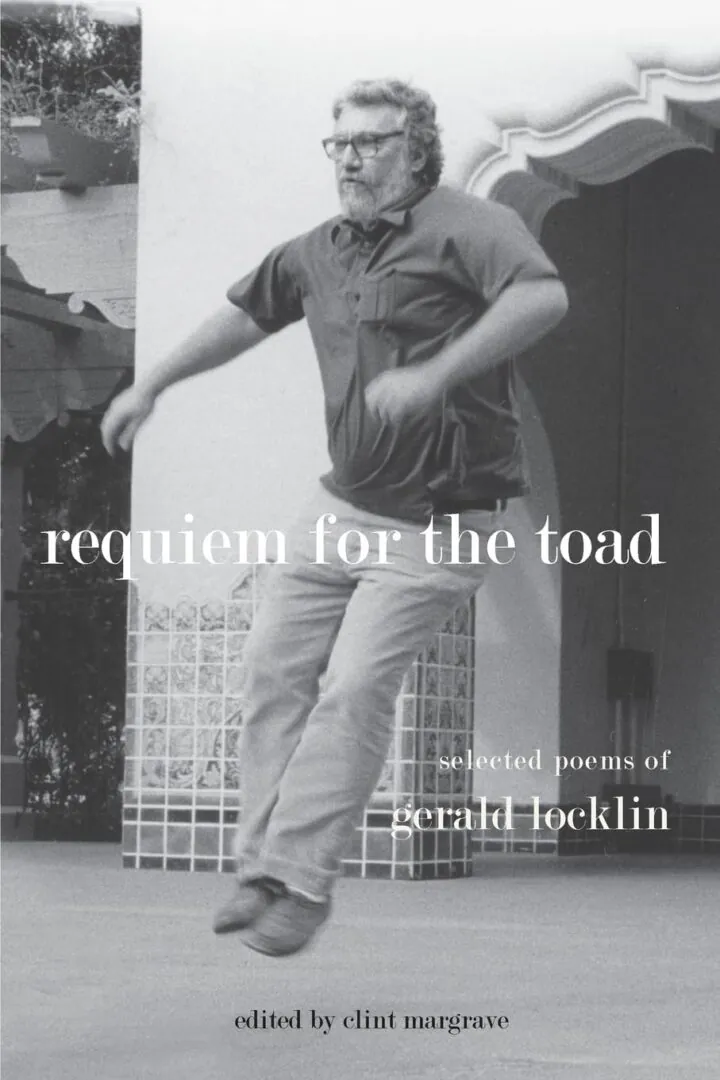
When the poet Gerald Locklin died in 2021 from COVID-19, American letters lost a singular voice and presence. Over six decades, with signature wit and restless contrarianism, Locklin published shelves of books and chapbooks of poetry and prose, thriving in a literary ecosystem of little magazines, fugitive publishers, and limited press runs. His body of work is large, hard to categorize, and hard to find. For the editor of a selected poems, Locklin left an editorial task bordering on the archeological.
Fortunately, editor Clint Margrave has diligently tracked down Locklin’s vast and dispersed corpus, and, in Requiem for the Toad, presented a generous selection that ranges from Locklin’s irreverent and edgy early poems to his lyrical, meditative, and still irreverent late work. Requiem delivers Locklin classics—“Beer,” “pedagogy,” “The Iceberg Theory”—alongside a varied selection that displays Locklin’s full thematic and formal range.
Gerald Locklin’s poetry took the measure of common experience in the music of common language. His poetic material came from everyday life at its most everyday. He wrote about lettuce, a to-do list, a colonoscopy. But everyday life for Locklin was also world literature, jazz, paintings, and he wrote, in the same direct language, of Paul Klee, Jean Paul Sartre, David Hockney. While one could call Locklin a populist, his poems make more than a populist claim that great works of art are (or should be) for all. His poems make an axiological statement, that great significance inheres in all experiences, high and low, deflated and elevated, in contemplation of abstract canvases and colonoscopies.
Poetry can convey this rich, layered significance in the language of everyday speech—or, as Locklin puts it in his poem toasting the poet Edward Field, “simple, unadorned, yet / musically, rhetorically, and / metaphysically organized language.” It’s a poetics of honesty and irreverence, allergic to pretense. The poem “Olfactory Poetics” distills his sensibility in five lines:
As soon as I get a whiff
of “poetry” in a poem
(not excluding my own),
I strongly suspect
It isn’t one.
Locklin’s poems are accessible and erudite, fun to read and funny, written with inventiveness and economy. His poems are so economical, in fact, that some do not have any words. Here, in full, is “Homage to John Cage”:
The blank space above is the poem in its entirety. Beat that, Aram Saroyan.
There were many types of Locklin poems, and many Locklins within them. There was Locklin in his self-effacing Toad persona and Locklin as a poet-professor of the barroom. However, throughout his work, as Requiem for the Toad attests, the poems of Locklin the father are among his strongest:
the freedom fighters
her mother ranks cleanliness
just a little higher than godliness,
so when my daughter realizes i’ve just caught her
wiping her hands on her jammies in the kitchen,
she winks conspiratorially,
and i wink back.
In six lines, the poem limns both a father-daughter relationship and marital dynamic with nuance and sweetness, its dramatic use of line and space creating comedic timing. That parental warmth remains throughout Locklin’s work even as the marriages turn to divorces:
my six-year-old
i take my daughter out to lunch.
she reads the wine list
and remembers fine points of oenology.
she enquires about the function
of the cork and soon has mastered
the fermentation process from the grape
to vinegar. she’s sensible in ordering
and takes an interest in cuisine.
in fact she’s about the only member of
the gentler (sic) sex whose conversation i enjoy.
for one thing she may be the only girl i know
possessed of a genuine intellectual curiosity.
and she escapes the tyranny of the obvious.
if we are dining at el matador, and i explain
the principle of corrida, she doesn’t
take the side of the goddam bull.
she doesn’t tell me i shouldn’t drink so much.
she doesn’t want to marry me.
she doesn’t regale me with anecdotes of the office,
memorabilia of the student cafeteria.
she asks about paris; she asks about rome.
she finds the world funny; she finds its words
wonderful. We love each other.
i think I’ll go see her right now.
The power of “my six-year-old” hinges not on its depiction of a father’s cloudless love for a daughter, but, paradoxically, on its willingness to voice ugly sentiments. Even the most generous Locklin reader would flag sexism here. Few writers would admit to such sentiments; fewer still would put them into a poem, let alone a poem of parental love. Locklin’s honesty demands it. “my six year old” is a full and blemished portrait, unflattering and unapologetic. If this risky approach costs Locklin readers, the honesty adds a vulnerable, discordant note to a poem that could easily tumble into the sentimental.
Requiem for the Toad is not the first Locklin selected. In 1998’s Go West, Young Toad, Mark Weber arranged selections of poetry and prose into an autobiographical anthology; in 2008, Paul Kareem Tayyar edited a career-spanning but slim New and Selected Poems. Other selected poems drew from briefer windows of time. Of all the selected poems, Requiem is the most comprehensive. And yet, if one can knock Requiem for the Toad for anything, it is for not being longer. Even at 250 pages, Requiem foregoes many poems (what happened to “happy hour”?), and cannot easily accommodate Locklin’s longer poems and sequences, such as 1978’s miniature Frisco Epic, 1998’s bleak Hospital Poems, or his excerpt-averse travel sequences.
Quibbles aside, Requiem for the Toad will stand as the definitive introduction to Locklin’s poetry. In it, new readers will find an unparalleled entrée; Locklin enthusiasts will find all the hits and new favorites. Hopefully, Requiem for the Toad will inspire a new generation of readers to sleuth out the chapbooks and little magazines from which Margrave culled his wonderful selections, and dig into the work of an American original.