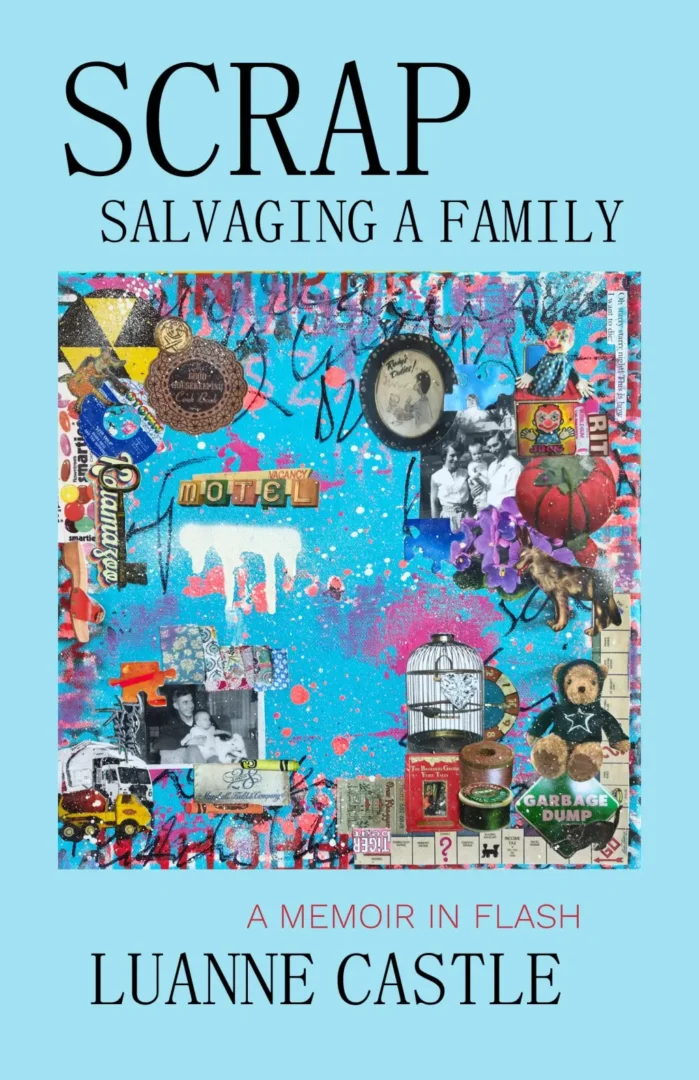
Scrap is one of the most versatile words in the English language; as a noun, a verb, and slang, its subtextual meanings all relate to the themes in Scrap: Salvaging A Family, Luanne Castle’s remarkably honest, bittersweet, and epiphanic memoir. A scrap can be something leftover, a piece or portion, bits of things, or a fragment. As a verb, scrap can mean to discard, throw away, cancel, or reject something. And when used as a slang word, it means an argument. All of these definitions describe the traumatic childhood, the difficult adolescence, and the journey of adulthood toward acceptance that Castle’s memoir renders. The subtitle of the book is “Salvaging a Family,” which aligns with what one does with scraps of things: we salvage scraps to make them whole, functional, and useful.
Part of Castle’s journey is becoming whole, understanding a troubled family and a very abusive father. To make sense of life with a dysfunctional parent, Castle scraps together evidential truths, family secrets, and finds redemption, acceptance and semblances—or shall we say scraps—of love and understanding. This tale is all told in flashes of vivid memories painted with poetic and poignant language.
The book is divided in three parts: Early years, Therapy, and Years Later. This threading of time creates a tapestry of a young girl’s life under a tutelage of unsettled secrets and abuse, which is remedied and rendered through the stories Castle gifts her readers. Whether being grounded, spanked, humiliated, or threatened, Castle writes of these instances with an underlying hope that through the abuse she will find acceptance and ways to love her very complex father who never knew his own father.
In the final flash vignettes, when as an adult, Castle connects with a grandchild of her father’s father—her half-cousin—she writes:
Calling her helps me find my footing in my new identity.
This new identity is the end product of a journey of searching for reasons to want to love a very broken man.
And then there is this that Castle writes toward the end of part one of the book, The Early Years:
I have never felt unloved. Hated, frightened, anxious, and claustrophobic, yes. But never unloved. I need to remember this every day.
These are the epiphanies that Castle reaches in writing this memoir, how one can come to terms with a very damaged relationship with one’s own parent, make closure on pain, and learn to accept love in all of its strange and compelling forms.
It took Luanne Castle almost two decades to write this book. Writing about trauma takes that long. There is the unspoken or loss of words concept behind trauma. Processing such abuse into literal words takes a toll on the human spirit, an action that can take years or a lifetime to recover from. For some it may never at all happen. Luckily, for Castle’s audience, she successfully writes about her childhood in a stunning and remarkable way, which makes the reader find hope that love can be found even in the darkest and most troubling places—and from her poem “Scrap,” which begins the book:
Love’s been stitched into me
by her threaded tongue
By the snips and wisp
the junk or trash, recyclable
material, remnants, fragments
Puzzle pieces awaiting home.
This remarkable book of one woman’s brave journey brings us to places of safety, acceptance, closure, and love. It brings us home.