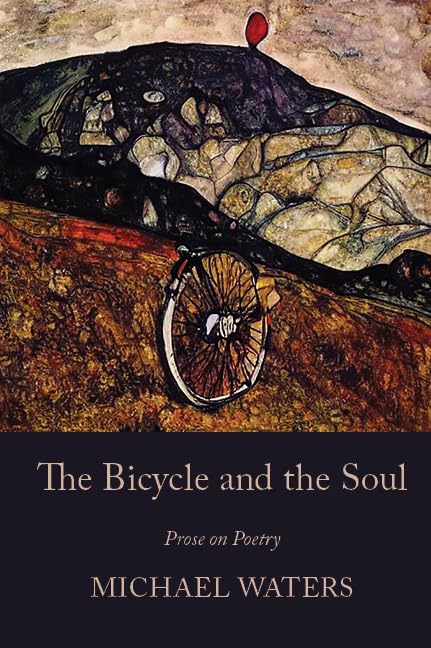
Michael Waters has been one of the most prolific and engaging poets of the Boomer generation and is widely admired as much for his technical mastery as for his forays into urban Americana and his dispatches from abroad. The Bicycle and the Soul, his first collection of “prose on poetry,” alternates between personal vignettes and hyper-focused readings of poems he wants us to know. It’s a brief romp at 95 pages, but its sidebars and obiter dicta are such that you sense wide-ranging sources of interest when it comes to poets and writing generally. We also get glimpses of a youth’s spots of time when the dotted outlines of the poet he would eventually become first emerge.
Readers will certainly come away with the impression that Waters can be partially viewed as a ’60s and ’70s New York-inflected culture dude, and he provides witty evidence for such a reading. On one occasion during summer vacation from high school, he mishears a line from the Dylan’s “Desolation Row” as “and every pound of T.S. Eliot/ fighting in the captain’s tower…” (an error he informs us is a species of mondegreen: look it up). Retreating to the 8th Street Bookshop, he discovers books by the still-living Pound and concludes, “He suddenly seemed…as vital a presence as The Beatles, as Dylan. ‘Ezra Pound,’ I mouthed to myself. Pop music was moving beyond me, and I had to be smarter to catch up.” Pop music would seem to provide minimal incubation for a poet, but in keeping up he began building a reputation as a poet who walks the line between rule-testing and linguistic discipline.
The title essay recounts his arriving late to confession as a teen in Queens when, having forgotten his bicycle lock, he explains to the Father why he is breathless, as he rattles off a list of convenient venial sins. The priest meets him by framing the dilemma: “And which concerns you more, your bicycle—or your soul?” We know the answer, as he bolts in time to save his ride from being snatched by random bad guys. Fittingly, the bike requires balance and alertness to terrain: it’s an intimate machine, both mighty and fragile like, say, a poem. As for the soul, you can always take that under advisement later. I note that Waters’ most recent collection is called Sinnerman. I note too that his forthcoming new and selected is called Pagan Sky.
He recounts meeting Allen Ginsberg and Peter Orlovsky when he was 16 and in the company of a young woman unfortunately named Linda Horr. After a reading at Town Hall, Waters goes up to meet the celebrated author of Howl, whereupon Ginsberg invites Waters and his consort up to his apartment for [drumroll here]—soup. He notes with tenderness that beneath the persona of the bearded Beat and counterculture hero there seemed to be a Jewish mother. Ginsberg writes down his phone number, which Waters adds to his wallet. “I’d told my parents about the invitation, so whenever I was late coming home from a track meet or the library or a movie, my father, a fireman, would start shouting at my mother, ‘I bet he’s going to see that Ginsberg guy!’ and my mother would start to cry.”
He also writes that his teenage desire to be a writer got a boost when he realized you could get paid, even as you went about improving your skill level. All you had to do was answer an ad in The Village Voice and be willing to take up hack work, in this instance cranking out formulaic, porno novels. He arranges a meeting with the editor of C.A.D. [sic] books, who, as you would suspect, doesn’t conceal his bemusement at the eager young naïf he is presented with (“I wasn’t sure what ‘blow’ meant.”). Flushed in his research, yet undaunted in pursuit of his new career, he sets to work searching for the right tumescent terms, offering such bound-to-be immortal bits of erotica as, “[She had] breasts like scoops of vanilla ice cream topped with maraschino cherries.” His mother finds one of his first attempts in this genre and furiously confronts him for his “filth,” adding the usual clincher: what would the neighbors think? Moments like these take amusement from the vaults of humiliation and nudge them forward into pointillist autobiography.
In another portrait embedded in the title essay, Robert Lowell comes to his rescue at a reading in England in the early ‘70s by introducing “Skunk Hour” as a confessional poem, after this student poet, an American youth no less, had intruded on the sensibilities of haughty dons by suggesting this might be a genre fit for any poet.
Later at graduate school in Iowa, we find him trying to meet the approval of conservative maestro Donald Justice, who, in his Zen-ish way, meted out praise to his students by the teaspoon for phrases and lines, seldom for whole poems. No one ever got the full monty. While Waters’ reports of his path wouldn’t qualify as stations of the cross, exactly, they are nevertheless spot-on, and we see what it takes to embark on a career.
He begins his readings with “In the Museum,” a 6-line poem from Isabella Gardener’s first collection (Birthdays from the Ocean, 1955) which presents newlyweds who confront the bones of a female mummy. After setting the scene, he gets down to business as a reliable and insightful docent. Notice how he zooms in: “The six lines of ‘In the Museum’ are written in rhyming fourteeners, their loose iambic heptameter crossed with trochaic and anapestic gestures toward rhythmic phrasings that empathize each line’s musical surface, what the poet John Logan called ‘a ballet for the ear.'” Got it.
In the technical precision of his readings, we come to understand that we are being taken to school by one who understands the deeper mission such tools enable. I was reminded of following an old painter I knew, Arthur Hall Smith, who led me through the great Vermeer exhibit at the National Gallery in 1995 and explained in detail how the artist confabulated his own paints to manage luminosity, working with ground bone ash, lapis lazuli, garlic juice, even urine to invent his pigments. You felt here was a kind of studied love that emerged from the technicalities. Such material intelligence also comes to the rescue of the making and layering of verse. He gives similar forensic treatment to poems by Frank Stanford, W. C. Williams, Gerald Stern, Bill Knott, Jean Valentine, Alicia Ostriker, and Diane Wakoski.
When writing about these poets, Waters prefers to go straight to scansion and other prosodic, examination tools, rather than abstracting themes. Thematic readings too often take precedence over a poem’s creation of experience. Sound comes first, and then words get their shape from ink trails, pencil lead, and laptop keyboards. They become malleable, symbolic vehicles to be reshaped as we go, creating a proper resonance.
While my own inclination has often been to approach poems through their thematic frameworks—their philosophical or emotional stakes, Waters reminds me that such interpretation only becomes valid when paired with X-ray vision into the innerds of old-fashioned craft. His readings of these poets return again and again to the shaping intelligence of the line, the modulation of tone, the architecture of both line and stanza. In other words, meaning and making start to become interchangeable. A poem is an object made under pressure: of line, cadence, image, and sonic control.
Nowadays we find ourselves in a prolonged historical moment when poems are frequently read as statements of identity, acts of witness, political interventions, and confessional disclosures. Nor are these things to be brushed aside hastily, and yet a poem’s force, to borrow Christopher Rick’s term, its authority, resides in the precise goings-on that account for its making in the first place.
The volume ends with an essay on his own poem, “Beloved,” written about his wife, the Romanian-American poet Mihaela Moscaliuc, and her love of books, as she made her way from post-Ceausescu Romania to the States. It’s a love poem, but Waters also puts on his jeweler’s loupe to examine his own procedure in crafting and in the process presents us with a discourse on the benefits of syllabic verse, which many readers, he alleges, don’t at first detect. For him, the form is not the net that turned Frost’s grassy field into a tennis court, so much as a power mechanism for moving the poem along, both horizontally, discovering the music in the line, and vertically, to the story it tells. Trusting what he calls “the sound of verse,” Waters asserts that “Such chiming effects help to keep the entire poem in the foreground, each word snug in its line, each equally important.” The sound, as well as the meaning of a word, leads eventually to another sound (and a word) with which it resonates. From here it’s phrase to phrase, finding newly emerging resonances on the go. He cites John Logan, Eric Pankey, and Theodore Roethke in the form’s defense because of its seemingly inconspicuous nature, but he hands off the best summary quote to Brad Leithauser: “As systems go, syllabic verse has little going for it, except for one puzzling thing: it works.”
I’m always eager to read a poet’s prose, to peek under the hood to see how the wires are connected. To be sure, the essays here are products of a poet’s left hand, not always reaching after the ideal of “a limited aesthetic whole,” in Iris Murdoch’s formulation, but offering something more immediate, less under the compression of ars poetica, but no less engaging in their own right. You come away with the impression of a poet who keeps among the artifacts of his memory images that clarify and expand how a career and the love evident in the pursuit of it, came about.
As the interweaving of anecdotes with readings suggests, Waters wishes to strike a balance between edgy curiosity and classical, even catholic, instincts, between staying in motion and staying focused. Fitzgerald famously remarked that “The test of a first-rate intelligence is the ability to hold two opposed ideas in the mind at the same time and still retain the ability to function.” If this be the twinkling virtue I think it is, you will come away from The Bicycle and the Soul having spent quality time in the presence of one of our finest poets.