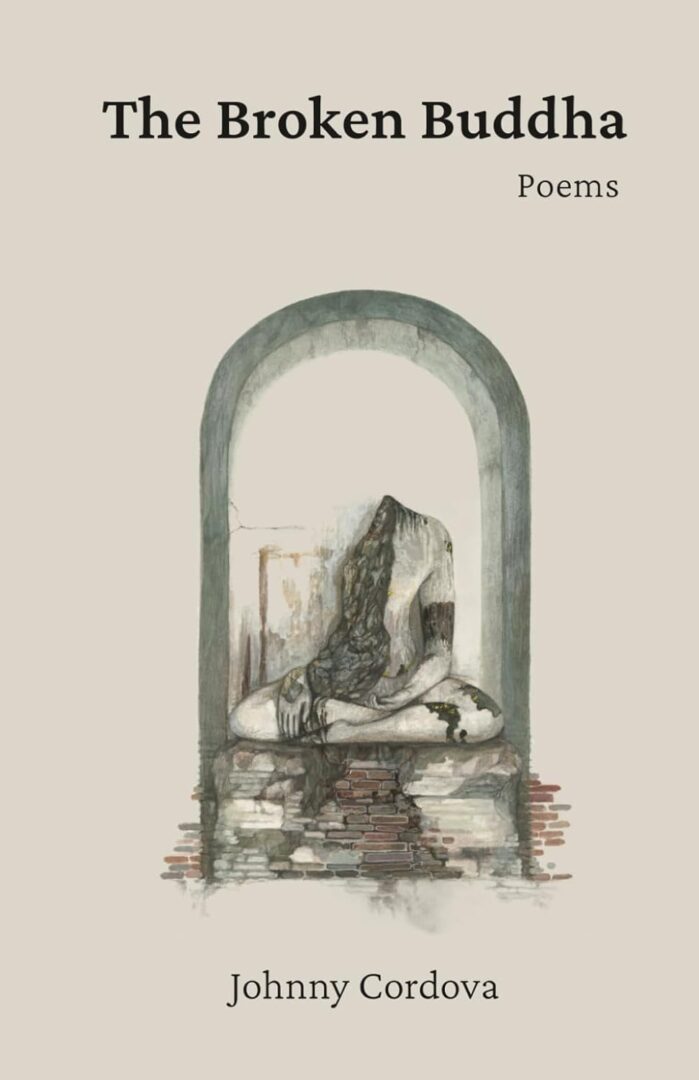
“Get out of your head,” whispers the headless Buddha from the cover of Johnny Cordova’s latest book of poems, The Broken Buddha (Roadside Press, 2026). Eastern religions teach us to sit in silence, watch thoughts come and go without attachment, and accept impermanence. In this revealing and revelatory collection, the author’s spiritual life is a lens through which he writes. We see where he struggles against it and where it shapes and comforts him. In these poems, his attention to details of the natural world and his precise, elegant language feel connected to his devotional practice of stillness, discipline and patience.
The title poem opens the book aptly, laying out the themes of how we break and how we heal. Cordova writes that a monk dropped an ancient statue in a fall down the stairs. After the head was glued back on, badly, it sat unclaimed in a marketplace until the author came upon it. He saw what others did not, that this Buddha had for over two centuries “presid[ed] over/ generations of prostrate monks/ breathing them in and breathing out.”
He sees his own reflection in the statue:
I bought him because I too missed a step
and went crashing down some stairs
my love in my arms
and could not be put back
together.
He goes on to confess that he is haunted by his own shortcomings and lives with the belief that “once one is broken/ one stays broken.” Then he ends the piece with these profound lines: “I bought him because I want him to teach me./ I bought him because he was broken.”
The poems are then presented in three sections, the first of which is called “All Night Rain.” Here Cordova takes us unflinchingly into one of his inner conflicts. He frames this in the Author’s Note preceding the section, maybe to prepare us for its candidness, as the “age-old striving to reconcile commitment to a spiritual path” with bodily desires and passion.
What follows are a number of explicit poems about encounters in southeast Asia, some after returning from rural monastery stays. In “Nana,” after a neighborhood in Bangkok, he writes about a go-go bar he sits in:
you see in a moment of perfect clarity
that it is not a doorway
to the mysteries of woman…
…as much as a second-class ticket
to a realm of hungry ghosts
where endless desperate searching
is never satisfied.
Yet, “despite your insight,” he continues, “You know as you contemplate/ the emptiness of all phenomena/ that you will take her back to your room.”
Later as he departs to go home, he wryly writes about going “back to your job teaching hot yoga/ to women in designer bikinis/ who will ask how your retreat went.” He looks down from his seat on the plane imagining the city “before Buddhism arrived by sea/ to a world awash with longing.”
Throughout many of the poems in this first section, it does indeed rain, in a heavy tropical way. In the section-titled poem, “All Night Rain” the “Relentless … pouring off the roof in sheets … hammering” rain becomes an intoxication. “All night, rain in my dreams/ Each time I awake rain/ without cease.” Perhaps the rain symbolizes a desire to wash away pain, or drown out the noise of his internal conflict. Or maybe it’s a punishing rain for his past actions–decisions that have led to him feeling broken and beyond repair.
He equates the downpour to losing himself in physical passion with a memory of a woman and ends in this image of the tension between spirit and body:
sitting zazen, it comes.
Rain rising up my spine.
She has entered here
like rain.
In the second section, “Sketches of India,” the author recounts a pilgrimage to various temples in India and gives us glimpses into ashram life and its effect on him. In “On the Way to Yogi Ramsuratkumar Ashram for Chanting,” it is “Before dawn…// The air is fresh with cow dung// In the distance: bells, singing.”
He has deep reverence for the people, from masters to beggars (some of which are both!) and for the ancient places he visits. He describes a morning in “Anandashram:”
5 a.m. is the Vishnu Sahasranamam,
chanted in Sanskrit.
You don’t know the words
so you close your eyes and listen.
Then later,
At 6 a.m. sadhus in orange line up
for coffee and chai.
…
[You] find a quiet place in the corner
with your notebook.
A man…
comes by to refill your cup
from a dented tin teapot.
Please, he says, as he serves you.
You lower your head to thank him.
This image is striking as well in “Fakir Poet;”
It is dark when you pass.
At first you don’t see him.
A man on a small carpet
…
A man against the wall in the dark
singing a song of the heart.
The third section, the longest, is titled “Ashes.” Here is where the past crashes up against the present most deeply. There are both nostalgic and bittersweet recollections from youth and coming of age. There are more insights into his continued devotion to a sitting practice at the ashram where he continues to live even though his old master is gone. We are introduced to a tragic loss that underlies much of the work in this part of the book; it builds with clues and emotions in a trio of poems that open this section. Then references to this event are scattered throughout, not unlike ashes, until a full circle ending.
In “The Day We Buried You,” the author writes that as he surrounded a headstone with bright quartz and found stones, it begins to rain, a “fine desert rain/ through which shone a translucent light/ some would describe as miraculous.”
He ends this sequence with these devastating lines that show us the depth of the loss, its utter wordlessness:
None of us knew what to say.
I still don’t know what to say.
I’m still not saying it.
Later, in “The Mountain and the Monk,” the author examines himself and admits that:
I have been a thoughtless man,
banished from the company of others
because for too long I sought my own
pleasure and gain at the expense
of ones who needed me.
Now I sit alone on this mountain,
…
in this second life
and I pray for the seasons
to break me down.
The final few poems show some evidence of healing. The natural world is a continual delight and solace. The graves he visits become places of peace and communion. He values old friendships and warmly shares chai and conversation. In the penultimate poem, he reveals a deep capacity for love.
In the poem about his wife, “Will You Miss Me?” he portrays a man who doesn’t casually express his emotions. Perhaps it is a result of having learned to temper them. That is why this passage is so unexpected and breathtaking in its declaration:
Love seems too trite a word
to describe the feeling that consumed my thoughts
all day yesterday, and nearly drove me to despair.
That I never want to die.
That I never want to leave this world
now that I’ve found you in it.
The final poem, “Ashes” is an echo of the epigraph in the beginning of the book by Issa, a famous Japanese haiku poet, written after Issa lost his daughter. How insignificant we are in the end, he seems to be saying, our lives and this world itself but a “dewdrop” in time and space.
Cordova seems to have learned something from the broken Buddha in the end. How to face and accept yourself, including your broken parts and the ache that comes from past regrets. How to keep getting back on the path in the cold morning to sit with yourself. A Zen concept I’ve heard around meditation circles seems fitting here: “Chop wood, carry water.” Do the work, stay present and grounded. Enlightenment is in the details. These poems end with reverence and awe that come from a place of wholeness. The final poem lingers and leaves us with the message that words are powerful, as they certainly are in this collection, but also never enough: “This great silence remains.”