


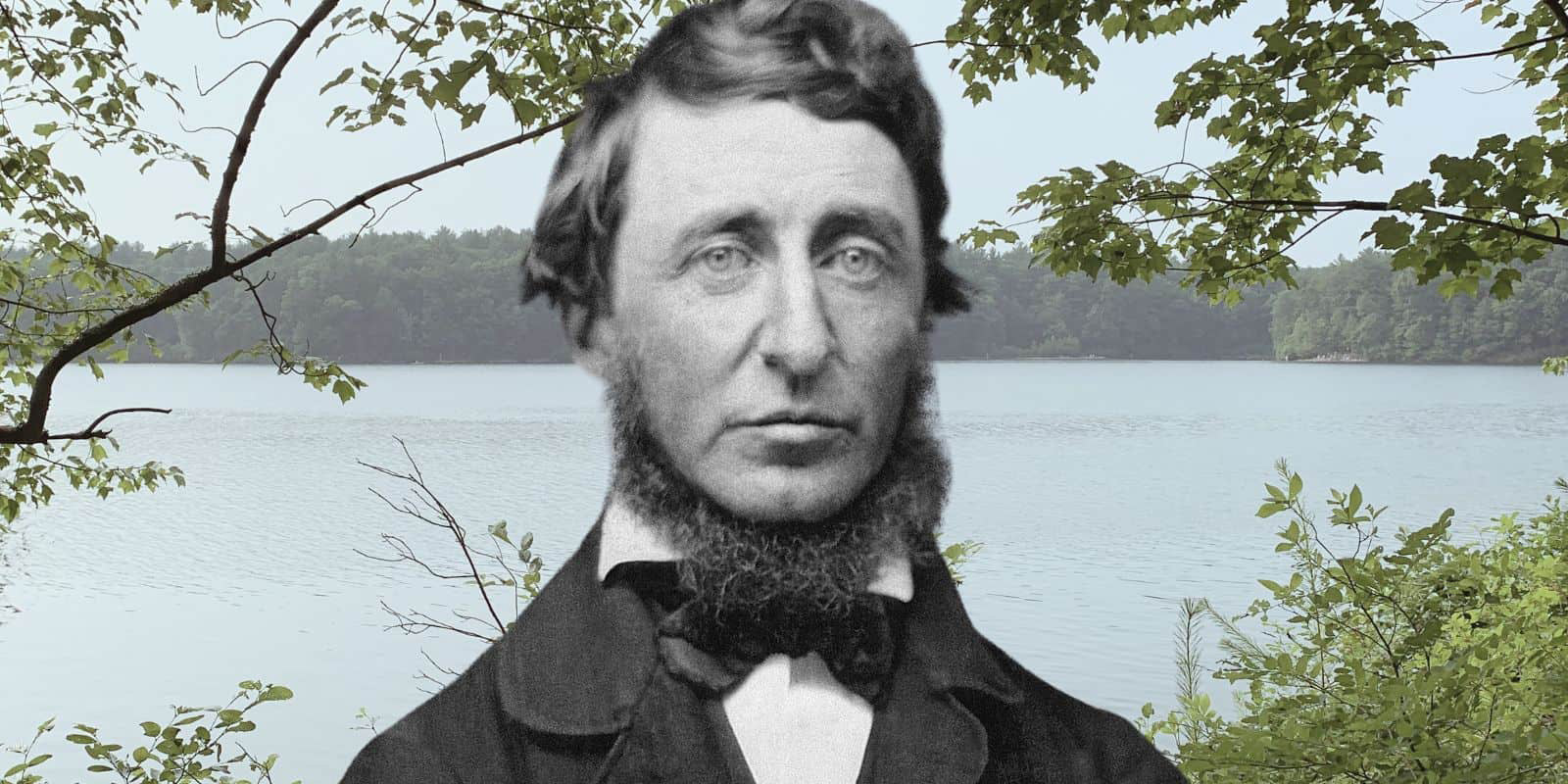
An American friend told me that in this country they studied Henry David Thoreau in high school. Having moved to the US from Italy more than 50 years ago, always striving to increase my knowledge of my adoptive land’s history and culture, I eventually read Walden, Or Life in the Woods in the 1990s.

But it was only a couple of weeks ago, when I watched on PBS the illuminating documentary Henry David Thoreau, produced by Ken Burns and Don Henley, that I began to understand the importance of his work and its contemporary significance.

In this slim booklet, Walden, Thoreau, born in Concord, Massachusetts in 1817, describes his life during the two year period (1845-1847) that he spent alone by Walden Pond living in a basic cabin that he had built. He supported himself by growing vegetables that he sold at the market and performing chores for the owner of the land, his friend and mentor Ralph Waldo Emerson.

Emerson, born in 1803, was the leader of the Transcendentalist movement, and described this belief system in his 1836 essay Nature.

Another Emerson’s disciple was Walt Whitman, born in 1819, author of the 1855 poetry collection Leaves of Grass.
Among the many experts featured in the Thoreau documentary, I was only familiar with two of them. Bill McKibben, author of books about the environment, like The End of Nature (1989) about the climate crisis, and Michael Pollan.
I had read all of Pollan’s books: The Botany of Desire (2001), The Omnivore’s Dilemma (2006), In Defense of Food (2008), Cooked: A Natural History of Transformation (2013), How to Change Your Mind (2018), This Is Your Mind on Plants (2021), and I was already reading his latest, A World Appears: A Journey into Consciousness (2026), when I saw the Thoreau documentary.

I noticed the synchronicity of these two experiences. Pollan refers to his conviction that plants have, if not a consciousness, a sentience, and mentions the experiments of Italian scientist Monica Gagliano, In 2021 I had interviewed Monica and written a few articles about her work. PLEASE do read here one published in Cultural Weekly. It seems clear that plants communicate with each other and perhaps with humans as well, through psychedelic trips on ayahuasca or magic mushrooms.
The connection with Thoreau is that he was meticulously recording in his diary the behavior of plants and animals that he encountered during his daily walks in the woods. He also studied Buddhist beliefs about the relationship between human beings and the natural world, which is not separate from us.
That concept is worth remembering today: animals, plants, oceans, forests, mountains and humans are all part of the same ecosystem and we cannot continue to destroy the environment without threatening our own survival.
I had investigated this idea while researching my book Robert Redford and the American West. I realized, while visiting the Sundance Institute, that Redford revered the Native American belief of respecting animals and nature. And so did Thoreau, who spent time in an indigenous people village in Massachusetts.

It was while watching the TV series The Madison (March 14-21) that creator Taylor Sheridan dedicated to Robert Redford, who passed away in 2025, that I was reminded of what Redford said about A River Runs Through It (1992). “When you’re fly-fishing, there’s something very powerful and deep about the experience, some real communion with nature that’s totally peaceful and really ancient.”
When I interviewed Kurt Russell about The Madison, he revealed that he also fly-fishes in Colorado. Michelle Pfeiffer, who plays his wife, has an amusing line when she talks her granddaughter into going fly-fishing with her: “Men do it while drunk, how hard could it be?”

It’s fitting to end this article with a joke to avoid the despair caused by the ending of environmental protection laws by our insane and cruel President. I will address in another article, also inspired by Thoreau, the destruction caused by wars and our duty to protest.