

When a Book Fair Becomes a Gatekeeper
The Risks of Cultural Extraction, Exclusion, and Displacement at the OC Book Fair
Book fairs promise discovery, literacy, community, and support for independent booksellers. I want to believe those promises. But after years of writing, organizing, and selling books in Orange County, I ask who is welcomed to the center, who stays at the edges, and who benefits when the tents come down. By using “OC,” the fair takes on a simple test: does it strengthen the local bookstores, writers, and cultural workers whose identity it uses?
The county’s name brings an audience and an assumption to trust it represents the region. U.S. Census Bureau QuickFacts reports that Orange County is 34.5% Hispanic or Latino, 25.0% Asian alone, 2.4% Black alone, 3.2% American Indian and Alaska Native alone, 0.4% Native Hawaiian and Other Pacific Islander alone, and 6.0% two or more races; 35.5% of residents are White alone and not Hispanic or Latino. The fair’s leaders, exhibitors, programs, publicity, and financial benefits should reflect those communities because including OC in the fair’s title implies representation.
Book fairs decide who receives attention, sales, and influence. When those benefits go mostly to well-funded or outside participants, I do not call that community building. I call it cultural extraction.
A diverse crowd can fill the fair while a small group keeps control. Without shared leadership and financial benefit, diversity becomes a performance rather than shared power.
Lessons From Southern California & Other Book Fairs
At the 2015 L.A. Art Book Fair, organizers used a “BLM” image without a working relationship with Black Lives Matter. The dispute showed how quickly an institution can turn a living movement into decoration and pursue wealthier audiences while moving away from the people whose histories give an event meaning.
The 2018 Los Angeles Times Festival of Books, hosted at the USC campus, placed a panel on preserving Black and Brown histories far from the main activity. The location sent its own message: our histories were present but still pushed aside. In a 2018 Hyperallergic interview piece regarding this experience, writer Lexis-Olivier Ray describes a familiar pattern in Virgil Village (6 miles from the USC campus): a predominantly Latino neighborhood becomes desirable, rents rise, and families lose their hold on the streets they call home. I know that pattern from Santa Ana, where I founded LibroMobile. I have watched redevelopment remake a Mexican American city while institutions celebrate its culture. This history does not prove that the OC Book Fair causes displacement, but it is why I will not confuse visibility with community power.
Similarly, Tayler Simon describes an adult book fair in her 2023 account from Columbia, South Carolina. Held in a changing neighborhood, the event featured nearly all white vendors, unaffordable goods, and little regard for Black and Brown residents. Residents must help run a cultural event and benefit from it, not merely provide its setting or stories.
What the OC Book Fair Promises
The OC Book Fair is fiscally sponsored by the Tustin Community Foundation and supported by local arts groups. Scheduled for November 14, 2026, in Old Town Tustin, it advertises booksellers, publishers, author programs, panels, roundtables, and children’s activities. Organizers also promise diverse participants, community outreach, wheelchair access, live captions, sensory-friendly programs, and accessible formats. Those offerings matter, but promises are not proof. I want to know who makes sure they happen and whether the communities involved can judge the results.
The public record leaves questions about who holds power. Reporting says the fair’s concept came from Sam Robertson, co-owner of Arvida Book Co., and launched with the Tustin Area Council for Fine Arts. CALIBA lists Robertson as a board member, and Arts Orange County also includes Robertson as a present board-member. Arvida and its foundation appear in current exhibitor materials, while the sources reviewed here name no other county bookstore as an equal founding partner. These overlapping roles do not prove wrongdoing, but they call for checks against favoritism.
The fair does not publicly identify their leadership and organizational structure, its conflict-of-interest rules, or how other county bookstores have a voice. If the process is equitable, organizers should show how it works. Orange County’s book community is larger than any one store.
The Bookstores Behind the Literary Community in OC
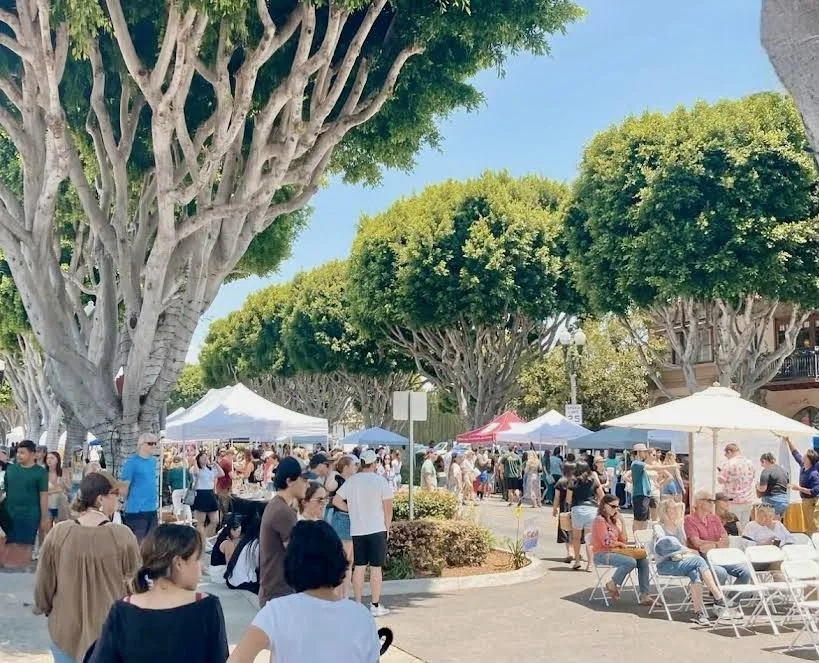
Orange County bookstores do this work every week. Arvida, which opened in 2020, is one local anchor, not the only one. I founded LibroMobile in Santa Ana ten years ago. Book Carnival has specialized in mysteries, suspense, and author events for more than forty years in OC; Lido Village Books reports nearly 50 years of history in Newport Beach; and Bookman has served Orange since 1990. Booktown USA in Anaheim closed in August 2026 after nearly 23 years. Newer bookstores include The Untold Story Bookstore and Heartbound Bookshop in Anaheim and Blackbird Books & Coffee in Huntington Beach. These stores pay rent, employ staff, support authors, and build relationships year-round.
Local writers have raised related concerns about representation, access, and communication. Huntington Beach novelist Mary Camarillo was initially excited about the first OC Book Fair. However, when she saw the 2024 agenda, she wrote, “The presenters didn’t look like the Orange County literary community that I knew.” In her account, Camarillo and members of her two accepted panels withdrew, proposed talks about inclusion or readings by Orange County Latinx writers, and offered to help; she says organizers removed their names but did not otherwise respond. I had the same experience after withdrawing LibroMobile in 2024 over the lack of diversity and local representation. LibroMobile was never invited again.
Orange County writer and 2026 Chapman University MFA graduate Julia Ainley echoes that concern while emphasizing what a genuinely local fair could offer: “The OC Book Fair reminds me of the LA Times Festival of Books, we already have that. As a local I would rather have a community-based fair where I can support local authors and Orange County bookstores like Bookman, Half Off Books, LibroMobile and others I have not discovered yet.” Her point extends Camarillo’s: local writers should see themselves in the program, and local readers should discover and support the bookstores already serving them.
Local author and editor Lisa Alvarez identifies another related obstacle: unclear and delayed communication can also keep local writers at the margins. After applying to participate in the 2025 fair, she accepted a conflicting Los Angeles engagement before receiving an offer for a promotional table without a reading or panel opportunity. Looking ahead, Alvarez writes, “I hope the application and programming process, especially communications, can become more transparent and responsive. I also hope that the broad range of local writers, often overshadowed by LA writers, could be centered. OC has so much to celebrate.” Taken together, Camarillo, Ainley, and Alvarez call for a fair that recognizes local writers not only as applicants or vendors, but as visible and prioritized participants in its annual programming.
Outside booksellers that appear only for a fair can divert sales and attention from local bookstores without sharing their year-round costs or accountability. A one-day marketplace can worsen that imbalance, especially when the OC Book Fair gives outside booksellers free vendor space while charging local authors $200 without booth equipment like tables and chairs. I saw a similar pattern around LibroMobile as commercial festivals and business projects expanded in downtown Santa Ana, limiting local access and sales. In late 2021, LibroMobile moved beside the Bristol Swap Mall, where discounted rent allowed us to continue. I cannot say the OC Book Fair has caused comparable harm, but organizers should measure its effects on local booksellers rather than assume their event offers everyone equal access.
Kealie Mardell-Carrera, board president and director of Underdog Bookstore, describes that responsibility from the perspective of an outside bookseller. After participating the first two years, they decided not to participate in this year’s OC Book Fair, they wrote, “We may have unknowingly caused harm by not considering the potential impact on local businesses.” In their statement, they said Underdog would consider local impact when booking future events outside its area and would start San Gabriel Valley bookseller meetings inspired by the OC Booksellers Club. Their response shows what accountability can look like: listen, step back when needed, and build better ways for independent bookstores to work together.
Proposed Orange County Bookstore Council
I propose a seven-seat Orange County Bookstore Council for the OC Book Fair: four independent bookstore representatives, one county librarian or literacy nonprofit leader, one local author or small-press representative, and one nonvoting fair administrator. Seats should rotate every two years. The council should review applications, fees, placement, programs, and local-impact reports. Members must disclose ties and step away from decisions that could benefit their business or close partners. Recusals and final results should be public. This same need for unity led me to start the OC Booksellers Club in July 2026. I’d welcome the opportunity to assist in building the council.
The Little Haiti Book Festival offers an alternative rooted model for OC to consider. Built with a Haitian cultural group, it joins books and art with talks about gentrification, immigration, memory, and the neighborhood’s future. Literature becomes part of community survival—not an attraction floating above it.
Accountability After the Fair
The OC Book Fair has strengths: local fiscal sponsorship, free admission, community programs, and accessibility promises. But “OC” is a claim of representation. County bookstores should share power, attention, and financial benefit.
I am not asking anyone to push Arvida Book Co. aside. It is a legitimate local literary hub. I am asking organizers to make sure a founding relationship does not become permanent control. Rotating seats, disclosures, recusals, and an independent selection process offer a path to shared power.
Going forward we should measure community-driven success beyond attendance: new customers for county booksellers, wider book access, paid local cultural work, and stronger year-round local collaborations. When the tents and tables come down, local bookstores, writers, and cultural workers should remain at the center. If organizers will not share the county’s name, power, and benefits, they should stop calling it the “OC” Book Fair and rename it—a simpler, but less equitable, solution.
*
Sources & Links
Arif, Alessandra. “A Real Bookstore: Independently-Owned Arvida Book Co. Opens in Old Town Tustin.” New University, 28 Oct. 2020, newuniversity.org/2020/10/28/a-real-bookstore-independently-owned-arvida-book-co-opens-in-old-town-tustin/. Accessed 20 Oct. 2026.
Artburst Miami. “Little Haiti Book Fest Keeps Its Core but Reflects on Top-of-Mind Issues.” Artburst Miami, 17 Apr. 2025, artburstmiami.com/visual_arts/little-haiti-book-fest-keeps-it-core-but-reflects-on-top-of-mind-issues. Accessed 20 Oct. 2026.
Arts Orange County. “Arts Orange County Board Members—Past & Present.” Arts Orange County, 29 June 2026, artsoc.org/wp-content/uploads/2026/06/Arts-Orange-County-Board-Members-History-Updated-06-29-26.pdf. Accessed 23 Oct. 2026.
Book Carnival. Book Carnival, annesbookcarnival.com/. Accessed 20 Oct. 2026.
California Independent Booksellers Alliance. “CALIBA Staff & Board of Directors.” CALIBA, caliballiance.org/caliba-staff-and-board-of-directors. Accessed 23 Oct. 2026.
Farag, Mariam. “Inaugural OC Book Fair Celebrates Literary Community.” New University, 21 July 2024, newuniversity.org/2024/07/21/inaugural-oc-book-fair-celebrates-literary-community/. Accessed 20 Oct. 2026.
LibroMobile. “Our Story.” LibroMobile, libromobile.com/ourstory. Accessed 23 Oct. 2026.
Olvera, Lola. “LibroMobile’s 10th Anniversary Weekend LitFest to Be Either a ‘Fundraiser or a Closing Celebration.’” Culture OC, 19 Aug. 2026, cultureoc.org/libromobiles-10th-anniversary-weekend-litfest-to-be-either-a-fundraiser-or-a-closing-celebration/. Accessed 23 Oct. 2026.
Pedersen, Erik. “Anaheim’s Booktown USA Bookstore Closes Its Doors after 23 Years.” Orange County Register, 17 Aug. 2026, ocregister.com/2026/08/17/anaheims-booktown-usa-bookstore-closes-its-doors-after-23-years/. Accessed 23 Oct. 2026.
Ray, Lexis-Olivier. “A Photographer’s Visual Record of Her Gentrifying Los Angeles Neighborhood.” Hyperallergic, 26 Apr. 2018, hyperallergic.com/a-photographers-visual-record-of-her-gentrifying-los-angeles-neighborhood/. Accessed 20 Oct. 2026.
Simon, Tayler. “Who Are We Pushing Out?” Liberation Is Lit, 14 June 2023, liberationislit.com/blogs/activism-101/who-are-we-pushing-out. Accessed 20 Oct. 2026.
The OC Book Fair. “About.” The OC Book Fair, theocbookfair.org/about. Accessed 20 Oct. 2026.
Tustin Community Foundation. Tustin Community Foundation, tustincommunityfoundation.org/. Accessed 20 Oct. 2026.
U.S. Census Bureau. “QuickFacts: Orange County, California.” U.S. Census Bureau, census.gov/quickfacts/fact/table/orangecountycalifornia/PST045225. Accessed 23 Oct. 2026.
Underdog Bookstore and Events, Inc. “Board of Directors.” Underdog Bookstore and Events, Inc., underdogbookstore.org/boardofdirectors. Accessed 23 Oct. 2026.