


The Los Angeles County Museum of Art has just opened its sprawling and controversial new David Geffen Galleries that house the permanent collection. The $724 million building (top image), designed by Swiss architect Peter Zumthor, was dedicated on April 19. Museum members are touring it now, and the general public will follow starting May 4.
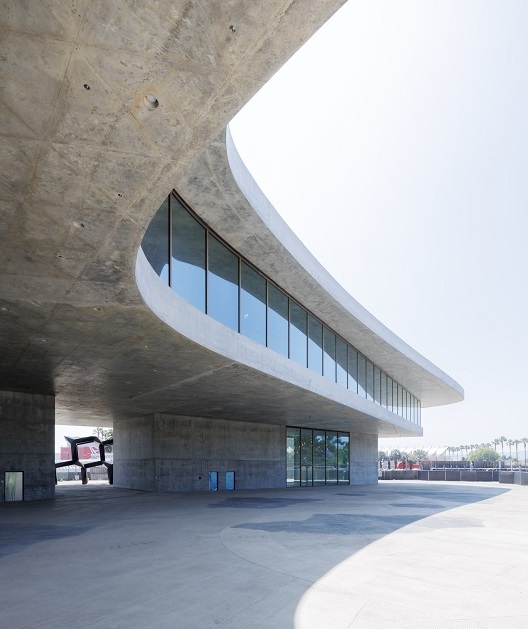
The building, more than a decade in planning and construction, is a curvy, 900-foot-long structure that lifts the galleries about 30 feet above ground level. It features a thick concrete floor, an equally thick concrete roof, and black glass exterior walls that give it a rather chilly look. At the eastern end it crosses over busy Wilshire Boulevard like a freeway interchange.
Supporting the main structure are seven pavilions on the ground level, housing a theater, restaurants, a museum shop, and spaces for education and other functions. This is where you take the elevator or stairs from the plaza up to the gallery level.
The galleries themselves are finished in the same style as the exterior: polished concrete floors and ceilings, exterior glass walls looking outside through thin, diaphanous curtains, and interior spaces divided by polished and often tinted concrete walls. It’s easy to get lost in the interior spaces, and that’s sort of the point of the design.
Rather than organizing the galleries chronologically, the David Geffen Galleries are laid out in four geographic regions: the Pacific Ocean, Indian Ocean, Mediterranean Sea, and Atlantic Ocean. Each of these areas include a diverse group of nations and cultures. In the Atlantic section, for example, there are works from Europe, North and South America, West and Central Africa, ranging from prehistory to the present. The idea is to let museum visitors discover artworks on their own as they tour the building.
Michael Govan, the museum’s director for 20 years and the driving force behind the new building, notes in his introduction to a guidebook of the collection that his “dream was of visitors wandering through art and ideas as one might meander through a park, choosing their own paths and engaging their own interests.”
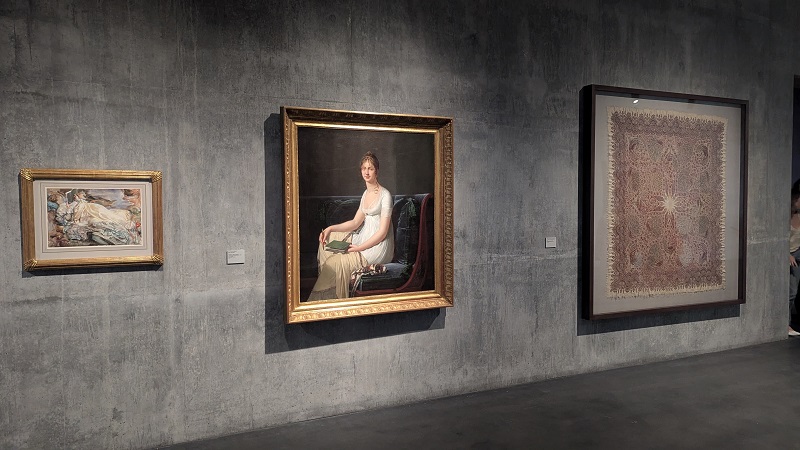
Thus we have, for example, three completely unrelated works hanging together on an interior wall of gray concrete: on the left, John Singer Sargent’s late Impressionist Rose-Marie Ormand Reading in a Cashmere Shawl, c. 1908; in the center, Robert-Jacques Lefevre’s neoclassical Portrait of a Woman Holding a Pencil and a Drawing Book, c. 1808; and an embroidered woolen shawl with a peacock design from the Kashmir region of India, c. 1870s.
Yes, all three works include a shawl or fabric — on the bed in the Sargent, on the woman’s lap in the Lefevre — but otherwise they seem completely unrelated. The contrasts between groups of works also can be a bit head-spinning.
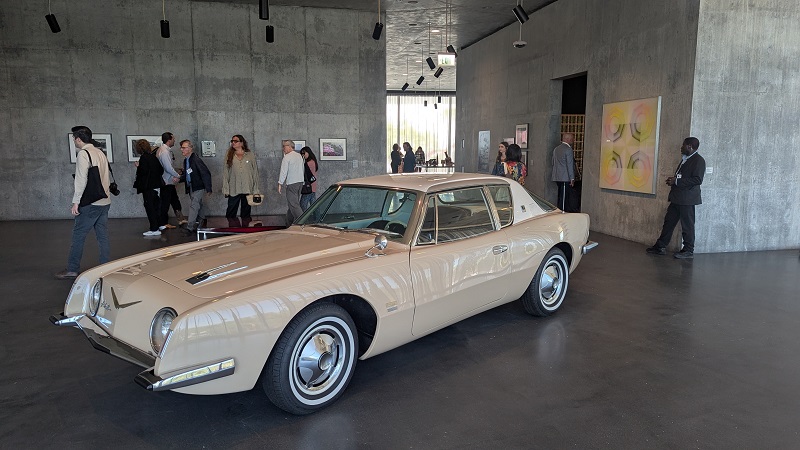
In the Pacific galleries, for example, a section called Car Culture includes a restored 1963 Studebaker Avanti two-door sport sedan. It’s displayed like a piece of sculpture.
Nearby are three prints from Edward Ruscha’s 1967 Parking Lots photography series, as well as a sample of Catherine Opie’s Freeways series. Yet when you turn a corner, you’re in an entirely different world of Japanese paintings and prints, such as Katsushika Hokusai’s iconic The Great Wave of about 1830-31.
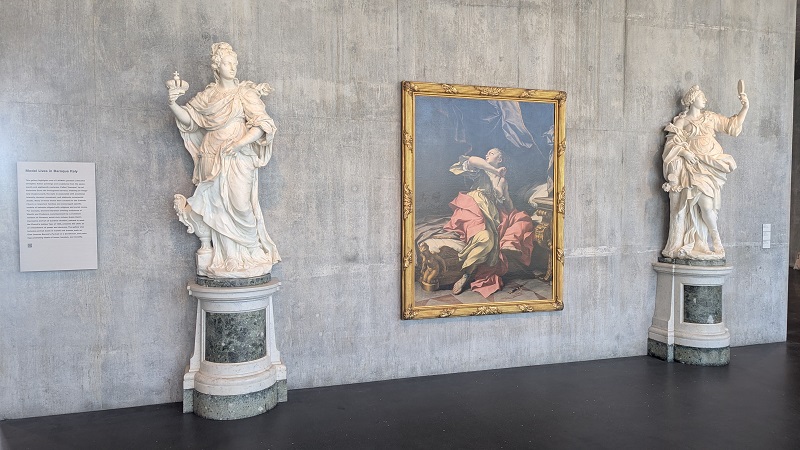
The glass walls present a challenge for curators deciding how to install artworks. On a wall in the Mediterranean area focusing on Italian Baroque works, for example, a painting by Ludovico Mazzanti, The Death of Lucretia, c. 1735-37, hangs on a concrete wall. It’s flanked by two large marble sculptures by Giovanni Baratta, Allegory of Wealth and Allegory of Prudence, both from about 1703-08. The sculptures, raised up on elaborate pedestals, look great in the brightly lit area. The painting, unfortunately, is a bit washed out.
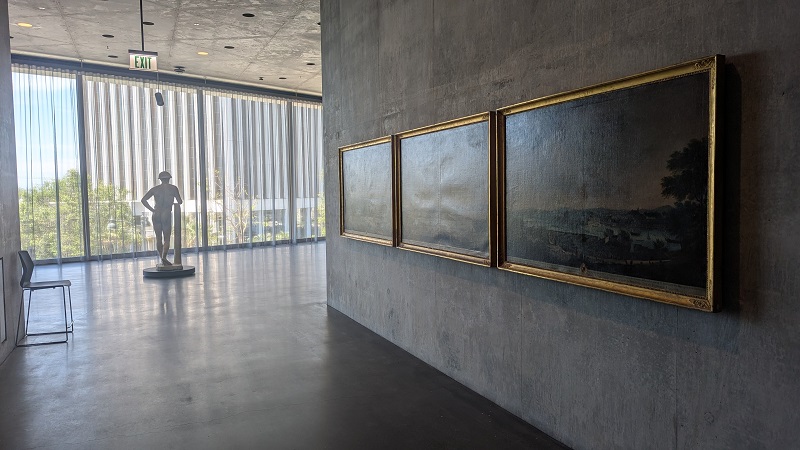
This lighting problem at the David Geffen Galleries is even more clear in areas that form a transition between brightly and dimly lit spaces. For example, three cityscapes of Toulon and Bayonne, France, by Juan Patricio Morlete Ruiz, all from 1771, are essentially blotted out when viewed in the direction of the exterior glass wall.
Fortunately, some of the most important paintings in LACMA’s collection get their own galleries in the interior of the building, protected from the bright exterior walls. These include the Carter Collection of 17th-century Dutch and Flemish works (a highlight of LACMA since the 1980s, displayed for some reason in the Mediterranean section) and the recently donated Perenchio Collection of Impressionist works.
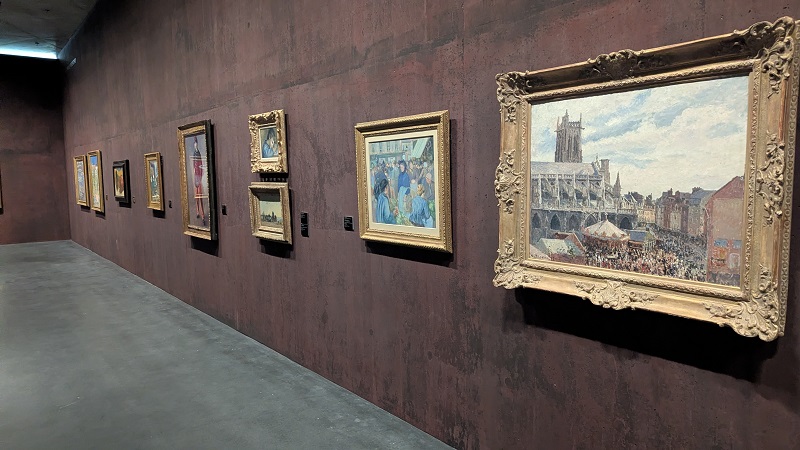
Both of these galleries are relatively long and narrow, with the cement walls tinted a darker shade. The Dutch paintings in particular seem dimly lit, presumably to protect the 400-year-old works. Yet both collections deliver the goods. The Impressionism gallery, featuring almost 40 works by Cezanne, Monet, Renoir, and other famous names, will surely be packed with visitors every day. (On a personal note, I’m happy that the Carter Collection is displayed in a separate gallery. Long ago, in 1978-81, I was the publications editor at LACMA and edited the museum’s catalog of the Carter Collection. I’ve been a big fan of Dutch and Flemish art ever since.)
One final quibble: LACMA’s new building could use more prominent signage, especially to mark the entrances to the interior galleries. And some of the wall labels for individual works — especially the black ones with small white typography — could be more legible.
Still, this inaugural show at the David Geffen Galleries will satisfy most visitors and leave them wanting to see more in the future. That’s a successful outcome for the citizens of Los Angeles County and beyond.
The Los Angeles County Museum of Art, 5900 Wilshire Blvd., is open weekdays from 11 a.m. to 5 p.m. except Wednesdays, when it’s closed, and Fridays, when it’s open until 6 p.m. The museum is open from 10 a.m. to 7 p.m. on weekends. See www.lacma.org for more information.
***
Top image: The David Geffen Galleries at LACMA, exterior view northwest from Wilshire Boulevard; photo © Iwan Baan.